In the closing years of the nineteenth century, European painting found itself caught between two imperatives that were becoming impossible to reconcile. The first was fidelity to appearance — the ambition, refined over five centuries, to render the visible world with ever greater precision of light, anatomy, and spatial depth. The second was fidelity to experience — the growing conviction among painters that the world as it felt, moved, and registered in consciousness bore almost no resemblance to the stable, geometrically ordered scene that academic painting presented. Impressionism had widened the crack by insisting that perception itself was the true subject. Post-Impressionism had widened it further by insisting that the painter's structural analysis mattered more than the retinal impression. By 1900, the crack had become a fault line, and the question was no longer whether painting would change but how thoroughly and how fast.
The pace turned out to be extraordinary. In the span of roughly fifteen years, from Cézanne's late watercolours to Malevich's Black Square, the entire tradition of Western pictorial representation was dismantled and rebuilt on principles that would have been unrecognisable to any painter of the previous century. That transformation did not happen in a single studio or a single city. It unfolded in Paris and Munich, Milan and Moscow, Amsterdam and Prague, driven by artists who in many cases were unaware of one another's parallel discoveries. The speed and geographical breadth of the change demand explanation, and explanations that rely solely on individual genius — Picasso's daring, Kandinsky's synesthetic vision, Mondrian's spiritual conviction — fail to account for the sheer simultaneity of the breakthrough. Something larger was at work: a convergence of technological disruption, philosophical upheaval, social transformation, and material experimentation that made the old picture-making conventions feel not merely outdated but intellectually dishonest.
The pages that follow trace the currents that ran beneath the individual breakthroughs of the period. Rather than telling the story movement by movement — Impressionism, Post-Impressionism, Cubism, Futurism, the Russian avant-garde — the material cuts across the movements to ask what structural forces were pushing so many artists in the same direction at the same time. The answer involves the collision of Western art with non-Western visual traditions, the philosophical demolition of naive realism by physics and psychology, the social upheaval that repositioned the artist from craftsman to provocateur, the material experiments that turned paint, paper, and metal into subjects rather than servants of illusion, and the network of cities, journals, and exhibitions through which ideas circulated at a speed that no previous generation of artists had experienced.
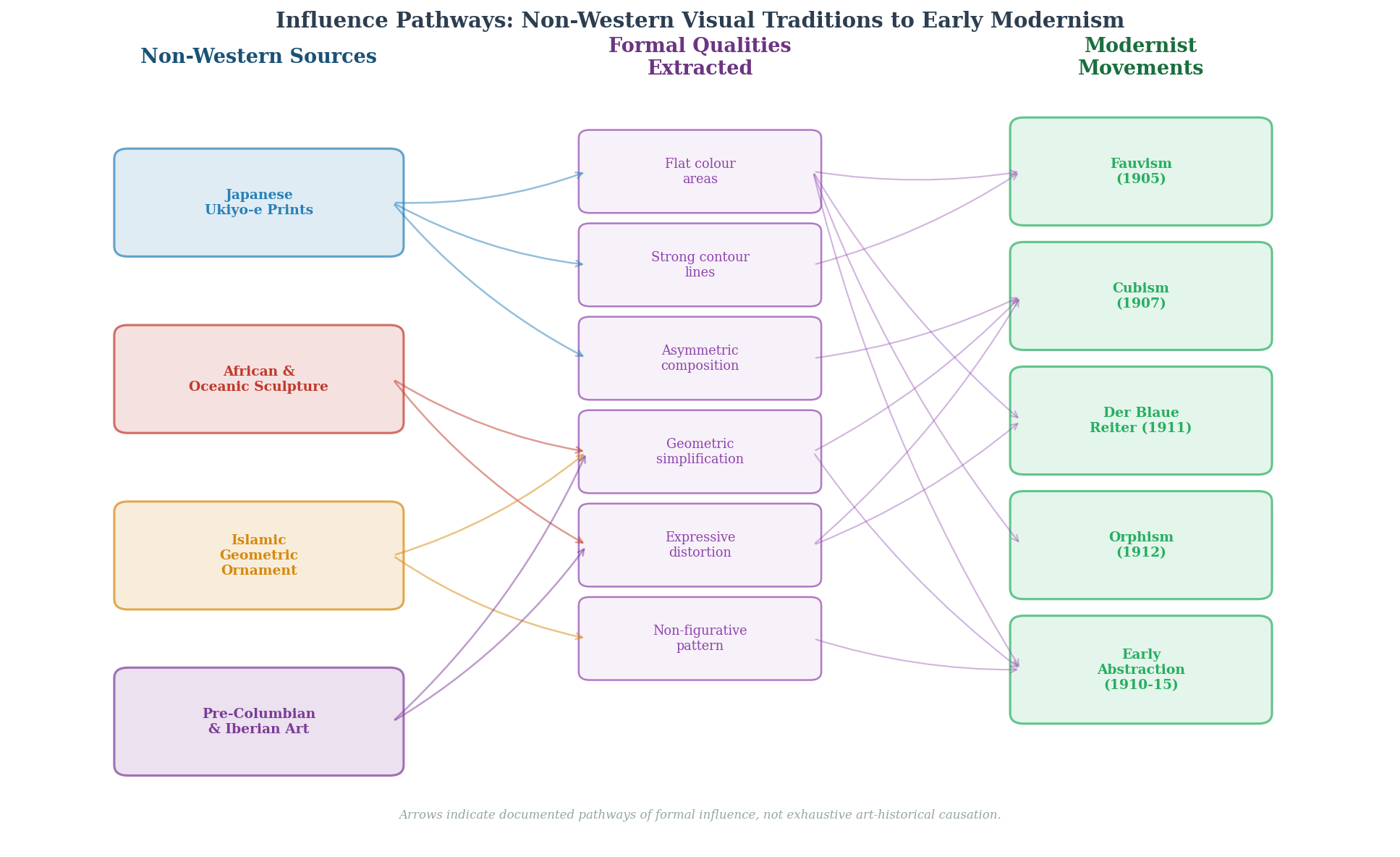
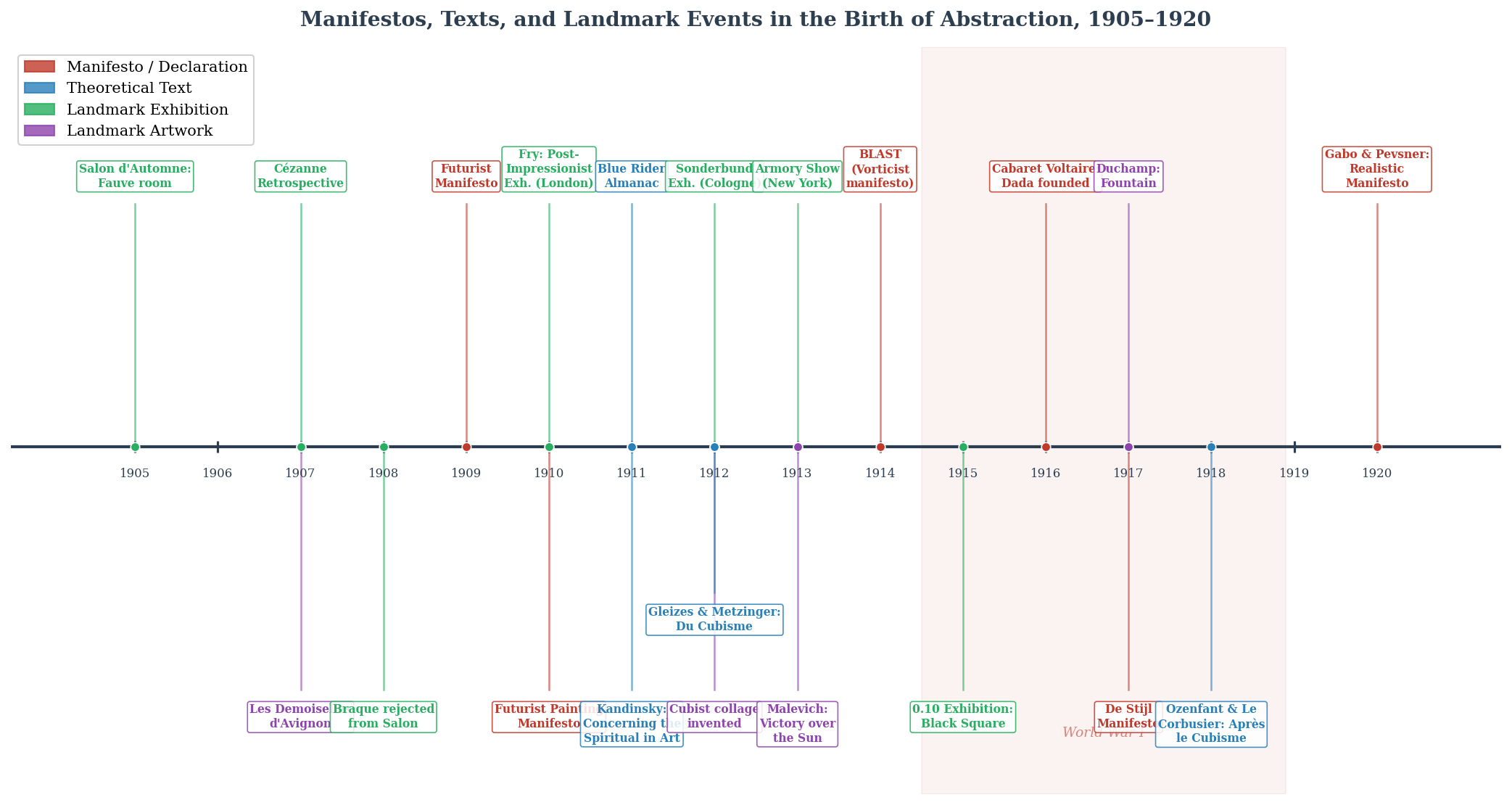
The two images below map these forces visually. The first charts the pathways of influence from non-Western art traditions — Japanese woodblock prints, African sculpture, Islamic geometric ornament — into the specific formal innovations of Fauvism, Cubism, and early abstraction. The second plots the extraordinary density of manifestos, theoretical texts, and landmark exhibitions that appeared between 1905 and 1920, revealing how the rhetorical and institutional infrastructure of modernism was built almost as rapidly as its visual language.
1. The Transitional Moment: 1895 to 1910
Why the Crisis Took Decades to Resolve
The standard narrative of modern art sometimes compresses the transition from representation to abstraction into a single dramatic rupture, as though the invention of photography immediately liberated painters to abandon the visible world. The actual timeline was far messier. Photography had been commercially available since the 1840s, yet in 1900 the overwhelming majority of exhibited paintings in Europe were still representational, and most of them were representational in ways that would have been recognisable to a viewer of the 1850s. The reason for the delay was not conservatism alone, though the institutional power of academies and salons was formidable. It was that the conceptual framework for a non-representational art did not yet exist.
To paint a picture that depicted nothing — no landscape, no body, no story — an artist needed not only the technical boldness to do so but also a theoretical justification for why such a picture was worth making, and an audience prepared to take it seriously. None of those conditions was met before the turn of the century. The Impressionists had loosened technique, but their subjects remained firmly anchored in the visible world: haystacks, cathedrals, dancers, riverbanks. The Post-Impressionists had introduced structural ambitions that sometimes overwhelmed subject matter — Cézanne's late landscapes verge on geometric abstraction, and Seurat's pointillist method can make the depicted scene feel secondary to the chromatic system — but none of them took the final step of eliminating the subject altogether. That step required a philosophical permission that arrived piecemeal, through developments in physics, psychology, and philosophy that collectively undermined the assumption that visual appearance was a reliable guide to reality.
The fifteen-year gap between the first serious cracks in representational convention (roughly 1895, when Cézanne's late work began to circulate among younger painters) and the first fully abstract paintings (roughly 1910 to 1912, depending on how one defines "fully abstract") was therefore not wasted time. It was the period in which the conceptual scaffolding for abstraction was assembled, piece by piece, from sources that lay largely outside the art world itself.
The Role of Non-Western Art
One of the most consequential forces acting on European painters at the turn of the century was their encounter with visual traditions that had never shared the Western commitment to illusionistic depth. Japanese ukiyo-e prints, which had been arriving in Europe in significant quantities since the 1860s, demonstrated that a picture could organise space through flat colour areas, strong contour lines, and asymmetric compositions without any loss of visual power. The Impressionists had already absorbed lessons from Japanese printmaking — Monet's garden at Giverny was a conscious attempt to inhabit a Japanese aesthetic — but the deeper impact came a generation later, when the Nabis, the Fauves, and the young Picasso began to treat flatness not as a charming decorative effect but as a structural principle.
African and Oceanic sculpture entered the conversation somewhat later, and its impact was more concentrated. The standard account centres on Picasso's visit to the Trocadéro ethnographic museum in 1907, shortly before he began Les Demoiselles d'Avignon, but the influence was broader than a single studio visit. Vlaminck, Derain, and Matisse were all collecting African masks and figures by 1905 or 1906, and their interest was not anthropological but formal. What they saw in African carving was a way of representing the human face and body that prioritised expressive distortion, geometric simplification, and the assertion of the carved surface over anatomical accuracy. These were precisely the qualities that European painters were struggling to articulate within their own tradition, and finding them already fully developed in another tradition provided both a model and a permission.
Islamic geometric ornament contributed a third strand of non-Western influence, though its impact is often underestimated because it was absorbed more gradually. Matisse travelled to Morocco in 1912 and 1913, and the decorative patterning of his later work owes a direct debt to the interlocking geometries of Islamic tilework. More broadly, the Islamic tradition's centuries-old demonstration that visual art could achieve extraordinary complexity and beauty without any figurative content at all served as a standing rebuke to the Western assumption that pictures must depict something.
The Intellectual Climate: Physics, Psychology, and the Fragmentation of Reality
The philosophical ground beneath representational painting was simultaneously being eroded by developments in science and philosophy that made the very idea of "depicting reality" seem naive. Einstein's special theory of relativity, published in 1905, proposed that space and time were not fixed containers for events but were themselves variable, dependent on the observer's motion. Planck's quantum hypothesis, advanced in 1900, suggested that energy at the subatomic level behaved in ways that defied continuous, smooth description. Neither theory was widely understood by artists in its mathematical detail, but both contributed to a general intellectual atmosphere in which the solidity and reliability of the physical world could no longer be taken for granted.
Psychology was equally disruptive. William James's concept of the "stream of consciousness," developed in the 1890s, proposed that perception was not a series of discrete snapshots but a continuous, overlapping flow in which memory, anticipation, and sensation mingled inextricably. Henri Bergson's philosophy of duration, which argued that lived time bore no resemblance to the clock time of physics, became enormously fashionable in Parisian intellectual circles in the first decade of the century. Bergson's public lectures at the Collège de France drew audiences that included artists, poets, and musicians alongside professional philosophers, and his insistence that rational analysis murdered the living reality it claimed to describe gave philosophical weight to the intuition that many painters were already feeling: that the camera's frozen instant was a lie about experience.
Friedrich Nietzsche's influence, though harder to trace in specific formal innovations, pervaded the avant-garde's self-understanding. His assault on fixed truths, his celebration of creative destruction, and his concept of the artist as a figure who creates values rather than reflecting them provided the ethical framework within which the demolition of pictorial convention could be experienced not as loss but as liberation. When Kandinsky wrote in Concerning the Spiritual in Art that the artist must be guided by "inner necessity" rather than external appearance, he was translating a fundamentally Nietzschean idea into the language of studio practice.
2. From Optical Truth to Structural Analysis
How Cézanne Became the Bridge
Paul Cézanne died in 1906, but his influence on the generation that followed was not fully felt until the memorial retrospective held at the Salon d'Automne in 1907. That exhibition, which gathered fifty-six of his paintings in a single room, was a revelation to the young painters who saw it. What they found was not Impressionism and not academic painting but something that seemed to occupy a position between the two that neither school had imagined possible: a form of painting that was intensely observational yet visibly constructed, that referred constantly to the motif — the mountain, the bathers, the apples on a tablecloth — yet made the act of pictorial construction the real drama of the picture.
Cézanne's technique of laying down small, parallel brushstrokes that followed the contours of forms while simultaneously asserting the flatness of the canvas surface created a visual tension that could not be resolved. The viewer's eye was continually invited to read depth — this plane recedes, that volume advances — and continually reminded that the entire scene was a pattern of coloured marks on a flat rectangle. This tension, which Cézanne himself described as the attempt to "treat nature by the cylinder, the sphere, the cone," became the central problem of the next generation. For Braque and Picasso, the lesson was geometric: forms could be broken into facets and reassembled. For Matisse, the lesson was chromatic: colour could be freed from its descriptive function and used architecturally. For Mondrian, who saw the retrospective on a visit to Paris, the lesson was reductive: if Cézanne's landscapes were already halfway to geometry, then the logical conclusion was to eliminate the landscape and paint the geometry alone.
The speed with which Cézanne's late work was metabolised by so many different artists with such different temperaments is one of the most striking features of the period. Within five years of the 1907 retrospective, his example had catalysed Analytic Cubism, Matisse's decorative abstraction, Delaunay's Orphism, and the first stirrings of Mondrian's grid paintings. No other single body of work in the history of Western art has generated such a rapid and diverse set of consequences.
The Fauve Colour Revolution
Before Cubism redefined pictorial space, Fauvism redefined pictorial colour. The Fauve exhibition at the Salon d'Automne of 1905 — the event that gave the group its name, when the critic Louis Vauxcelles described a room of conventionally modelled sculptures surrounded by wildly coloured canvases as "Donatello among the wild beasts" — was the first public demonstration that colour could be systematically divorced from its descriptive function. Matisse's Woman with a Hat used green and violet on the face, orange on the background, and red on the hat not because those colours corresponded to anything the eye saw but because they created a chromatic structure that functioned on its own terms.
The theoretical basis for this liberation had been laid by the Neo-Impressionists, particularly Paul Signac, whose 1899 treatise D'Eugène Delacroix au néo-impressionnisme argued that colour contrasts obeyed laws that were independent of subject matter. But where Signac's colour theory was systematic and scientific, Matisse's Fauvism was intuitive and expressive. The difference mattered enormously for the future of abstraction, because it established two distinct pathways toward non-representational colour: the analytical pathway, which would lead through Delaunay's simultaneous contrasts to hard-edge abstraction and colour field painting, and the expressive pathway, which would lead through Kandinsky's improvisations to Abstract Expressionism. Both pathways began in the same recognition — that colour need not describe — but they diverged in their understanding of why it mattered.
The Fauve moment was brief. By 1908, most of its practitioners had moved on, and the critical conversation was dominated by Cubism. But the brevity of the movement is deceptive. What Fauvism accomplished in three years was the permanent severing of the link between local colour (the actual hue of an object under given lighting conditions) and pictorial colour (the hue the painter chose to apply). Once that link was broken, it could not be restored, and every subsequent movement in modern art inherited the freedom that the Fauves had claimed.
The Dissolution of the Object
The parallel attack on spatial coherence followed a different logic but converged on the same result: the emancipation of pictorial elements from their subservience to the depicted scene. Cubism's contribution was to demonstrate that a single object — a guitar, a bottle, a human head — could be represented from multiple viewpoints simultaneously, destroying the unified perspective that had governed Western painting since Brunelleschi. But the dissolution of the object was not solely a Cubist achievement. Cézanne's late watercolours left large areas of the paper bare, so that the depicted landscape seemed to float in fragments against an undefined white ground. Matisse's Red Studio of 1911 dissolved the spatial distinction between floor, wall, and table by painting them all in a single, unmodulated red. Boccioni's States of Mind paintings of 1911 merged the figure with its environment through interpenetrating planes of movement.
What these diverse strategies shared was a willingness to let the integrity of the depicted object yield to the demands of the pictorial surface. In traditional painting, the surface was invisible — it was a window through which the viewer looked at the scene beyond. In the new painting, the surface became opaque, asserting itself as a physical fact that the viewer had to reckon with before, and sometimes instead of, reading the depicted content. This shift from transparency to opacity was perhaps the single most consequential technical development in the entire transition to abstraction, because it redirected attention from what the painting showed to what the painting was.
The dissolution was gradual rather than instantaneous. Even in the most radical Cubist works of 1911 and 1912, fragments of recognisable subject matter — a moustache, a pipe, a newspaper headline — survived as anchors that prevented the picture from tipping over into pure abstraction. Picasso and Braque were careful to maintain these anchors, and there is considerable evidence that both artists regarded full abstraction with suspicion. The complete elimination of the object was left to other hands: Kandinsky in Munich, Malevich in Moscow, Mondrian in Amsterdam. But the conceptual groundwork was laid in the Cubist studio.
3. The Social Upheaval and the Avant-Garde Stance
Urbanism, Industrialisation, and the Speed of Modern Life
The transformation of European painting did not take place in a social vacuum. The cities in which the new art was made were themselves being transformed at a rate that had no historical precedent. Paris between 1890 and 1914 was rebuilding its infrastructure — the Métro opened in 1900, electric street lighting replaced gas, department stores replaced market stalls — and the visual texture of daily life was changing accordingly. Speed, noise, fragmentation, and the bombardment of the senses by advertising, traffic, and electric light became defining features of urban experience, and painters who claimed to be painting "modern life" could no longer do so using the compositional strategies designed for pastoral landscapes and mythological scenes.
The Italian Futurists were the most explicit in linking artistic innovation to technological speed. Marinetti's Founding Manifesto of Futurism, published on the front page of Le Figaro in February 1909, declared that "a roaring motorcar is more beautiful than the Victory of Samothrace" and called for the destruction of museums, libraries, and academies. The rhetoric was deliberately provocative, but the underlying observation was shared by artists across Europe who felt that representational painting, with its frozen instant and single viewpoint, was constitutionally incapable of capturing the kinetic, multi-sensory reality of modern urban life. Boccioni's sculptures attempted to fuse the figure with the space through which it moved. Delaunay's Eiffel Tower paintings fragmented the structure into prismatic shards that seemed to vibrate with the energy of the city. Léger's Contrast of Forms reduced the urban landscape to an assemblage of cylinders and cones that echoed the machinery of industrial production.
The connection between social modernisation and artistic modernism was not automatic, and it is possible to overstate it. Kandinsky's path to abstraction was routed through Theosophy and synesthesia, not through the experience of urban speed, and Mondrian's Neoplasticism was an attempt to transcend the contingencies of modern life rather than to represent them. But even these more spiritually motivated artists were shaped by the modern city in negative terms: their retreat into pure form was a retreat from something specific, and that something was the chaotic sensory overload of the industrialised metropolis.
The Avant-Garde as a Social Position
The concept of the avant-garde — a military metaphor denoting the advance guard of an army — was applied to art and literature from the mid-nineteenth century onward, but it acquired its modern meaning in the period between 1905 and 1920. To be avant-garde was not simply to be innovative; it was to adopt a specific social posture defined by opposition to established institutions, hostility toward bourgeois taste, and a messianic conviction that art was leading humanity toward a transformed future. This posture had practical consequences for the kind of art that was produced, because it placed a premium on rupture, provocation, and the deliberate violation of audience expectations.
The sociology of the avant-garde has been extensively analysed, most notably by Pierre Bourdieu, who argued that the avant-garde's rejection of commercial success was itself a strategy for accumulating a different kind of capital — cultural prestige — that could eventually be converted into economic reward. Whether or not one accepts Bourdieu's analysis in its full cynicism, it is clear that the avant-garde position created a self-reinforcing dynamic: the more aggressively an artist rejected conventional beauty, the more credibility he or she gained within the avant-garde community, and the more pressure there was to push further. This dynamic helps explain the escalating radicalism of the period, from the mild provocations of Impressionism to the absolute negations of Dada, in a span of only forty years.
The avant-garde stance also shaped the relationship between art and text. Because the new art was deliberately difficult — because it could not be appreciated through the conventional criteria of resemblance, narrative clarity, and technical finish — it required explanation, justification, and theoretical defence. This need gave rise to a new figure: the artist-theorist, who accompanied visual innovation with written manifestos, essays, and lectures that told the audience how to look and why the old ways of looking were no longer adequate. Kandinsky, Malevich, Mondrian, and the Futurists all devoted enormous energy to writing, and their texts were not afterthoughts but integral components of their artistic projects.
The Role of Manifestos and Theoretical Writing
The manifesto became the signature literary form of the early twentieth-century avant-garde, and its proliferation between 1905 and 1920 is remarkable. The Futurist Manifesto of 1909 was followed by technical manifestos on painting (1910), sculpture (1912), and architecture (1914). The Vorticists published Blast in London in 1914. De Stijl issued its manifesto in 1917 and its painters' manifesto in 1918. The Dadaists produced manifestos that parodied the form itself. The Suprematists, the Constructivists, and the Purists all published programmatic statements that combined aesthetic argument with social and sometimes political demands.
The sheer quantity of manifesto-writing in this period reflects the fact that abstract art could not rely on the visual literacy that representational art took for granted. A viewer standing before a Raphael Madonna did not need a manifesto to understand what the painting depicted or why it might be considered beautiful. A viewer standing before a Malevich Black Square needed, at the very minimum, to be told that the black square was not a joke, a failure, or an empty gesture, and the manifesto was the instrument through which that minimum was delivered. The manifestos also served a competitive function, staking territorial claims in the rapidly expanding field of avant-garde practice. To publish a manifesto was to declare that one's movement was the true vanguard, that rival movements were either insufficiently radical or headed in the wrong direction, and that the future belonged to one's own principles.
The theoretical writings of individual artists were often more nuanced than the manifestos, and their influence was correspondingly more durable. Kandinsky's Concerning the Spiritual in Art, published in 1911, remains one of the most sustained arguments for non-representational painting ever written. Its central claim — that colour and form possess an expressive power that is independent of, and potentially more profound than, their ability to depict objects — drew on the psychology of perception, the philosophy of aesthetics, and Kandinsky's own experience of synesthesia to construct a case for abstraction that was at once personal, philosophical, and practical. Mondrian's writings, though less fluent, were equally ambitious in their attempt to ground Neoplasticism in a comprehensive worldview drawn from Theosophy and Hegelian dialectics. These texts did not merely accompany the art; they constituted a parallel body of work without which the art itself would have been received very differently.
4. The Material Turn: From Illusion to Surface
Paint as Paint: The Discovery of Medium Specificity
One of the most consequential shifts in early modernist practice was the gradual recognition that the physical materials of painting — pigment, canvas, wood, paper — were not transparent vehicles for depicted content but were themselves expressive elements with their own aesthetic properties. This recognition, which the critic Clement Greenberg would later codify as the principle of "medium specificity," did not arrive as a sudden theoretical insight but emerged incrementally through studio practice. When Cézanne left patches of bare canvas visible in his watercolours, he was not being lazy; he was acknowledging the surface as a pictorial element equal in status to the painted marks. When Matisse applied colour in large, flat areas that refused to model form or suggest depth, he was asserting the painted surface against the depicted space. When Braque mixed sand into his paint in 1912, he was introducing a tactile quality that had nothing to do with representation and everything to do with the physical reality of the picture as an object.
The implications of this shift were enormous. If the materials of painting were themselves significant, then the traditional hierarchy that subordinated technique to subject — in which the painter's skill was evaluated by how successfully it disappeared, leaving only the illusion of the depicted scene — was inverted. Technique became visible, and visibility became a value rather than a defect. The impasto of Van Gogh, the drips and spatters that would later characterise Pollock, the scraped and reworked surfaces of de Kooning — all of these depended on the prior recognition that the painter's physical engagement with materials was a legitimate, and potentially primary, source of meaning.
This recognition also had implications for the viewer's relationship to the painting. A representational painting invites the viewer to look through the surface at the depicted world beyond. A painting that asserts its materiality invites the viewer to look at the surface itself — to attend to the thickness of the paint, the weave of the canvas, the edges where colours meet. This shift from looking through to looking at was not merely a technical adjustment but a fundamental change in the aesthetic contract between artwork and audience, and it paved the way for the fully non-representational painting in which there was no depicted world to look through to, only the surface itself.
Collage, Assemblage, and the Expansion of Materials
The Cubist invention of collage in 1912 extended the material turn from paint to the entire range of materials that might be affixed to a picture surface. When Picasso glued a piece of oilcloth printed with a chair-caning pattern onto a canvas in his Still Life with Chair Caning (May 1912), and when Braque pasted strips of wood-grain wallpaper onto a charcoal drawing in Fruit Dish and Glass (September 1912), they introduced a principle that would reverberate through the entire subsequent history of modern art: the principle that a painting could incorporate real-world materials that were not representations of things but were themselves things.
The distinction was philosophically explosive. A painted image of a newspaper is a representation — it refers to a newspaper through the medium of paint. A piece of actual newspaper glued to a canvas is a presentation — it is itself, not an image of itself. The collage technique thus collapsed the distance between art and the everyday world in a way that no amount of representational skill could have achieved, and it raised questions about the boundary between art and non-art that would fuel artistic debate for the rest of the century. If a piece of newspaper could be art when glued to a canvas, what about a piece of newspaper lying on a table? What about the table itself? These questions, which may sound like philosophical puzzles, had real consequences for the practice of art, because they opened the door to an unlimited expansion of the materials and objects that could be incorporated into artistic production.
The Russian Constructivists carried this expansion furthest in the pre-war period. Tatlin's "corner counter-reliefs" of 1914 and 1915, which projected outward from the wall using wood, metal, and wire, dissolved the boundary between painting and sculpture and introduced industrial materials into the space of art. Tatlin's move was not merely formal but ideological: he believed that art should be made from the materials of modern production — steel, glass, concrete — rather than from the traditional materials of bourgeois culture. This conviction would develop, after the Russian Revolution, into the full Constructivist programme of integrating art with industrial design, architecture, and social planning.
The Frame, the Pedestal, and the Exhibition Space
The material turn extended beyond the art object itself to the apparatus that surrounded it. The frame, which in traditional painting served to separate the pictorial world from the real world — to mark the boundary between the space of illusion and the space of the gallery — became an object of critical attention when the painting inside it ceased to offer an illusion. If the painting was not a window onto another world but a flat object covered in paint, then the frame was not a border between two kinds of space but a decorative surround for a physical thing, and its conventions — gilded wood, elaborate moulding, proportional relationship to the canvas — were revealed as arbitrary.
The Impressionists had already simplified the frame, preferring plain white or pale-coloured surrounds that did not compete with the delicate chromatic effects of their canvases. The avant-garde went further. Mondrian painted the edges of his canvases and sometimes extended the composition onto the frame itself, blurring the distinction between picture and surround. Malevich exhibited his Black Square in the corner of a room, across the angle where two walls met — the position traditionally reserved for religious icons in Russian homes — eliminating the frame entirely and making the architectural space of the gallery a component of the work.
The exhibition space itself became a site of innovation. El Lissitzky's Proun Room of 1923, which covered the walls, floor, and ceiling of a gallery with geometric forms, transformed the exhibition from a neutral container for discrete artworks into an immersive environment. These experiments anticipated the installation art and site-specific practice of the later twentieth century, and they demonstrated a principle that the early abstractionists were discovering from multiple directions: that once the art object ceased to be a transparent window onto a depicted world, every aspect of its physical presentation — its materials, its frame, its placement in space — became a potential site of artistic meaning.
5. The Geography of Innovation
Paris as Laboratory and Marketplace
Paris occupied a unique position in the geography of early modernism, functioning simultaneously as the primary site of artistic innovation and the primary market for the new art. The city's infrastructure of studios, cafés, galleries, and salons provided the physical spaces in which artists from across Europe and beyond encountered one another's work, debated ideas, and formed the alliances and rivalries that drove the pace of innovation. Montmartre and later Montparnasse were genuinely international communities: Picasso was Spanish, Modigliani Italian, Chagall Russian, Brancusi Romanian, Mondrian Dutch, and the community of artists working in Paris at any given moment between 1900 and 1914 represented a concentration of talent and ambition that no other city could match.
The gallery system played a crucial role in this concentration. Dealers such as Daniel-Henry Kahnweiler, who signed exclusive contracts with Picasso and Braque and mounted exhibitions of their Cubist work from 1907 onward, and Ambroise Vollard, who had championed Cézanne since the 1890s, provided financial support that allowed artists to work full-time on experimental painting that had no established market. The salons — both the official Salon and the independent alternatives, the Salon des Indépendants and the Salon d'Automne — provided exhibition venues where the new art could be seen by a broad public. And the collectors, led by the Russian merchants Sergei Shchukin and Ivan Morozov, who between them assembled extraordinary collections of Impressionist, Post-Impressionist, and Cubist painting before 1914, provided the economic validation that sustained the enterprise.
Paris was also the centre of the critical discourse that accompanied the new art. Apollinaire's art criticism, which combined poetic sensitivity with a willingness to engage the most radical innovations on their own terms, helped to establish a vocabulary for discussing non-representational painting at a time when most critics either ignored it or dismissed it as incompetent. The journals — particularly Les Soirées de Paris and the Mercure de France — provided platforms for theoretical debate that reached beyond the art world into the broader intellectual culture of the city.
Munich, Milan, Moscow: Parallel Revolutions
Paris was not the only site of innovation, and one of the most striking features of the transition to abstraction was the degree to which it occurred simultaneously in cities that were geographically and culturally distant from one another. Munich, where Kandinsky founded the Neue Künstlervereinigung München in 1909 and the Blue Rider group in 1911, was an independent centre of avant-garde activity with its own artistic traditions, its own exhibition infrastructure, and its own theoretical preoccupations. Kandinsky's path to abstraction owed relatively little to Cubism and a great deal to German Expressionism, Russian folk art, Theosophy, and his own synesthetic perception of colour as sound. The abstraction he arrived at was correspondingly different from anything being produced in Paris: fluid, organic, and musical where Cubism was angular, analytical, and architectural.
Milan functioned as the headquarters of Futurism, a movement that shared Cubism's interest in the fragmentation of form but motivated it differently. Where the Cubists fragmented the object in order to analyse its structure from multiple viewpoints, the Futurists fragmented the object in order to convey the sensation of movement, speed, and interpenetration that they associated with modern life. Boccioni's sculpture Unique Forms of Continuity in Space of 1913 dissolved the boundary between figure and atmosphere in a way that owed nothing to Parisian example and everything to Bergson's philosophy of duration and Marinetti's rhetoric of dynamism. The Futurist contribution to the transition was less a set of formal innovations than a demonstration that the destruction of representational convention could be driven by excitement about the future rather than by analysis of pictorial structure.
Moscow, where Malevich unveiled his Black Square at the 0.10 exhibition in December 1915, was the site of the most radical gesture of the entire period. Malevich's Suprematism proposed a painting reduced to its absolute minimum — geometric forms floating in an undifferentiated white space — and it did so on the basis of a philosophical argument that owed as much to Russian religious thought as to Western aesthetics. Tatlin's counter-reliefs, developed in the same Moscow milieu, proposed an equally radical alternative that pointed not toward spiritual transcendence but toward material production. The coexistence of these two diametrically opposed programmes in a single city at a single moment illuminates the degree to which the transition to abstraction was not a single movement with a single logic but a convergence of multiple, sometimes contradictory, impulses.
The Circulation of Ideas: Journals, Salons, and Personal Networks
The geographical dispersion of innovation raises the question of how ideas circulated between cities and movements. The answer involves a combination of personal travel, international exhibitions, reproductions in journals and books, and the postal correspondence that connected artists across national boundaries. Kandinsky had lived in Munich but maintained close contact with the Russian art world and exhibited at the Salon des Indépendants in Paris. Mondrian moved from Amsterdam to Paris in 1912 specifically to immerse himself in Cubism, and he later moved to London and New York, carrying the De Stijl programme with him. Marinetti was an indefatigable promoter who toured Europe lecturing and organising exhibitions of Futurist work, and the Futurist manifestos were translated into multiple languages and circulated as far as Russia and Japan within months of their publication.
The international exhibitions of the period functioned as nodes in this circulatory network. The Sonderbund exhibition in Cologne in 1912, which assembled works by Cézanne, Van Gogh, Gauguin, Picasso, Braque, Matisse, and Munch in a single survey, gave many viewers their first opportunity to see the trajectory of modern art laid out as a coherent development. The Armory Show in New York in 1913 introduced American audiences to European modernism on a grand scale and provoked a public controversy that ensured the new art could no longer be ignored. The 0.10 exhibition in Petrograd in 1915, though smaller, was equally consequential for the Russian avant-garde, establishing Suprematism and the counter-relief as rival poles of non-representational art.
Reproductions in journals and books were often the primary means by which artists encountered work being produced in other countries. The quality of photographic reproduction was limited, and the experience of seeing a Cubist painting in a black-and-white photograph in a magazine was obviously very different from seeing it in person. But the information conveyed — the fragmentation of form, the flattening of space, the interpenetration of planes — was sufficient to inspire experimentation, and many of the cross-influences that shaped early modernism were mediated not by direct contact but by the imperfect channel of printed reproduction. The speed and density of this circulation distinguished the early twentieth-century avant-garde from all previous artistic movements and goes a long way toward explaining the simultaneity of the transition to abstraction across such widely separated centres.
6. The Convergence of Many Paths
Why Abstraction Emerged Independently in Multiple Locations
The fact that fully non-representational painting appeared almost simultaneously in Munich (Kandinsky, c. 1910 to 1912), Paris (Kupka, Delaunay, c. 1912), Moscow (Malevich, 1915), and Amsterdam (Mondrian, c. 1913 to 1914) is sometimes cited as evidence that abstraction was "in the air" — an inevitable development that any sufficiently advanced artistic culture would have arrived at sooner or later. This interpretation captures something real about the structural pressures bearing on European painting in the early twentieth century, but it risks understating the contingency and individuality of each artist's path.
Kandinsky arrived at abstraction through a combination of synesthesia (the involuntary experience of seeing colours when hearing sounds), Theosophical belief in a spiritual reality beyond material appearances, and his encounter with Monet's Haystack paintings, one of which he reportedly failed to recognise as a haystack, an experience that revealed to him that a painting could be powerful without being identifiable. Kupka arrived through a fascination with the visual properties of motion and light, informed by his study of colour theory and optics. Delaunay arrived through the analysis of simultaneous colour contrasts, pushing the Impressionist interest in light to the point where the depicted subject dissolved into pure chromatic interaction. Mondrian arrived through a progressive simplification of landscape motifs — trees, dunes, church facades — guided by Theosophical convictions about the reduction of multiplicity to unity. Malevich arrived through a sequence that ran from Impressionism through Cubism and Futurism to Suprematism, driven by a philosophical ambition to reach what he called "the zero of form."
Each of these paths was distinctive, and the abstraction that each artist produced was correspondingly distinctive. Kandinsky's early abstractions are gestural, colourful, and dynamic; Mondrian's are geometric, restrained, and static; Malevich's are spare, weightless, and cosmic. What the paths shared was not a common destination but a common departure: the recognition that the representational function of painting — its ability to depict the visible world — was not its essential function, and that other functions, whether expressive, spiritual, structural, or philosophical, could sustain a painting just as fully.
The Point of No Return: 1910 to 1915
The period between 1910 and 1915 concentrated more radical innovation in the visual arts than any comparable five-year span in history. Kandinsky painted his first fully abstract watercolour (the dating is disputed, but the work certainly existed by 1913). Picasso and Braque invented collage. Duchamp submitted a urinal to an exhibition and called it art. Malevich exhibited the Black Square. Tatlin built his corner counter-reliefs. Mondrian began his series of paintings reducing a tree to a grid of horizontal and vertical lines. Delaunay painted his Windows series, in which the depicted subject dissolved into a mosaic of colour patches. Boccioni sculpted Unique Forms of Continuity in Space. The Blue Rider almanac was published. Apollinaire coined the term "Orphism." Gertrude Stein's word portraits demonstrated that the same principles of fragmentation and reassembly could be applied to language.
The density of this innovation created a sense of accelerating momentum that contemporaries experienced as both exhilarating and alarming. The art critic Roger Fry, who organised the influential Post-Impressionist exhibitions in London in 1910 and 1912, wrote that the pace of change was unprecedented and that no one could predict where it would lead. The outbreak of the First World War in August 1914 interrupted the momentum without reversing it. Many artists were mobilised — Braque and Léger served in the French army, Marc and Macke were killed, Boccioni died in a cavalry exercise — and the international networks that had sustained the circulation of ideas were severed. But the conceptual breakthroughs of the pre-war years were not lost. When the war ended, the artists who survived resumed their work on foundations that had been irreversibly laid.
The war itself became, for many artists and intellectuals, a retrospective justification for the avant-garde's assault on the old order. The argument, which was made explicitly by the Dadaists and implicitly by many others, was that the civilisation that had produced the Western Front — with its industrial-scale killing, its bureaucratic management of death, and its grotesque gap between patriotic rhetoric and physical reality — had forfeited any claim to cultural authority. If the academies, the salons, and the established taste of the bourgeoisie had led to this, then the destruction of their aesthetic values was not merely an artistic experiment but a moral imperative.