Roughly half of the nitrogen atoms currently in your body passed through a single industrial process invented in the early twentieth century. The proteins in your muscles, the enzymes in your cells, the DNA encoding your genome — all of it depends on nitrogen, and for billions of people alive today, that nitrogen was extracted from the air by the Haber-Bosch process. No other chemical reaction has so directly shaped the size and survival of the human population. And at its heart, Haber-Bosch is a story of catalysis under pressure: the attempt to force a stubborn molecule to react using an iron surface, extreme conditions, and a hard-won chemical compromise.
That is where Part I begins. But the same conceptual logic — a catalyst lowering an activation barrier, a surface providing a reaction pathway that would otherwise be inaccessible, a careful balance between thermodynamic and kinetic demands — governs every industrial catalytic process. From the catalytic cracking that turns crude oil into petrol, to the catalytic converter that keeps urban air breathable, these principles play out at civilisational scale.
Part II then crosses into living chemistry. Enzymes are the molecular machines that catalyse every reaction in every cell of every organism on Earth. They are more selective than any industrial catalyst, often faster, and they operate at body temperature in water — conditions that would be laughably mild for the Haber-Bosch reactor. Understanding how they achieve this requires moving from surfaces and promoters to protein structures, reaction mechanisms, and the quantitative framework of Michaelis-Menten kinetics.
Both parts are telling the same story: catalysis is not a trick. It is a precise manipulation of molecular geometry and electronic environment, whether you are engineering a promoted iron surface or reading the three-billion-year-old design of a serine protease.
PART I: INDUSTRIAL CATALYSIS
1. The Haber-Bosch Process
The Nitrogen Problem
The air you are breathing right now is 78% nitrogen. It is all around you, in vast and inexhaustible supply. Yet for most of human history, that nitrogen was effectively inaccessible — locked inside a molecule so stable that almost nothing in the environment can break it open.
The nitrogen molecule, N₂, is held together by a triple bond with a bond enthalpy of approximately 945 kJ/mol. This is among the highest bond enthalpies of any diatomic molecule. Breaking it requires delivering an enormous quantity of energy to a very small target. As a result, N₂ is essentially chemically inert under ordinary conditions. It does not burn, does not react with water, and — critically — cannot be absorbed or used by plants and animals directly.
Living organisms need nitrogen in a "fixed" form: as ammonia (NH₃), nitrate (NO₃⁻), or organic nitrogen compounds incorporated into amino acids and nucleotides. Before the twentieth century, the fixed nitrogen available to agriculture came almost entirely from natural sources: bacterial nitrogen fixation in root nodules, decomposition of organic matter, and finite deposits of guano and sodium nitrate ore. These sources capped the amount of food that could be grown. Population and food supply were locked in a tight Malthusian relationship.
The discovery of a way to fix nitrogen industrially changed this constraint permanently.
The Reaction and Its Dilemma
The target reaction is simple:
N₂(g) + 3H₂(g) ⇌ 2NH₃(g) ΔH° = −92 kJ/mol
Ammonia synthesis is exothermic and involves a reduction in the number of moles of gas (4 mol of reactants → 2 mol of products). Applying Le Chatelier's principle immediately reveals the tension at the heart of this process:
Temperature: The reaction is exothermic, so decreasing temperature shifts the equilibrium toward products. Low temperature is thermodynamically favourable — at 25 °C and 300 atm, the equilibrium mixture is roughly 50% NH₃. But decreasing temperature also decreases the reaction rate. The activation energy for breaking N≡N is so large that at room temperature, the reaction is immeasurably slow even over a catalyst. Raising the temperature moves the equilibrium the wrong way but makes the kinetics viable.
Pressure: The mole reduction (4 → 2) means high pressure shifts the equilibrium toward products. This is unambiguously beneficial for both equilibrium yield and rate. The constraint is purely engineering: high-pressure vessels are expensive, difficult to build, and dangerous.
The industrial compromise, arrived at after years of experimentation by Fritz Haber and scaled to production by Carl Bosch, is to operate at:
- Temperature: 400–500 °C — high enough for acceptable reaction rate over the catalyst, low enough to retain useful equilibrium conversion
- Pressure: 150–300 atm — high enough to push equilibrium toward NH₃, achievable with industrial engineering
- Iron catalyst promoted with K₂O and Al₂O₃
At these conditions, the single-pass conversion of N₂ to NH₃ is only about 15–25%. The unreacted N₂ and H₂ are separated from the ammonia (which is condensed out as a liquid) and recycled back into the reactor. The process is continuous and the overall yield is made economically viable by this recycling design.
The Catalyst: Iron and Its Promoters
The catalyst is α-iron (the body-centred cubic form of iron), not a uniform metal surface but one with specific crystal faces exposed. Experimental work established that the Fe(111) face is particularly active — its geometry presents iron atoms in an arrangement that can bind and activate N₂ effectively. Other faces are less active or nearly inactive.
The iron surface works by providing a lower-energy pathway for N₂ dissociation. The rate-limiting step in ammonia synthesis is the dissociative adsorption of N₂: the N≡N bond must be broken as the two nitrogen atoms adsorb onto the iron surface. This is where the ~945 kJ/mol bond enthalpy becomes relevant — but the iron surface provides a set of intermediate states (N₂ weakly adsorbed, N₂ strongly adsorbed in a "side-on" configuration, then dissociated N atoms) that collectively lower the activation energy far below what the gas-phase dissociation would require.
Once atomic nitrogen is on the surface, it reacts stepwise with hydrogen:
N*(s)  + H*(s)   → NH*(s)
NH*(s) + H*(s)   → NH₂*(s)
NH₂*(s)+ H*(s)   → NH₃*(s)
NH₃*(s)          → NH₃(g)
where *(s) denotes a species adsorbed on the surface. The final desorption of NH₃ is actually endothermic (the product must leave the surface) — which is one reason why too low a temperature also slows the process.
The two promoters serve distinct roles:
Al₂O₃ (structural promoter): Iron nanoparticles on a surface tend to sinter — small crystallites migrate and merge into larger ones at high temperature, dramatically reducing the total surface area available for catalysis. Al₂O₃ particles sit between iron crystallites and physically prevent this coalescence, maintaining the high dispersion of active iron throughout the catalyst's working lifetime.
K₂O (electronic promoter): Potassium oxide donates electron density to the iron surface, making the surface iron atoms more electron-rich (more "basic" in electronic terms). This increases the binding strength of N₂ to the surface and facilitates the critical step of N≡N bond activation. The promoter does not provide active sites itself — it modifies the electronic character of the iron sites.
Langmuir-Hinshelwood Mechanism
The overall mechanism of Haber-Bosch follows the Langmuir-Hinshelwood model: both N₂ and H₂ adsorb onto the iron surface, react while adsorbed, and the product NH₃ then desorbs. This is distinct from the Eley-Rideal mechanism, where a gas-phase species reacts directly with a surface-bound species without itself adsorbing.
The rate law for Haber-Bosch catalysis is not a simple power law but reflects the competition between different adsorbed species for surface sites. At operating conditions, the surface is largely covered by nitrogen atoms (N*), and the rate-limiting dissociative adsorption of N₂ depends sensitively on the availability of pairs of adjacent free surface sites.
Historical Context
Fritz Haber received the Nobel Prize in Chemistry in 1918 for discovering the catalytic synthesis of ammonia. Carl Bosch received it in 1931 for developing the high-pressure engineering that made the process industrial. The legacy is double-edged. The ammonia produced has enabled the feeding of billions — estimates suggest that without synthetic fertiliser, roughly half the current global population could not be sustained by the food supply. The same nitrogen chemistry, however, enabled the large-scale production of nitrogen-based explosives in World War I, and Haber himself oversaw the development of chlorine gas as a weapon. The Haber-Bosch process stands as perhaps the clearest example of chemistry as a force that can simultaneously sustain and destroy human life.
2. Catalytic Cracking of Petroleum
Why Crude Oil Must Be Processed
Crude petroleum is a mixture of hydrocarbons spanning an enormous range of molecular sizes — from methane (C₁) through to heavy asphaltene molecules containing hundreds of carbon atoms. Straight-run distillation separates crude oil by boiling point into fractions: light gases, naphtha, kerosene, diesel, heavy fuel oil, and bitumen. The problem is that the natural composition of crude oil does not match the demand profile of industrial civilisation. There is far more heavy fuel oil than the market can absorb, and far less high-octane petrol and chemical feedstocks than industry requires.
The solution is to break long hydrocarbon chains into shorter, more valuable ones — a process called cracking.
Thermal vs. Catalytic Cracking
Thermal cracking — heating heavy oil to 450–750 °C without a catalyst — works via free-radical mechanisms. Radicals are formed by homolytic C–C bond cleavage and propagate through the mixture in a largely uncontrolled chain reaction. The product distribution is broad and includes large quantities of gases, light alkenes (useful), and coke (useless solid carbon deposits). Selectivity is poor.
Catalytic cracking, developed commercially in the 1930s and refined continuously since, achieves a much more controlled and economically useful product distribution. The catalyst directs the reaction through an ionic mechanism — specifically, via carbocations — rather than radicals. This mechanistic difference is what gives catalytic cracking its advantage in selectivity.
Fluid Catalytic Cracking (FCC)
The dominant modern process is fluid catalytic cracking (FCC), which processes roughly one billion litres of oil per day globally. The process operates as follows:
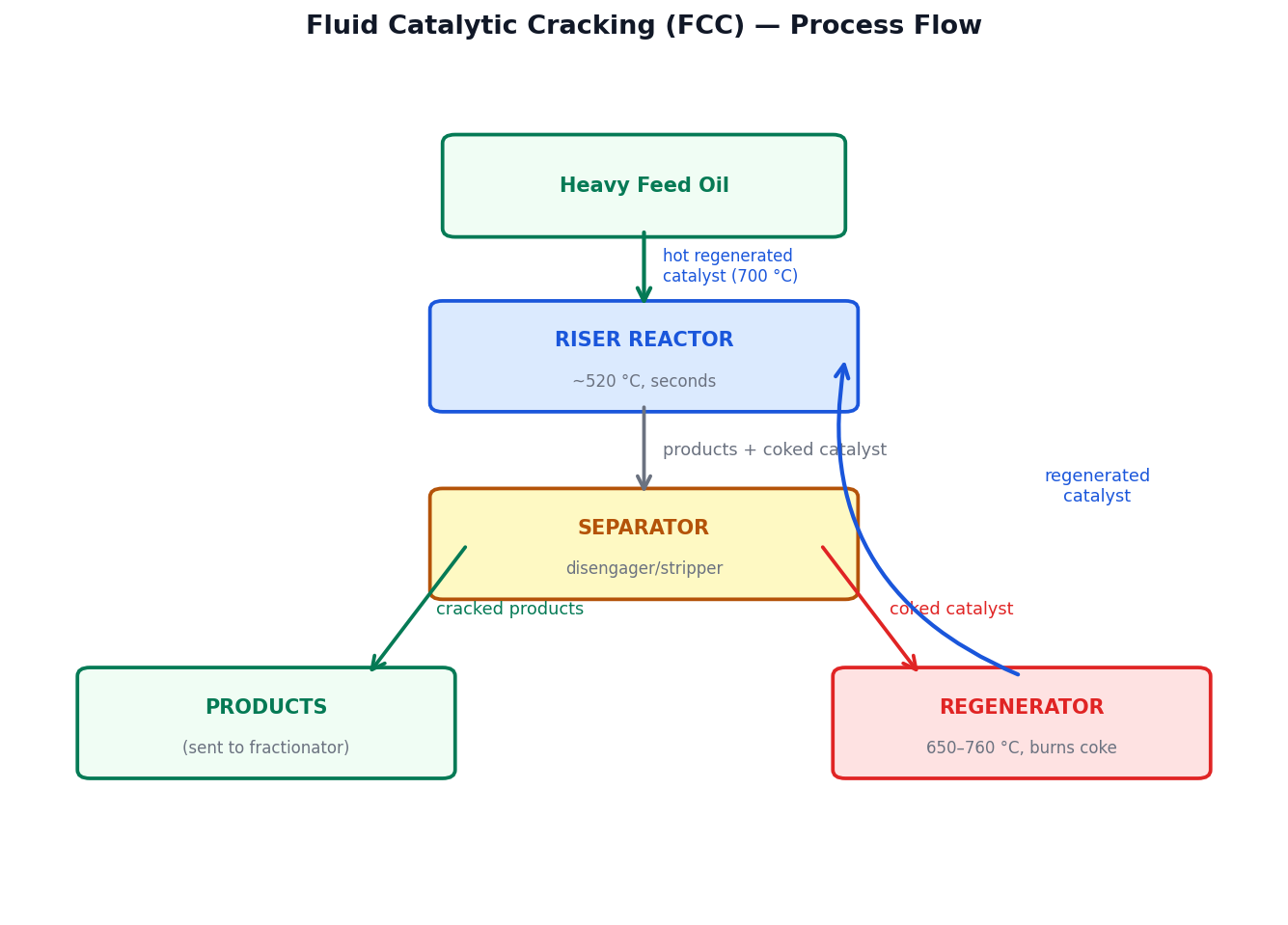
The riser reactor is a vertical tube through which the catalyst and oil feed travel upward together for only a few seconds of contact time. The catalyst then separates from the products, is stripped of residual oil, and is sent to the regenerator where the coke that has deposited on the catalyst surface is burned off with air. The heat released by coke combustion (coke is essentially pure carbon, so this is essentially burning carbon) heats the regenerated catalyst, which then provides the thermal energy needed for the endothermic cracking reactions in the riser — a thermally elegant closed loop.
Zeolite Catalysts and Shape Selectivity
The catalyst in FCC is a zeolite — specifically, a synthetic aluminosilicate zeolite known as Y-zeolite (faujasite structure), mixed with a clay binder and other components. Zeolites are crystalline frameworks of silicon and aluminium atoms linked by oxygen bridges, forming a regular three-dimensional network of channels and cavities.
The structure of a zeolite can be thought of as a molecular sieve:
          [zeolite pore, ~7–8 Å diameter]

  O---Si---O---Al---O---Si---O
  |         |         |       |
  O         O         O       O
  |         |         |       |
  Si    [PORE]        Si      Al
  |         |         |       |
  O         O         O       O
  |         |         |       |
  O---Al---O---Si---O---Al---O
              ↑
      Brønsted acid site
      (bridging OH group)
The pore diameter (typically 5–8 Å, depending on the zeolite type) is comparable to the size of hydrocarbon molecules. This means only molecules small enough to fit into the pores can access the interior surface where the active sites are located. Molecules that are too large cannot enter; molecules that form inside the pores but are too large to exit will react further until they are small enough to leave. This is shape-selective catalysis — the geometry of the catalyst controls which reactions can occur, adding a spatial dimension to selectivity that has no counterpart in homogeneous catalysis.
When aluminium replaces silicon in the framework (Si⁴⁺ → Al³⁺), a net negative charge appears on the framework oxygen atoms adjacent to the aluminium. This charge is balanced by a proton (H⁺), producing a Brønsted acid site — a bridging hydroxyl group that is strongly acidic. These acid sites are the catalytic centres for cracking.
The Cracking Mechanism
The Brønsted acid sites protonate hydrocarbon molecules entering the pores, generating carbocations (carbenium ions). The mechanism then proceeds through three key steps:
- Initiation: A proton from a Brønsted acid site attacks a C–C or C–H bond of a large alkane, generating a carbocation. The most stable carbocations are tertiary (a carbon bearing a positive charge attached to three other carbons) > secondary > primary.
- β-scission: The carbocation undergoes fragmentation. The C–C bond in the β-position (one bond away from the carbon bearing the charge) breaks. This produces a smaller alkene and a new, smaller carbocation. The process repeats, progressively fragmenting the chain.
- Hydrogen transfer and termination: Carbocations can abstract a hydride (H⁻) from a nearby neutral molecule, terminating one chain and initiating cracking of another. The predominance of this step over β-scission is what distinguishes catalytic cracking from thermal cracking and leads to a product slate with more branched alkanes (better for petrol octane rating) and fewer light alkenes than purely thermal routes.
The formation of coke — the carbon deposit that deactivates the catalyst — occurs when large polycyclic aromatic molecules (formed by condensation reactions inside the pores) cannot exit and build up until they block the pores entirely. The FCC regeneration cycle removes this coke, restoring the catalyst's activity.
3. The Catalytic Converter
The Problem of Internal Combustion Emissions
An internal combustion engine runs by burning a fuel-air mixture in a confined space. The combustion is rapid, imperfect, and occurs at extremely high temperatures. The exhaust it produces contains three categories of problematic compounds:
- Carbon monoxide (CO): produced by incomplete combustion when local fuel-to-air ratios are too high. CO is toxic — it binds to haemoglobin with ~200× the affinity of oxygen, preventing oxygen transport.
- Unburned hydrocarbons (CₓHᵧ): fuel that passed through the cylinder unreacted or partially reacted. These contribute to photochemical smog and some are carcinogenic.
- Nitrogen oxides (NOₓ = NO + NO₂): formed when N₂ and O₂ in the air react at the high temperatures inside the cylinder (~2,000 °C). NOₓ drives the formation of tropospheric ozone and acid rain, and NO₂ is directly toxic.
The challenge is that treating these three pollutants requires chemically opposite conditions: CO and hydrocarbons need to be oxidised (require an oxidising environment), while NOₓ needs to be reduced to N₂ (requires a reducing environment). A converter that handles all three simultaneously is non-trivial to design.
The Three-Way Catalytic Converter (TWC)
The three-way catalytic converter does exactly this. Its structure is a ceramic honeycomb monolith — typically made of cordierite (a magnesium aluminosilicate), with thousands of parallel square channels running through it. The walls of the channels are coated with a high-surface-area washcoat of γ-Al₂O₃ (gamma alumina), which in turn carries the active metals: platinum (Pt), palladium (Pd), and rhodium (Rh).
The three simultaneous reactions are:
Reaction 1 — CO oxidation (Pt, Pd):
2CO(g) + O₂(g) → 2CO₂(g)
Reaction 2 — Hydrocarbon oxidation (Pt, Pd):
CₓHᵧ + (x + y/4)O₂ → xCO₂ + (y/2)H₂O
Reaction 3 — NOₓ reduction (Rh):
2NOₓ → N₂ + xO₂
Platinum and palladium handle the oxidation reactions. Rhodium is specifically responsible for NOₓ reduction — it is exceptionally effective at dissociating N–O bonds on its surface, allowing nitrogen atoms to combine and desorb as N₂. This division of labour among the precious metals is deliberate: each metal has a different surface chemistry optimised for its assigned reaction.
The Stoichiometric Window
For all three reactions to work simultaneously, the exhaust composition must be neither too rich (too much unburned fuel) nor too lean (too much excess oxygen). If the mixture is too rich (fuel-excess), there is insufficient oxygen for reactions 1 and 2. If it is too lean (oxygen-excess), the oxidising conditions prevent reaction 3 (there is too much O₂ competing with NOₓ for the rhodium surface).
The operating point where all three reactions are simultaneously efficient is called the stoichiometric window — the air-to-fuel ratio at which combustion is stoichiometrically balanced (denoted λ = 1, where λ is the ratio of actual air supplied to the stoichiometric requirement). This window is remarkably narrow: a deviation of just a few percent outside it causes a sharp increase in one or more pollutants.
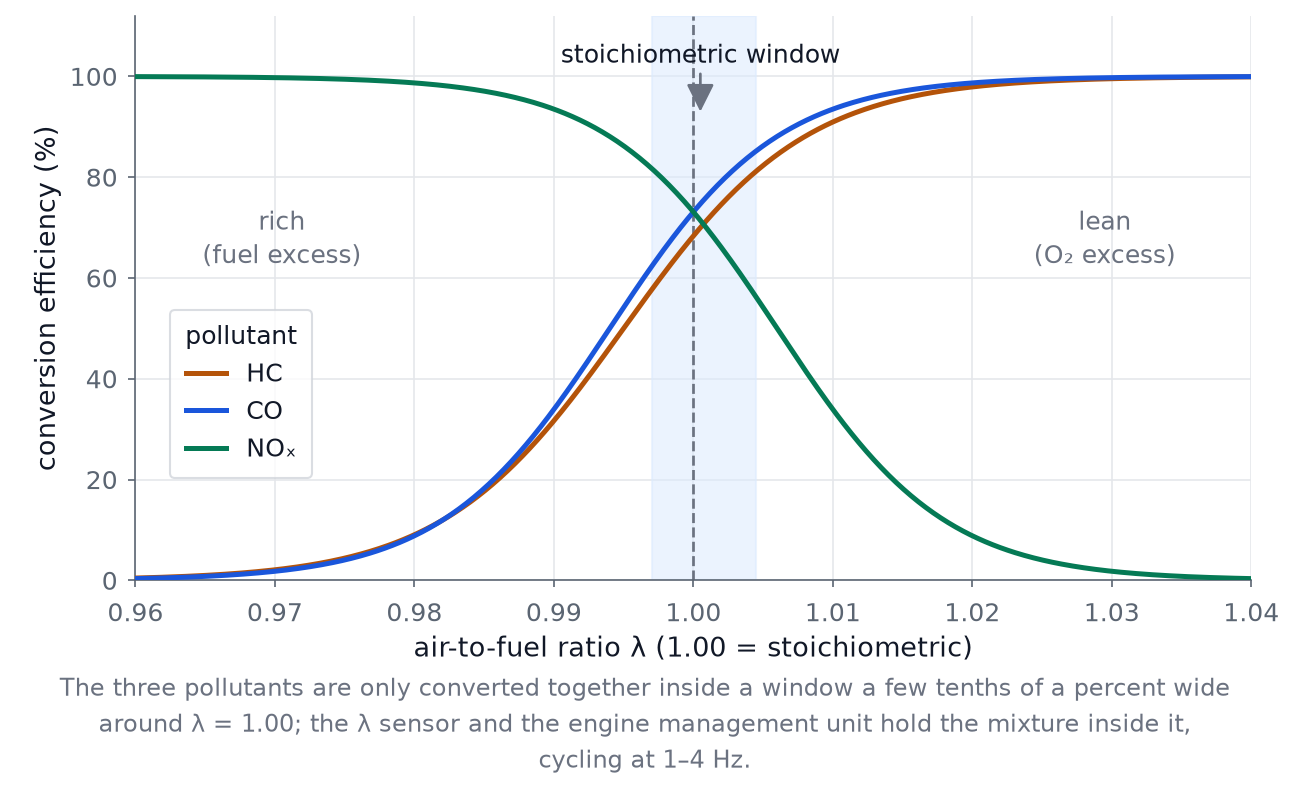
Maintaining λ = 1 requires real-time monitoring and control. An oxygen sensor (lambda sensor) in the exhaust stream measures the oxygen content of the exhaust gas and sends a continuous signal to the engine management unit (EMU), which adjusts fuel injection timing to keep the mixture within the window. This feedback loop operates at about 1–4 Hz and is one of the earliest examples of closed-loop electronic control in everyday consumer products.
Cold-Start Problem
The catalytic converter only achieves significant activity above its light-off temperature — typically 200–300 °C, depending on the metals and specific reactions involved. Below this temperature, the activation energy barriers are too high for meaningful conversion rates even with the catalyst present.
In a cold engine start, the converter is at ambient temperature and does nothing for the first one to three minutes while it heats up. During this period, raw exhaust gases pass through unprocessed. Studies have shown that cold-start emissions can account for 60–80% of total trip emissions for a short urban journey. This has driven significant engineering effort toward solutions including:
- Electrically heated catalysts that bring the converter to light-off temperature before the engine is started
- Close-coupled catalysts positioned immediately after the exhaust manifold (where exhaust is hotter) rather than under the car
- Hydrocarbon traps that adsorb unburned fuel during cold start and release it when the converter is hot
Catalyst Poisoning
The precious metals in the converter are highly sensitive to certain contaminants:
Lead irreversibly poisons both Pt and Rh by adsorbing strongly onto the active surface sites, displacing reactants. The introduction of the catalytic converter in the 1970s drove the worldwide phase-out of tetraethyllead fuel additive — a transition that also dramatically reduced atmospheric lead levels and, it is now understood, reduced average blood lead levels with significant neurological benefits across populations.
Sulfur adsorbs on the precious metal surfaces and blocks active sites. Tighter limits on sulfur content in petrol and diesel were implemented alongside converter technology.
Phosphorus (from engine oil additives) coats the washcoat surface and progressively reduces catalyst efficiency. This is a factor limiting converter lifetime in high-mileage vehicles.
PART II: ENZYME CATALYSIS
4. The Scale of Enzyme Activity
Industrial catalysts are impressive. The Haber-Bosch iron catalyst runs continuously at 450 °C and 200 atm, dissociating the world's most stubborn diatomic molecule millions of times per second at each active site. FCC zeolites handle feeds of tens of thousands of tonnes per day. The catalytic converter converts >99% of CO to CO₂ within milliseconds of contact.
Yet enzymes routinely do things that industrial chemists cannot. Consider just two examples. The enzyme carbonic anhydrase interconverts CO₂ and bicarbonate at rates up to 10⁶ reactions per second per active site — faster than almost any industrial catalyst operating under any conditions, and it achieves this at 37 °C in water at pH 7.4. The enzyme catalase decomposes hydrogen peroxide to water and oxygen at rates approaching 4 × 10⁷ reactions per second per molecule, making it among the fastest known enzymes. These rates approach the theoretical maximum set by molecular diffusion — the enzyme is so fast that the limiting factor is simply how quickly the substrate can diffuse through solution to the active site.
How do enzymes achieve this? They are proteins: polymers of amino acids folded into highly specific three-dimensional structures. The active site — the pocket or cleft where catalysis occurs — is a precisely shaped environment that evolved over billions of years to bind a specific substrate and stabilise the specific transition state of a specific reaction. The amino acid residues lining the active site are positioned with sub-ångström precision to provide exactly the right combination of hydrogen-bond donors, hydrogen-bond acceptors, hydrophobic contacts, and reactive groups.
The distinction between industrial and enzymatic catalysis is ultimately one of structural sophistication. An iron surface has a limited repertoire of binding geometries determined by crystal structure. A protein active site is programmable — its shape, charge distribution, and chemical functionality can be fine-tuned by evolution (or increasingly by protein engineering) to achieve almost any desired selectivity and rate enhancement.
5. Michaelis-Menten Kinetics
The Reaction Model
The quantitative framework for enzyme kinetics begins with a simple model proposed by Leonor Michaelis and Maud Menten in 1913. An enzyme (E) binds its substrate (S) to form an enzyme-substrate complex (ES), which then either converts to product (P) and regenerates the free enzyme, or dissociates back to E + S:
E + S ⇌ ES → E + P
More precisely, with rate constants:
         k₁          k₂
E + S ⇌ ES  →  E + P
         k₋₁
where k₁ is the rate of ES formation, k₋₁ is the rate of ES dissociation back to E + S, and k₂ (often written kcat) is the rate of the catalytic step converting ES to E + P.
The Michaelis-Menten equation gives the initial reaction rate (v) as a function of substrate concentration [S]:
v = (Vmax × [S]) / (Km + [S])
Interpreting the Parameters
Vmax is the maximum reaction rate, achieved when the enzyme is saturated — that is, when essentially all enzyme molecules have substrate bound in their active sites. Vmax is proportional to the total enzyme concentration and to the rate of the catalytic step.
Km (the Michaelis constant) is the substrate concentration at which v = Vmax/2. It has units of concentration (typically μM or mM). Km is a composite constant: under the standard approximation, Km = (k₋₁ + k₂) / k₁. When the dissociation step is fast compared to the catalytic step (k₋₁ >> k₂), Km ≈ k₋₁/k₁, which is the dissociation constant of the ES complex — a true measure of binding affinity. In this limit, low Km means tight binding (high affinity), and high Km means weak binding (low affinity).
The shape of the Michaelis-Menten curve is a rectangular hyperbola:
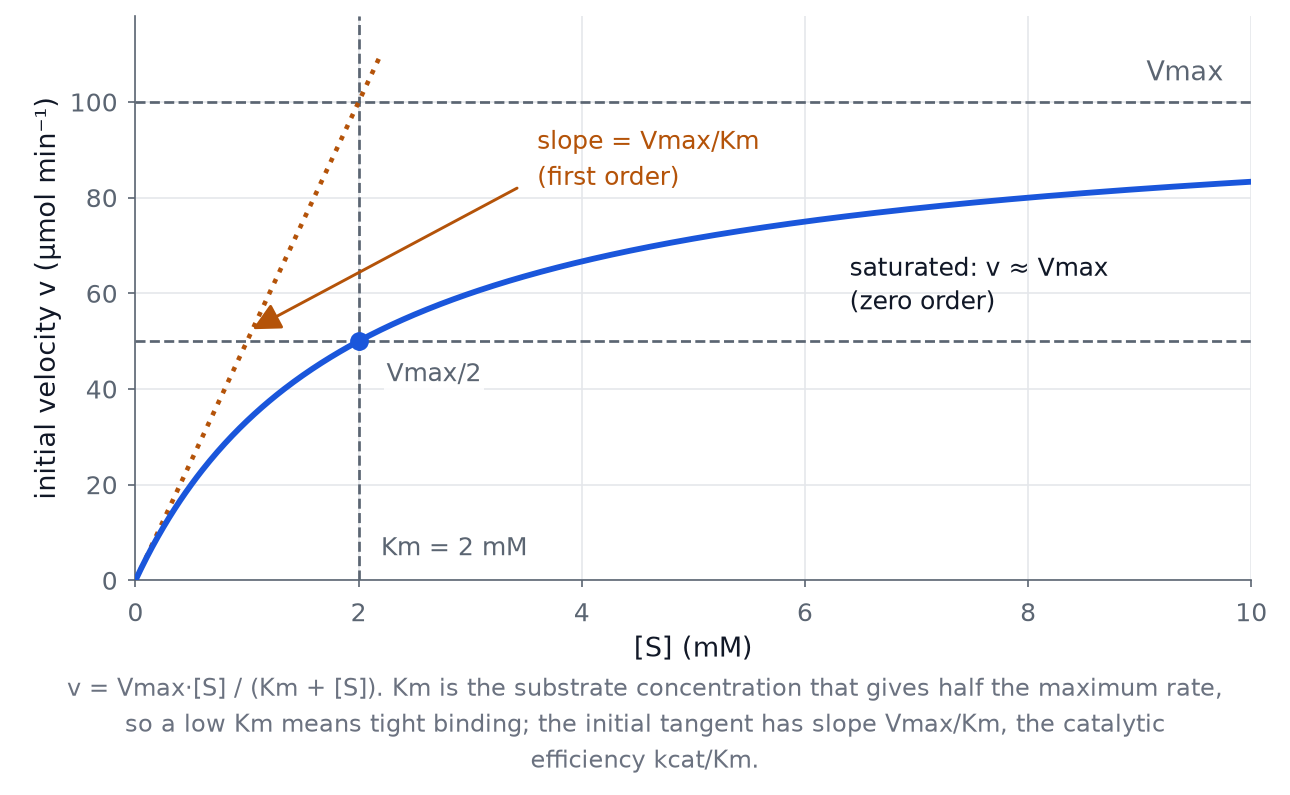
At low [S] (where [S] << Km), the equation simplifies to v ≈ (Vmax/Km) × [S] — first-order kinetics, rate proportional to substrate concentration. At high [S] (where [S] >> Km), v approaches Vmax — zero-order kinetics, rate independent of substrate concentration because the enzyme is saturated.
kcat and Catalytic Efficiency
The turnover number (kcat) is the number of substrate molecules converted to product per active site per second when the enzyme is fully saturated. It has units of s⁻¹. The relationship between Vmax and kcat is:
Vmax = kcat × [E]total
where [E]total is the total molar concentration of active sites. kcat values for enzymes span an enormous range: from less than 1 s⁻¹ for some very slow enzymes to 4 × 10⁷ s⁻¹ for catalase.
However, kcat alone does not capture enzyme efficiency, because an enzyme that is extremely fast but binds substrate very poorly (high Km) will be slow under physiological conditions where [S] is low. The comprehensive measure of enzyme performance is the catalytic efficiency:
Catalytic efficiency = kcat / Km (units: M⁻¹s⁻¹)
This ratio gives the rate of reaction per unit enzyme concentration per unit substrate concentration — essentially the second-order rate constant for the overall E + S → E + P reaction at low [S]. The theoretical upper limit of kcat/Km is set by the diffusion limit: substrate molecules cannot reach the active site faster than they can diffuse through solution. This limit is approximately 10⁸ – 10⁹ M⁻¹s⁻¹. Enzymes like carbonic anhydrase II (kcat/Km ≈ 1.5 × 10⁸ M⁻¹s⁻¹) and catalase (kcat/Km ≈ 4 × 10⁷ M⁻¹s⁻¹) approach or reach this limit — they are diffusion-limited, meaning the enzyme converts substrate essentially as fast as substrate can arrive. Evolution has optimised these enzymes to the point where further improvement to the chemistry would make no difference: the bottleneck has moved outside the enzyme entirely.
6. Enzyme Mechanisms: Serine Proteases
Overview
Serine proteases are a family of enzymes that cleave peptide bonds in protein substrates. Major examples include chymotrypsin (cleaves after large hydrophobic residues such as phenylalanine and tryptophan), trypsin (cleaves after positively charged residues, lysine and arginine), and elastase (cleaves after small residues like glycine and alanine). Despite their different substrate specificities — determined by the shape of the "specificity pocket" adjacent to the active site — all three use an identical catalytic mechanism.
The Catalytic Triad
At the core of every serine protease active site is the catalytic triad: three amino acid residues working in concert.
- Serine 195 — the nucleophile that directly attacks the peptide bond
- Histidine 57 — a general base that activates Serine 195
- Aspartate 102 — orients and stabilises Histidine 57 through hydrogen bonding
The numbering (195, 57, 102) reflects the positions of these residues in the chymotrypsin amino acid sequence. In the folded protein, these three residues are brought into precise geometric proximity despite being far apart in sequence — a striking illustration of how protein folding creates active sites from discontiguous parts of the chain.
     Asp 102 ─── His 57 ─── Ser 195
     (H-bond     (H-bond     (nucleophile)
      donor)      acceptor/
                  donor)
Step-by-Step Mechanism
Step 1 — Activation of Serine: Histidine 57 acts as a general base, abstracting the proton from the hydroxyl group of Serine 195. This converts the serine –OH into a much more powerful nucleophile, the serine alkoxide (–O⁻). Aspartate 102, bearing a negative charge at physiological pH, hydrogen-bonds to the histidine imidazole ring, stabilising the protonated histidinium that forms and correctly orienting His for its role.
Step 2 — Nucleophilic attack: The activated Serine 195 oxygen attacks the carbonyl carbon (C=O) of the peptide bond to be cleaved. This carbon goes from trigonal planar (sp² geometry) to tetrahedral (sp³ geometry) as a bond forms to the serine oxygen — a transition through a tetrahedral intermediate.
Step 3 — Stabilisation by the oxyanion hole: The tetrahedral intermediate has a negatively charged oxygen (the former carbonyl oxygen, now an alkoxide) that is unstable. Two backbone N–H groups in the active site (from Gly 193 and Ser 195 itself) are positioned to donate hydrogen bonds specifically to this oxygen. This arrangement is called the oxyanion hole. It does not exist in that geometry in the ground state of the enzyme — it is a specific structural feature whose geometry precisely matches the transition state, not the substrate. This is the mechanistic basis of the central principle of enzyme catalysis: enzymes stabilise the transition state preferentially over the ground state, thereby lowering the activation energy.
Step 4 — First product leaves: The tetrahedral intermediate collapses: the peptide bond N–C bond breaks, and the amine portion of the cleaved peptide (with its newly free N-terminus) departs as the first product. The enzyme is now in an acyl-enzyme intermediate state — the serine is covalently bonded to the carbonyl carbon of the remaining peptide fragment.
Step 5 — Deacylation: A water molecule enters the active site. Histidine 57, now acting as a general base again, abstracts a proton from water, generating a hydroxide (OH⁻) nucleophile. This hydroxide attacks the carbonyl carbon of the acyl-enzyme, again forming a tetrahedral intermediate stabilised by the oxyanion hole.
Step 6 — Second product leaves: The tetrahedral intermediate collapses, the bond between Serine 195 and the substrate fragment breaks, and the second product (the C-terminal fragment of the original substrate) departs. The enzyme is fully regenerated — Serine 195 is free, Histidine 57 has lost its extra proton, and the active site is ready for the next substrate molecule.
What This Mechanism Illustrates
The serine protease mechanism exemplifies several features of enzyme catalysis that generalise broadly:
- Covalent catalysis: The enzyme forms a transient covalent bond to its substrate (the acyl-enzyme intermediate), creating a lower-energy pathway than direct water attack on the peptide bond would provide.
- General acid-base catalysis: Histidine 57 shuttles protons during the mechanism, avoiding the energetically costly generation of fully charged species at physiological pH.
- Transition-state stabilisation: The oxyanion hole is the most direct illustration of the principle that enzyme active sites are complementary to the transition state, not to the substrate or product. The hydrogen-bond donors are positioned for the geometry of the sp³ tetrahedral transition state carbon, not for the sp² ground-state carbonyl.
- Specificity: The serine protease mechanism explains how, but the specificity pocket (whose shape differs among chymotrypsin, trypsin, and elastase) explains why a given enzyme cleaves after certain residues and not others — selectivity is determined by a different part of the active site than the catalytic machinery itself.
7. Enzyme Mechanisms: Carbonic Anhydrase
The Reaction and Its Physiological Importance
Every tissue in your body produces CO₂ as a metabolic waste product. CO₂ must be transported in the blood to the lungs, where it is exhaled. But CO₂ itself is only sparingly soluble in blood. The solution is to convert CO₂ to bicarbonate (HCO₃⁻), which is far more soluble:
CO₂ + H₂O ⇌ H₂CO₃ ⇌ H⁺ + HCO₃⁻
In the tissues, CO₂ produced by metabolism is hydrated to H⁺ and HCO₃⁻. The HCO₃⁻ is transported in plasma to the lungs, where the reaction is reversed: HCO₃⁻ is converted back to CO₂, which diffuses into the alveoli and is exhaled. Simultaneously, the H⁺ produced in tissues and consumed in lungs helps regulate blood pH within the narrow physiological range of 7.35–7.45.
The uncatalysed hydration of CO₂ is far too slow for these physiological purposes — the rate constant for uncatalysed hydration is approximately 0.15 s⁻¹ under physiological conditions. Carbonic anhydrase II achieves a kcat of approximately 10⁶ s⁻¹ — an acceleration of nearly seven orders of magnitude. This makes it one of the fastest enzymes known.
The Zinc Active Site
Unlike the serine protease, which uses only amino acid side chains as catalytic tools, carbonic anhydrase employs a metal ion — specifically zinc(II) — at its active site. Zinc is coordinated by three histidine residues (His 94, His 96, His 119 in human carbonic anhydrase II) and a water molecule, in a roughly tetrahedral geometry:
        His 94
          \
           Zn²⁺ ──── His 96
          /    \
     His 119   OH₂  ← catalytic water molecule
The three histidine residues are rigid, provided by the protein scaffold, and fix the zinc in position. The fourth coordination site holds the catalytic water (or, during the reaction, a hydroxide or CO₂).
The Role of Zinc: pKa Manipulation
Free water has a pKa of 15.7 — it is an extremely poor nucleophile at neutral pH, because very little of it is in the hydroxide (OH⁻) form at pH 7. For water to be useful as a nucleophile in enzyme catalysis, its tendency to donate a proton must be dramatically increased.
The zinc(II) ion, being a small, doubly charged Lewis acid, coordinates the water molecule and withdraws electron density from the O–H bonds. This destabilises the water molecule (makes it easier to lose H⁺) and lowers its pKa to approximately 7 in the active site. At physiological pH, roughly half of the zinc-bound water is already in the hydroxide form (Zn-OH). This zinc-bound hydroxide is the actual nucleophile in the catalytic reaction.
The zinc ion does not itself break or form bonds with CO₂ — it acts purely to generate an effective nucleophile at a pH where free water would be essentially inert. This is a beautiful example of how enzymes can tune the reactivity of common molecules by controlling their local environment.
The Catalytic Cycle
Step 1 — Nucleophilic attack: The zinc-bound hydroxide (Zn-OH) attacks CO₂, which binds in a hydrophobic pocket adjacent to the zinc. The carbon of CO₂ is attacked by the nucleophilic oxygen of Zn-OH, and bicarbonate (Zn-HCO₃⁻) forms at the zinc centre. This step converts CO₂ and the hydroxide directly to HCO₃⁻.
Step 2 — Product release: Bicarbonate dissociates from the zinc, and a water molecule takes its place, restoring the Zn-OH₂ species.
Step 3 — Proton transfer: The zinc-bound water must lose a proton to regenerate the active Zn-OH nucleophile. At the diffusion-limited rates this enzyme operates at, even the apparently simple step of proton transfer becomes the bottleneck. The enzyme uses a proton shuttle mechanism: Histidine 64, whose imidazole group can be protonated and deprotonated, transfers the proton from the zinc-bound water through a chain of hydrogen-bonded water molecules to the bulk solvent. This is the actual rate-limiting step at high pH — the chemical transformation is fast, but regenerating the active hydroxide form requires efficient proton removal.
Zinc vs. Serine Protease: Contrasting Strategies
Carbonic anhydrase and the serine proteases represent two of the major strategies enzymes use to generate nucleophiles:
| Feature | Serine Protease | Carbonic Anhydrase |
|---|---|---|
| Nucleophile source | Amino acid side chain (Ser-OH) | Metal ion-activated water |
| Activation mechanism | General base (His) increases nucleophilicity of Ser | Lewis acid (Zn²⁺) lowers pKa of water |
| Covalent intermediate? | Yes (acyl-enzyme) | No |
| Metal cofactor? | No | Yes (Zn²⁺) |
| kcat | ~100 s⁻¹ | ~10⁶ s⁻¹ |
Both ultimately achieve the same thing: generating a nucleophile with sufficient reactivity to attack a chemically resistant bond under mild aqueous conditions. The means are entirely different. This diversity of mechanism is part of what makes enzyme chemistry so rich — there is rarely a single "correct" catalytic strategy, and evolution has independently arrived at multiple solutions to similar problems.
8. Selectivity in Catalysis
A Unifying Theme
Looking across the industrial and enzymatic examples here, one theme recurs at every scale: selectivity — the ability of a catalyst to direct a reaction toward a specific product when other reactions are thermodynamically possible. Selectivity has multiple dimensions, and each matters for different reasons.
Chemoselectivity
Chemoselectivity refers to a catalyst's ability to react preferentially with one functional group in the presence of others. A chemoselective catalyst for ketone reduction, for example, would reduce a ketone without also reducing an alkene, an ester, or an aldehyde present in the same molecule. Industrial hydrogenation catalysts (Pd/C, Raney nickel) are often poorly chemoselective — they will reduce almost any reducible functional group. Achieving chemoselectivity requires either modifying the catalyst (e.g., Lindlar's catalyst, which selectively reduces alkynes to Z-alkenes) or using reagents with inherent functional-group selectivity.
Enzymes achieve near-perfect chemoselectivity as a matter of routine. A kinase enzyme that phosphorylates a specific hydroxyl group on a sugar does not accidentally phosphorylate other hydroxyl groups on the same molecule — the active site geometry only positions the intended oxygen near the phosphate donor. In the context of the serine proteases: chymotrypsin cleaves peptide bonds, not ester bonds or phosphate bonds, even though the chemistry (nucleophilic acyl substitution) is in principle the same. The active site is tuned for one reaction.
Regioselectivity
Regioselectivity refers to preference for reaction at one position on a molecule over another position of the same functional group type. Consider a linear alkane: thermal cracking can cleave any C–C bond. Catalytic cracking using zeolites shows regioselectivity — the pore size and acid site distribution favour cleavage at specific positions. Enzymatic reactions are often exquisitely regioselective: cytochrome P450 enzymes that hydroxylate steroids can introduce an –OH group at a single carbon out of the twenty-seven carbon atoms in the steroid framework, leaving all other C–H bonds untouched.
Stereoselectivity
Stereoselectivity refers to the preferential formation of one stereoisomer over others when a reaction could in principle produce multiple stereoisomers. It divides into two sub-types:
Diastereoselectivity is the preference for one diastereomer over another. Diastereomers differ in configuration at one or more but not all stereocentres in a molecule with at least two stereocentres. A diastereoselective reaction on a substrate with one existing stereocentre, introducing a second, would give predominantly one of the two possible diastereomeric products.
Enantioselectivity is the preference for one enantiomer over its mirror image. Enantiomers are non-superimposable mirror images — they have the same connectivity and the same bond energies, so they are identical in energy in an achiral environment. A catalyst can distinguish between them only if the catalyst itself is chiral. Enzymes are inherently chiral — all the amino acids that make up a protein are L-amino acids, and the protein fold is therefore chiral. Every enzyme active site is a chiral environment, and this chirality is what enables the perfect enantioselectivity that enzymes routinely achieve.
Why Selectivity Matters in Practice
In pharmaceuticals, selectivity is not merely an aesthetic preference — it can be a matter of life and safety. The most famous example is thalidomide, a drug prescribed in the late 1950s as a sedative and anti-nausea treatment for pregnant women. Thalidomide has a single stereocentre, and the (R)-enantiomer has the intended therapeutic effect, while the (S)-enantiomer causes teratogenic effects (severe birth defects). Even if enantiopure (R)-thalidomide had been administered, it would not have been safe — the molecule racemises in vivo — but the example illustrates the stakes of enantioselectivity in drug design.
More broadly, because biological molecules (enzymes, receptors, ion channels, DNA) are chiral, a drug molecule interacts with its biological target stereospecifically. The wrong enantiomer may be inactive (wasted dose), may target a different receptor with unwanted effects, or may actively cause harm. Regulatory agencies now routinely require that new chiral drugs be developed and administered as single enantiomers rather than racemates.
In industrial chemistry, poor selectivity translates directly into economic loss. Every molecule of starting material that reacts to give an unwanted byproduct is a molecule that cannot be sold as the desired product, plus a separation problem that consumes energy and generates waste. The E-factor (kilograms of waste produced per kilogram of desired product) of the pharmaceutical industry is dramatically higher than that of the petrochemical industry, largely because the complex molecules in drug synthesis have many functional groups that can react unintentionally.
The gap between industrial and enzymatic catalysis is most visible in enantioselectivity. Enzymes perform asymmetric synthesis with 100% enantioselectivity as a matter of routine. Industrial chemists have developed a rich toolkit of chiral catalysts — the Nobel Prize in Chemistry 2001 went to Knowles, Noyori, and Sharpless for chiral catalysts for hydrogenation and oxidation reactions — but achieving enzyme-level enantioselectivity across diverse substrates and reaction types remains an active research frontier. This gap is one of the strongest arguments for using enzymes (or engineered enzymes) directly in chemical synthesis, an approach now central to the pharmaceutical industry.
Selectivity as a Design Principle
Looking back at the three industrial systems in Part I through the lens of selectivity:
- Haber-Bosch achieves high chemoselectivity: the iron surface under operating conditions converts N₂ and H₂ into NH₃ with little formation of competing products (like N₂H₄ or higher nitrogen oxides). The catalyst and conditions are tuned for this specific reaction pathway.
- FCC zeolites use shape selectivity — a structural mechanism for controlling regioselectivity that has no direct biological equivalent. The pore geometry is a physical filter that enforces selectivity by exclusion.
- The catalytic converter uses three different metals to achieve three different transformations in series on the same washcoat. This is a form of functional chemoselectivity built into the catalyst architecture through metal selection.
In each case, selectivity is not incidental — it is the central engineering objective. The same is true of enzyme active sites, which have been shaped by evolution over billions of years specifically to solve the selectivity problem that chemistry alone cannot.
One unifying pattern — activation energy, surface mechanisms, the role of the catalyst in providing a lower-energy reaction pathway — has now materialised across six very different systems: an iron surface at 450 °C fixing nitrogen, a zeolite pore at 520 °C cracking petroleum, a precious-metal washcoat converting exhaust gases, a protein pocket cleaving peptide bonds, a zinc-activated water molecule interconverting CO₂ and bicarbonate. The chemistry is different in each case. The logic is the same.