For more than two thousand years, infinity was treated as a single, undifferentiated idea, a word that meant "without end" and nothing more. The Greeks used it to construct paradoxes. The medieval scholastics reserved it for God. The mathematicians of the Enlightenment used it as shorthand for a limit process that could always be extended but never completed. In every case, infinity was one thing, a monolith beyond the finite, a darkness past the last number.
Georg Cantor's achievement, developed across a series of papers between 1874 and 1891, was to shatter that monolith. He showed that infinite sets are not all the same size, that the natural numbers and the real numbers represent genuinely different magnitudes of infinity, and that behind the single word "infinite" hides an entire hierarchy of sizes, each strictly larger than the last, ascending without any ceiling. The tool he used was disarmingly simple: the concept of a one-to-one correspondence, or bijection, applied with ruthless consistency to infinite collections. The consequences were anything but simple. They overturned a philosophical consensus stretching back to Aristotle, provoked a ferocious backlash from Cantor's contemporaries, and laid the groundwork for the revolutions in logic and computation that would reshape mathematics in the twentieth century.
This material traces the full arc of that revolution, from the ancient paradoxes that first exposed the conceptual difficulties of the infinite, through the surprising uniformity of countable sets, to the diagonal argument that fractured infinity into a hierarchy, and onward to the power set construction that extends that hierarchy without limit. Along the way, it examines the strange arithmetic of infinite cardinals, the distinction between algebraic and transcendental numbers, the measure-theoretic perspective on the size of sets, and the Continuum Hypothesis that Cantor himself could never resolve. The story is one of conceptual courage: the willingness to take a definition seriously even when its consequences seem absurd, and to follow a line of reasoning wherever it leads, even into territory that the entire weight of mathematical tradition had declared off limits.
From Paradox to Precision: The Conceptual Arc of Infinity
The Ancient Challenge and the Modern Response
Zeno of Elea constructed his paradoxes around 450 BCE not as mathematical puzzles but as philosophical weapons, designed to show that motion and plurality are logically incoherent. The paradox of Achilles and the Tortoise argues that a swift runner can never overtake a slower one with a head start, because the runner must first reach the point where the tortoise was, by which time the tortoise has moved further ahead, generating an infinite regress of ever-smaller gaps. The Dichotomy paradox argues that motion cannot even begin, because before crossing any distance you must first cross half of it, and before that a quarter, and so on without end. The Arrow paradox argues that at any single instant an arrow occupies a fixed position and is therefore motionless, so if time is composed of instants, the arrow never moves.
These arguments are not sophistry. They expose a genuine tension between the continuous nature of space and time and the discrete, step-by-step character of any process of traversal or enumeration. The Achilles paradox generates an infinite geometric series 100 + 10 + 1 + 0.1 + …, whose terms shrink by a factor of ten at each step. The Dichotomy generates the series L/2 + L/4 + L/8 + …, whose terms halve at each step. The Arrow challenges the very coherence of instantaneous motion, demanding a concept of velocity that the ancient world did not possess. In each case, the paradox arises because the Greeks had no theory of convergent infinite series, no rigorous definition of a limit, and no formal account of what it means for a continuous quantity to be decomposed into infinitely many parts. Within their conceptual framework, Zeno's paradoxes were unanswerable, and the most influential response was Aristotle's strategic retreat: distinguish between potential infinity, which is permissible (you can always extend a process further), and actual infinity, which is not (you cannot treat an infinite process as completed). This distinction dominated mathematical thinking for over two millennia.
The modern resolution required the machinery of limits, developed with full rigour by Cauchy and Weierstrass in the nineteenth century. The geometric series ∑ₙ₌₀∞ rⁿ = 1/(1-r) for |r| < 1 shows that infinitely many terms can sum to a finite value, and the ε-δ definition of a limit provides a precise account of what it means for partial sums to converge. The total distance Achilles runs is 100 · 1/(1 - 1/10) = 1000/9 metres, reached in a perfectly finite time. The Dichotomy series 1/2 + 1/4 + 1/8 + … sums to exactly 1, meaning the full distance is traversed. The Arrow paradox requires the concept of the derivative, the instantaneous rate of change defined as the limit of a difference quotient: velocity at an instant is not a property of the arrow at that instant alone, but a relationship between its positions across an interval that is being shrunk toward zero. Each paradox dissolves, but each resolution requires exactly the conceptual commitment that Aristotle had forbidden: treating an infinite process as having a definite, completed result. The resolution of Zeno's paradoxes is, in miniature, the overthrow of the Aristotelian prohibition on actual infinity.
Aristotle's Long Shadow
Aristotle's distinction between potential and actual infinity was not a casual remark. It was a carefully argued philosophical position, embedded in a comprehensive account of what kinds of things can exist and what kinds of operations are coherent. For Aristotle, a completed infinite totality was a contradiction in terms: infinity meant "without end," and a completed process is one that has reached its end, so a completed infinity was an end that had no end. The natural numbers could be extended indefinitely, but they could not be gathered into a single, finished collection. The line could be divided without limit, but it could not be treated as the union of infinitely many completed parts.
This prohibition was reinforced by theological considerations in the medieval period, where the actual infinite was associated with the divine and considered beyond the reach of finite human intellect. Even into the nineteenth century, mathematicians of the highest calibre accepted the Aristotelian consensus. Gauss protested in 1831 against "the use of an infinite quantity as an actual entity," insisting that the infinite was "only a manner of speaking." Cauchy built his rigorous foundations for calculus entirely within the potential-infinity framework, and his approach remains standard in analysis courses to this day. The taboo was not a sign of intellectual timidity; it reflected a genuine and reasonable caution about objects whose properties seemed to defy ordinary logic.
The cost, however, was that certain questions could not even be formulated. If infinite collections are not legitimate mathematical objects, you cannot ask whether two infinite collections have the same size, or whether one is larger than the other. You cannot investigate the internal structure of the infinite, because you have denied that it has an internal structure to investigate. Cantor's revolution began precisely by rejecting this prohibition: by treating infinite sets as mathematical objects in their own right, subject to the same criteria of comparison that apply to finite sets, and by following the consequences wherever they led.
The Successor Function and the Birth of Formal Counting
The natural numbers ℕ = {0, 1, 2, 3, …} are generated by a single operation: the successor function S(n) = n + 1, which takes each number to the next. Starting from zero and applying the successor repeatedly produces the entire sequence. Giuseppe Peano formalised this in 1889 with five axioms: zero is a natural number; every natural number has a successor; zero is not the successor of any number; different numbers have different successors; and any property that holds for zero and passes from each number to its successor holds for all natural numbers. From these axioms, all of ordinary arithmetic can be derived.
The natural numbers are the prototype of a countably infinite set, and the Peano axioms make precise what "countably infinite" means in structural terms: a set with a first element, a successor operation that never cycles or branches, and no last element. But the really powerful idea is not the successor function itself; it is the concept of bijection, which generalises the act of counting from finite to infinite sets. When we count a finite collection, we establish a one-to-one correspondence between its elements and the numbers {1, 2, …, n}. Two finite sets have the same size precisely when such a correspondence exists between them. Cantor's insight was to apply this same criterion, without modification, to infinite sets: two sets have the same cardinality if and only if a bijection exists between them. This definition is the only one that is both consistent with the finite case and mathematically productive in the infinite case, and it is the foundation on which the entire theory of infinite cardinalities rests.
The Surprising Geometry of Countable Sets
Galileo's Paradox and the Dedekind Definition
The first recorded observation that an infinite set can be matched one-to-one with a proper subset of itself belongs to Galileo, who noted in 1638 that the function f(n) = n² establishes a bijection between the natural numbers and the perfect squares. Every natural number has a unique square, and every perfect square is the square of a unique natural number. Yet the perfect squares are a proper subset of the natural numbers, missing all non-square numbers like 2, 3, 5, 6, and so on. In the finite world, a proper subset is always strictly smaller than the whole. In the infinite world, a proper subset can be exactly the same size.
Galileo found this so disturbing that he concluded the concepts of "larger" and "smaller" simply do not apply to infinite collections. He set the puzzle aside as unanswerable. Two and a half centuries later, Richard Dedekind turned Galileo's paradox into a definition: a set is infinite if and only if it can be placed in bijection with a proper subset of itself. This is not a quirk or an anomaly; it is the defining characteristic of infinite sets. The integers ℤ can be listed as 0, 1, -1, 2, -2, 3, -3, …, establishing a bijection with ℕ even though ℕ is a proper subset of ℤ. The even numbers can be matched with all natural numbers via n ↦ 2n. The odd numbers can be matched via n ↦ 2n+1. The prime numbers, though they thin out along the number line and become increasingly rare among large integers, can still be listed in order 2, 3, 5, 7, 11, … and matched one-to-one with ℕ. In each case, the part is as large as the whole, a property that is impossible for finite sets and that constitutes the very meaning of infinity in the Dedekind sense. This property, far from being a peripheral curiosity, is the structural signature that separates the infinite from the finite: no finite set can be placed in bijection with a proper subset, while every infinite set can.
The Diagonal Enumeration of the Rationals
The rational numbers ℚ present a far more formidable challenge to the bijection criterion than the integers do. The rationals are dense in the real line: between any two distinct rationals, no matter how close, there are infinitely many more. Between 0 and 1 alone there is an infinite profusion of fractions, and between any two of those fractions there is another infinite profusion. The intuitive expectation is that such a densely packed set must be vastly larger than the sparsely distributed natural numbers.
Cantor demolished this expectation in 1874 with one of the most elegant constructions in the history of mathematics. Arrange all positive rationals p/q in a two-dimensional grid, with the numerator p indexing rows and the denominator q indexing columns. Every positive rational appears in this grid (indeed, each appears infinitely often, since 1/2 = 2/4 = 3/6). Now traverse the grid along successive diagonals: first the diagonal p + q = 2 (containing 1/1), then p + q = 3 (containing 1/2 and 2/1), then p + q = 4, and so on, skipping any fraction that is not in lowest terms. This diagonal sweep visits every positive rational exactly once, producing a complete listing r₁, r₂, r₃, … that is a bijection from ℕ to ℚ⁺. Including zero and the negative rationals by the same interleaving technique used for the integers yields |ℚ| = |ℕ| = ℵ₀.
The result is a profound lesson in the difference between topological and cardinal properties of sets. Density is a topological property: it describes how a set is distributed within a larger space. Cardinality is a set-theoretic property: it counts how many elements a set has, regardless of how they are distributed. A set can be topologically dense and cardinally small, or topologically sparse and cardinally large. The rationals are dense in the reals yet have the same cardinality as the discrete, gap-riddled natural numbers. The primes, which grow ever sparser among the integers, form a countably infinite set just as large as the integers themselves. Topological density tells you about distribution; cardinality tells you about quantity; and these two measures of size are completely independent of each other. This distinction, once grasped, is one of the most liberating ideas in modern mathematics, freeing the concept of "size" from the narrow intuitions shaped by our experience with finite collections.
Cardinal Arithmetic and the Algebra of Aleph-Null
The cardinality ℵ₀ of the natural numbers is the smallest infinite cardinal, and its arithmetic is governed by rules that bear no resemblance to the arithmetic of finite numbers. The union of two countably infinite sets is countably infinite: ℵ₀ + ℵ₀ = ℵ₀. This follows immediately from the interleaving technique, which weaves two infinite sequences into one. The Cartesian product of two countably infinite sets is countably infinite: ℵ₀ × ℵ₀ = ℵ₀. This is the content of the diagonal enumeration, which lists all pairs (m, n) of natural numbers in a single sequence. Adding a single element to a countably infinite set does not change its cardinality: ℵ₀ + 1 = ℵ₀, because you can shift every element one position and insert the new element at the front.
These identities can also be expressed through the Cantor pairing function, which encodes any pair (m, n) ∈ ℕ × ℕ as a single natural number ⟨ m, n ⟩ = (m+n)(m+n+1)/2 + n. This function is a bijection from ℕ × ℕ to ℕ, providing a concrete implementation of the identity ℵ₀ × ℵ₀ = ℵ₀. It traces a diagonal path through the grid of pairs, visiting each cell exactly once, and its inverse recovers the original pair from its encoded number. The pairing function is the algebraic backbone of Hilbert's Hotel and of every argument that shows a countable union or product of countable sets is countable.
The remarkable stability of ℵ₀ under addition, multiplication, and finite exponentiation might suggest that no operation on infinite sets can produce a genuinely larger infinity. Every attempt to escape countability by combining, pairing, or multiplying countable sets seems to circle back to ℵ₀. Even ℵ₀ⁿ = ℵ₀ for every finite n, because the set of all n-tuples of natural numbers can be encoded as natural numbers via iterated pairing. The countable world is, in this sense, self-contained: it absorbs every finite combination of its own copies without growing. The question is whether there exists any set at all, any operation at all, whose output genuinely exceeds ℵ₀. The answer, when it came, would permanently transform the mathematical understanding of the infinite.
The Diagonal Argument and the Fracture of Infinity
Cantor's First Proof and the Completeness of the Reals
Cantor's first proof that the real numbers are uncountable appeared in 1874, seventeen years before the more famous diagonal argument. It uses a technique of successive confinement, sometimes called the nested interval method. Suppose you have a list r₁, r₂, r₃, … that is claimed to contain every real number in some interval [a, b]. Cantor constructs a nested sequence of closed intervals [a₁, b₁] ⊃ [a₂, b₂] ⊃ [a₃, b₃] ⊃ …, each one excluding the next element of the list that falls within it, so that rₙ is eventually shut out of the shrinking intervals.
The critical step relies on the completeness of the real numbers: the property that any nested sequence of closed intervals with lengths tending to zero has at least one point in common. This completeness is itself a deep and non-obvious property. The rationals are dense in the real line, with a rational between any two rationals, but they are not complete: it is possible to construct nested intervals with rational endpoints whose common limit point is irrational. The sequence of intervals [1, 2], [1.4, 1.5], [1.41, 1.42], [1.414, 1.415], … converges to √2, which is not rational. This is precisely the gap that completeness fills: the real numbers include all such limit points, leaving no hole in the line. Cantor's nested interval proof exploits this gaplessness to produce a real number c that lies in every interval of the sequence but never appears in the list, contradicting the assumption that the list is exhaustive. The proof is geometrically vivid and philosophically transparent, but it depends essentially on the completeness of the reals, the very property that distinguishes ℝ from ℚ. It is this completeness, this gaplessness, that makes the reals uncountable.
The 1891 Diagonal Argument
The diagonal argument, published in 1891, is the proof that made Cantor famous and that has reverberated through mathematics ever since. It is shorter, sharper, and more general than the 1874 proof, and its method is applicable far beyond the specific question of the reals.
Suppose, for contradiction, that the real numbers in the interval [0, 1] can be arranged in a list: r₁, r₂, r₃, … Write each as an infinite decimal expansion, so rᵢ = 0.dᵢ₁dᵢ₂dᵢ₃… where each dᵢⱼ is a digit from 0 to 9. This produces an infinite array of digits, with the i-th row being the expansion of rᵢ. Now construct a new number d = 0.d₁d₂d₃… by reading along the main diagonal of this array, the entries d₁₁, d₂₂, d₃₃, …, and choosing each digit dₙ to differ from dₙₙ. The resulting number d disagrees with r₁ in the first decimal place, with r₂ in the second, with rₙ in the n-th, and therefore d is not equal to any rₙ. But d is a real number in [0, 1], and the list was supposed to contain every such number. Contradiction. No listing of the reals is possible, and |ℝ| > |ℕ|.
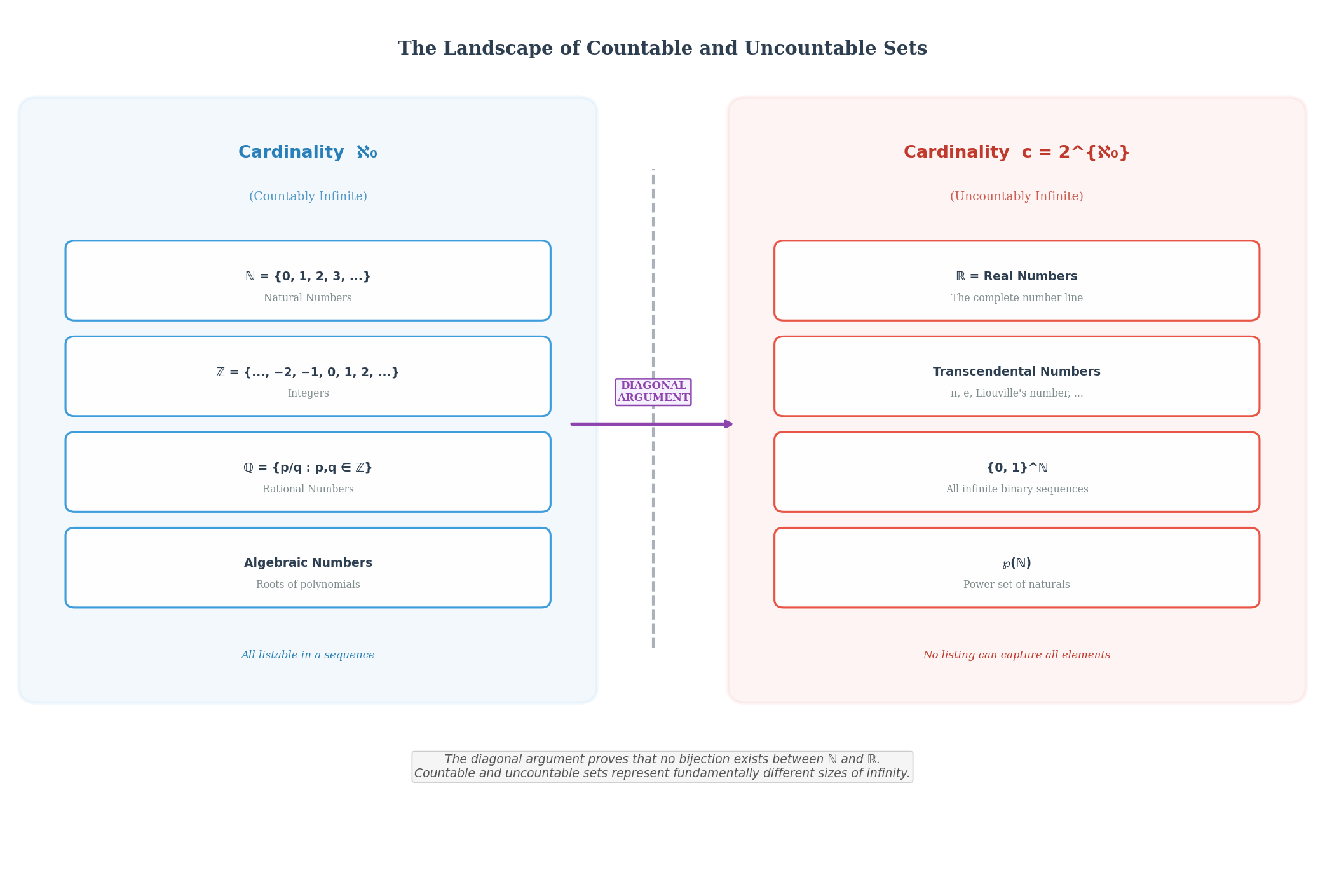
The proof establishes something that may not be fully absorbed on first encounter: it shows not merely that the real numbers are infinite, but that they are a strictly larger infinity than the natural numbers. The cardinality of ℝ is denoted 𝔠, the cardinality of the continuum, and it equals 2ℵ₀, because each real number in [0,1] can be represented as an infinite binary sequence, and the collection of all such sequences has cardinality 2ℵ₀. The equation 𝔠 = 2ℵ₀ > ℵ₀ is the first proof in human history that there are multiple sizes of infinity.
The Subtleties of the Construction
The diagonal argument is elegant but not without technical pitfalls. The most important concerns the non-uniqueness of decimal representations: certain real numbers have two distinct infinite decimal expansions. For example, 0.5000… = 0.4999… and more generally any terminating decimal equals an expansion ending in repeated nines. A naive diagonal construction might produce a number that appears absent from the list under one representation while being present under its alternative representation.
The standard remedy is to restrict the digits of the constructed number to a two-element set that avoids both 0 and 9. Define dₙ = 3 if dₙₙ ≠ 3, and dₙ = 5 if dₙₙ = 3. The resulting number consists entirely of threes and fives, so it is never a terminating decimal and never ends in repeated nines. Its decimal representation is unique, and any number that differs from it in even a single decimal place genuinely represents a different real number. With this choice, the construction is fully rigorous: for every n, dₙ ≠ dₙₙ, and the number d has a unique expansion that matches no row of the array.
The significance of this technicality extends beyond mere housekeeping. It illustrates a recurring theme in the theory of the infinite: arguments that seem straightforward in the finite case require careful handling in the infinite case, where the structure of infinite representations introduces subtleties that have no finite analogue. The dual-representation problem for decimals is one instance of a broader phenomenon: infinite objects can be equal in value while differing in representation, and any proof that constructs infinite objects must account for this possibility.
The Landscape of the Countable and the Uncountable
Algebraic Numbers and Their Countability
The diagonal argument draws a sharp line between countable and uncountable sets, but where exactly does this line fall? The algebraic numbers provide a crucial data point. A real number is algebraic if it is the root of some polynomial with integer coefficients: √2 is algebraic (satisfying x² - 2 = 0), the golden ratio φ = (1+√5)/2 is algebraic (satisfying x² - x - 1 = 0), and every rational number p/q is algebraic (satisfying qx - p = 0). The algebraic numbers include every number that can be expressed using the four arithmetic operations and root extractions, a vast and richly structured collection.
Yet the algebraic numbers are countable. The argument proceeds in layers, each invoking a closure property of countable sets. For each degree n, the polynomials of degree n with integer coefficients are determined by n+1 integer coefficients, so the set of such polynomials is a subset of ℤⁿ⁺¹, which is countable (as a finite product of countable sets). Each polynomial of degree n has at most n real roots, by the fundamental theorem of algebra. So the algebraic numbers arising from degree-n polynomials form a countable set, being at most a finite multiple of a countable set. The full set of algebraic numbers is the union over all degrees n = 1, 2, 3, … of these countable sets, and a countable union of countable sets is countable, by the same diagonal argument that proved the rationals countable. Therefore |algebraic numbers| = ℵ₀, and the algebraic numbers, despite encompassing every number expressible by radicals from the integers, sit on the same side of the countable-uncountable divide as the natural numbers and the rationals.
Transcendental Numbers and the Weight of the Continuum
If the algebraic numbers are countable and the reals are uncountable, then the non-algebraic real numbers, the transcendental numbers, must be uncountable. This is a simple set-theoretic argument: ℝ is the union of the algebraic and transcendental reals, the algebraic part is countable, and the whole is uncountable, so the transcendental part must be uncountable. The transcendental numbers are not rare curiosities scattered thinly among the algebraic numbers; they constitute, in the cardinality sense, almost all of the real line.
Identifying specific transcendental numbers, however, is far harder than proving they exist in abundance. Joseph Liouville constructed the first explicit transcendental number in 1844, a decimal whose pattern of digits (ones separated by rapidly increasing stretches of zeros) allows it to be approximated by rationals far more closely than any algebraic number can be. Charles Hermite proved in 1873 that e is transcendental, and Ferdinand von Lindemann proved in 1882 that π is transcendental, a result that immediately settled the ancient problem of squaring the circle: since π is not a root of any polynomial with integer coefficients, it cannot be constructed with compass and straightedge, and the geometric construction the Greeks sought for two thousand years is provably impossible.
Despite these celebrated examples, almost nothing is known about whether specific combinations of known constants are transcendental. Whether e + π, e · π, or πᵉ is transcendental, rational, or algebraic remains unknown. Cantor's argument guarantees that transcendental numbers overwhelmingly outnumber algebraic ones, yet explicitly exhibiting even a single transcendental number requires substantial analytic work. The transcendentals are everywhere and almost always invisible, a strange conjunction that underscores the gap between cardinality arguments, which tell you how many objects of a given type exist, and constructive arguments, which tell you where to find them.
Lebesgue Measure and the Two Faces of Size
Cardinality is one way to measure the size of a set, but it is not the only one. For subsets of the real line, Henri Lebesgue introduced in the early twentieth century a notion of measure that generalises the intuitive concept of length. The Lebesgue measure μ assigns to each sufficiently well-behaved subset of ℝ a non-negative number representing its "length" or "volume." For an interval [a, b], μ([a, b]) = b - a. For a finite set, μ = 0. For a countable set, μ = 0 as well, because a countable set can be covered by intervals of total length ε for any ε > 0, by assigning an interval of length ε / 2ⁿ around the n-th element.
This means that the rational numbers in [0,1], though countably infinite and dense, have Lebesgue measure zero. They occupy no "space" on the real line in the measure-theoretic sense. A randomly chosen real number in [0,1] is rational with probability exactly zero. By the same reasoning, the algebraic numbers have measure zero. The transcendental numbers, by contrast, have measure one: they account for all of [0,1] in the sense of Lebesgue measure.
The measure-theoretic perspective and the cardinality perspective are complementary but genuinely distinct. A set can be uncountable yet have Lebesgue measure zero: the Cantor set, a fractal subset of [0,1] constructed by iteratively removing middle thirds of intervals, is uncountable (it has cardinality 𝔠, the same as the full real line) yet has Lebesgue measure zero, occupying no length at all. The Cantor set demonstrates that uncountability and positive measure are independent properties: you can have one without the other. Conversely, a set can have full measure while being topologically nowhere dense, failing to contain any interval however small. Cardinality answers the question "how many elements does this set have?" and Lebesgue measure answers the question "how much space does it occupy on the number line?" For the real line, these are genuinely different questions with genuinely different answers, and understanding both is essential to navigating the landscape of infinite sets.
Hilbert's Hotel and the Power Set Ladder
Hilbert's Hotel and Its Rooms
David Hilbert, one of the most influential mathematicians of the early twentieth century and a passionate defender of Cantor's work, popularised a thought experiment that makes the strange arithmetic of ℵ₀ vivid and unforgettable. Imagine a hotel with infinitely many rooms, numbered 1, 2, 3, …, all occupied. A new guest arrives. The manager asks every current guest to move to the room with the next number: the guest in room n moves to room n + 1. Room 1 is now vacant, and the new guest is accommodated without displacing anyone. The "full" hotel has absorbed a new guest because the bijection n ↦ n+1 shifts every occupant while freeing a room.
The situation escalates. A bus carrying countably many passengers arrives. The manager asks each guest to move to the room with twice their current number: the guest in room n goes to room 2n. All odd-numbered rooms are now empty, and the infinite bus is accommodated by assigning bus passenger k to room 2k - 1. This implements the identity ℵ₀ + ℵ₀ = ℵ₀: two countably infinite sets interleaved into one. When infinitely many buses, each carrying infinitely many passengers, arrive simultaneously, the manager uses the Cantor pairing function or a prime-based encoding to assign every passenger from every bus a unique room, implementing ℵ₀ × ℵ₀ = ℵ₀. One elegant method assigns the guest in seat n of bus m to room 2ᵐ · 3ⁿ; by the uniqueness of prime factorisation, no two passengers receive the same room. A more efficient method uses the pairing function directly, wasting no rooms at all.
The Hotel thought experiment has a sharp boundary, however. If an uncountably infinite group of guests arrives, no rearrangement can accommodate them all. The rooms are indexed by ℕ, and any assignment of guests to rooms is a function from the guest set into ℕ, which can accommodate at most countably many guests. The diagonal argument guarantees that an uncountable set cannot be placed in bijection with any countable set. Hilbert's Hotel is a playground for countable infinity; the uncountable realm is structurally beyond its reach.
The Power Set and Cantor's General Theorem
To ascend beyond ℵ₀ in a systematic way, Cantor identified a construction that generates a strictly larger set from any given set: the power set. For any set A, the power set 𝒫(A) is the collection of all subsets of A. If A = {1, 2, 3}, then 𝒫(A) has 2³ = 8 elements: the empty set, three singletons, three pairs, and A itself. For a finite set of n elements, |𝒫(A)| = 2ⁿ, which grows exponentially. For an infinite set, the growth is even more dramatic.
Cantor's theorem, in its general form, states that for any set A, whether finite or infinite, |𝒫(A)| > |A|. The proof is a direct generalisation of the diagonal argument. Suppose f: A → 𝒫(A) were a bijection. Define the set D = {x ∈ A : x ∉ f(x)}, the set of all elements of A that are not members of their own image under f. Since D is a subset of A, we have D ∈ 𝒫(A), so by the assumed surjectivity of f, some element d ∈ A satisfies f(d) = D. But then asking whether d ∈ D produces a contradiction in either case: if d ∈ D, then by definition d ∉ f(d) = D; if d ∉ D, then d satisfies the membership condition for D, so d ∈ D. This contradiction shows no bijection from A to 𝒫(A) can exist, and since the map x ↦ {x} provides an injection from A into 𝒫(A), we conclude |𝒫(A)| > |A|.
For A = ℕ, the theorem gives |𝒫(ℕ)| > ℵ₀. And since each subset of ℕ can be encoded as an infinite binary sequence (placing a 1 in position n if n belongs to the subset and a 0 otherwise), the set of all subsets of ℕ has cardinality 2ℵ₀ = 𝔠 = |ℝ|. The connection is worth savouring: every subset of ℕ corresponds to a unique infinite binary string, and every infinite binary string corresponds to a unique real number in [0,1] (its binary expansion). The power set of ℕ, the real number line, and the set of all infinite binary sequences are three descriptions of the same mathematical object, three perspectives on the same cardinality. The real line, the central object of calculus and analysis, the number system that underpins physics and engineering, is nothing other than the power set of the natural numbers in disguise.
The Infinite Tower of Cardinals
Cantor's theorem, applied iteratively, produces an unending ascent of infinite cardinalities. Starting from ℕ with cardinality ℵ₀, one application gives 𝒫(ℕ) with cardinality 2ℵ₀ > ℵ₀. A second application gives 𝒫(𝒫(ℕ)) with cardinality 22ℵ₀ > 2ℵ₀. Each step produces a strictly larger infinity, and the steps never terminate. There is no largest infinity, because given any set, no matter how enormous, its power set is larger.
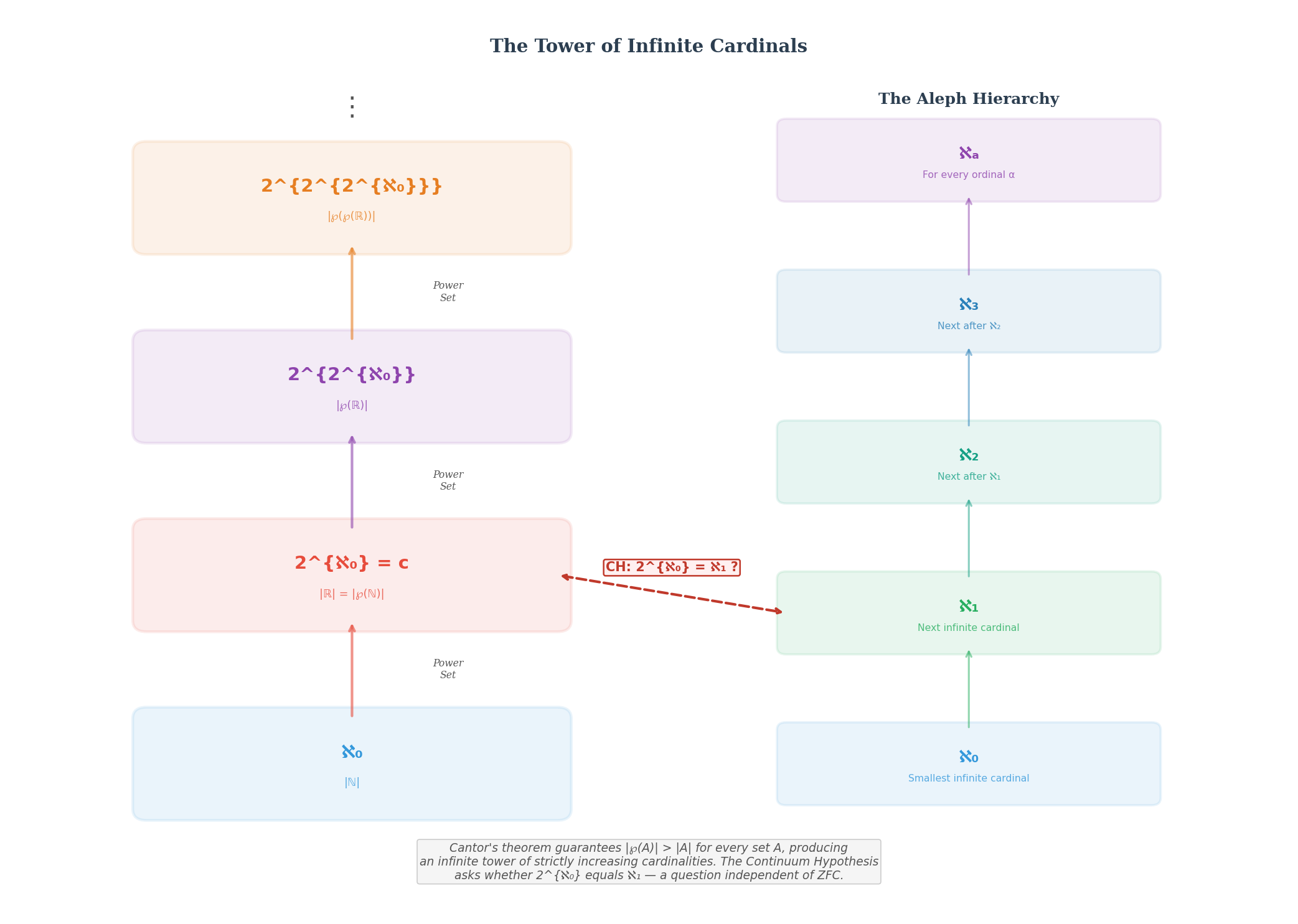
Cantor organised this hierarchy using the aleph notation. The smallest infinite cardinal is ℵ₀. The next smallest infinite cardinal, the smallest cardinal strictly greater than ℵ₀, is denoted ℵ₁. Then comes ℵ₂, then ℵ₃, and so on: for each ordinal α, there is a corresponding infinite cardinal ℵα. The alephs form a well-ordered sequence of all infinite cardinalities, mirroring the way the natural numbers form a well-ordered sequence of all finite cardinalities. The infinite, which Aristotle and Gauss and Cauchy had treated as a single, homogeneous beyond, turns out to be infinitely stratified, a hierarchy within a hierarchy, a structure as intricate and differentiated as the finite numbers it was once contrasted with.
This is perhaps the single most stunning result in the entire theory. The naive picture of infinity as one thing, a featureless immensity past the last number, is replaced by a landscape of infinities, each dwarfing the last, extending upward without bound. The infinite is not the opposite of the structured; it is itself structured, layered, and rich beyond anything the two-thousand-year tradition of treating it as a simple negation of finitude had suggested.
Cantor's Legacy and the Horizon Beyond
Opposition and Vindication
Cantor's theory was not received with the acclaim it deserved. Leopold Kronecker, one of the most powerful figures in German mathematics, was a committed finitist who believed mathematics should concern itself only with finitely constructible objects. He called Cantor a "corrupter of youth" and worked to block his publications and academic advancement. Henri Poincare, the leading French mathematician of the era, called set theory "a disease from which mathematics will one day recover." Ernst Mach was dismissive. The mathematical establishment was, at best, indifferent and, at worst, actively hostile.
There were sympathisers, and their influence grew as the decades passed. Richard Dedekind corresponded extensively with Cantor and appreciated the depth of his work, contributing his own foundational insights about the nature of numbers and continuity. Karl Weierstrass, Cantor's former teacher, was more receptive than many contemporaries, though even he expressed reservations about the more extreme implications of transfinite arithmetic. Gottlob Frege found Cantor's ideas congenial with his own logicist programme, which sought to reduce all of mathematics to pure logic. Bertrand Russell, encountering the diagonal argument as a young philosopher-mathematician, was electrified by its implications and would go on to play a central role in the foundational crisis that Cantor's work helped to precipitate. And David Hilbert, more than anyone, grasped the magnitude of what Cantor had achieved. His declaration, "No one shall expel us from the paradise that Cantor has created," was not rhetorical flourish; it was a statement of mathematical conviction, delivered in full awareness of the controversy it endorsed. Hilbert placed the Continuum Hypothesis at the very top of his famous list of twenty-three unsolved problems in 1900, signalling to the mathematical world that Cantor's questions were not peripheral curiosities but central challenges for the discipline.
Cantor himself paid a heavy personal price for his revolutionary work. He suffered recurrent depressive episodes from 1884 onward and spent extended periods in sanatoriums. The professional hostility he faced, the intractability of the Continuum Hypothesis that consumed his later years, and personal losses including the death of his youngest son all took their toll. He never obtained the prestigious Berlin professorship he sought, spending his entire career at the less prominent University of Halle. He died in a sanatorium in Halle in January 1918, largely unrecognised by the mathematical establishment he had transformed. Within a generation, his work would become the foundation on which all of modern mathematics is built, and the notation and concepts he introduced, from aleph numbers to the diagonal argument, would be taught in every university mathematics department in the world.
The Continuum Hypothesis and Hilbert's First Problem
Having established that ℵ₀ < 𝔠 = 2ℵ₀, and that the alephs form an ascending sequence ℵ₀ < ℵ₁ < ℵ₂ < …, Cantor confronted a natural and apparently straightforward question: where does 𝔠 sit in the aleph hierarchy? Is 𝔠 = ℵ₁, meaning there is no infinity between the countable and the continuum? Or is 𝔠 = ℵ₂, or some larger aleph, with intermediate infinities lurking between ℵ₀ and 𝔠?
Cantor's conjecture was that 𝔠 = ℵ₁: that the cardinality of the continuum is the very next infinite cardinal after ℵ₀, with nothing in between. This conjecture is the Continuum Hypothesis, and it can be stated in several equivalent ways. There is no set S with ℵ₀ < |S| < 2ℵ₀. Equivalently, every infinite subset of ℝ is either countable or has the same cardinality as ℝ itself. Cantor spent years attempting to prove the hypothesis, without success, and the effort contributed to his mental decline.
The Continuum Hypothesis became the first of the twenty-three famous problems that Hilbert presented to the International Congress of Mathematicians in Paris in 1900, a list that defined the agenda for twentieth-century mathematics. Its resolution would take more than sixty years and would involve two of the most extraordinary results in the history of logic: Kurt Godel's proof in 1938 that the hypothesis is consistent with the standard axioms of set theory, meaning you cannot disprove it, and Paul Cohen's proof in 1963 that it is independent of those axioms, meaning you cannot prove it either. The Continuum Hypothesis can be neither proved nor disproved from the axioms that underpin virtually all of modern mathematics. It is not merely unsolved; it is, in a precise technical sense, unsolvable within the standard framework of Zermelo-Fraenkel set theory with the Axiom of Choice. Whether there exists an infinity between ℵ₀ and 𝔠 is a question that the axioms of mathematics, as currently formulated, simply cannot answer. The implications of this independence, and the philosophical questions it raises about the nature of mathematical truth, about whether mathematics is discovered or invented, and about whether the set-theoretic universe is a single determinate reality or a multiverse of equally valid possibilities, belong to later material in this series.
The Diagonal Method as a Universal Engine
The diagonal argument is not merely a clever technique for proving one theorem about the real numbers. It is a fundamental pattern in the logic of self-reference, a method that generates new objects by systematically differing from every member of a given enumeration, and it recurs throughout the deepest results in mathematics and logic.
Alan Turing's 1936 proof that the halting problem is undecidable follows exactly the diagonal pattern. Suppose a program H could determine, for any program P and input w, whether P halts on w. Construct a new program D that, given a program P as input, runs H(P, P) and does the opposite: halts if H says P loops, loops if H says P halts. Then ask whether D halts on input D. Either answer leads to contradiction, precisely mirroring Cantor's construction of a real number that differs from every listed real. Kurt Godel's incompleteness theorems of 1931 use an arithmetised version of the same self-referential construction, encoding the statement "I am not provable" within the language of arithmetic via the technique of Godel numbering. Cantor's theorem, Godel's theorem, and Turing's theorem are, at the deepest structural level, the same result in different mathematical clothing: a demonstration that any sufficiently rich system, when it attempts to enumerate or capture its own outputs, inevitably produces something that escapes the enumeration.
This universality is what elevates the diagonal argument from a theorem about real numbers to a foundational principle of mathematics and logic. It stands as the connecting thread between Cantor's paradise of multiple infinities, Godel's revelation of the inherent incompleteness of formal systems, and Turing's discovery of the absolute limits of computation. The paradoxes that arise when a system tries to describe itself, the contradictions that surface when self-reference is unrestrained, and the independence results that show certain questions to be unanswerable within standard axioms are all manifestations of the same deep pattern. The diagonal idea also connects backward to the foundations crisis that shook mathematics in the early twentieth century: Bertrand Russell's paradox of 1902, which showed that the naive comprehension principle underlying Cantor's original set theory leads to outright contradiction, is itself a diagonal construction. The set of all sets that do not contain themselves applies the membership predicate to itself, just as the diagonal argument applies the enumeration to its own output. The crisis that Russell's paradox triggered, and the axiomatic reconstruction of set theory that followed, would reshape the foundations of the entire discipline, providing the formal framework within which Cantor's paradise could be made rigorous and secure. The story of infinity does not end with the hierarchy of cardinals; it opens outward into the foundations of all mathematics, into the limits of formal proof and mechanical computation, and the diagonal argument is the key that unlocks every door along the way.