Every claim to knowledge rests on something. When you say you know that the Earth orbits the Sun, or that water boils at one hundred degrees Celsius at sea level, or that your friend is trustworthy, you are not merely expressing a hunch or a preference. You are asserting something stronger: that you have reason to hold the belief, that the belief connects to reality in a way that mere guessing does not, and that you could, if pressed, say something about why you hold it. The groundwork for understanding what knowledge requires — justified true belief, at minimum — was laid by the Gettier problem and its aftermath, which showed how difficult it is to specify those requirements precisely. Reliabilism, tracking accounts, safety conditions, and virtue epistemology each attempted to close the gap that Gettier had opened, and each revealed new complications.
This material turns the lens inward, toward the machinery that sits beneath those accounts. What does it actually mean to believe something? Is belief an all-or-nothing commitment, or does it come in degrees that shift as new evidence arrives? What counts as evidence, and how should evidence change what you think? When you justify a belief by pointing to another belief, and that belief to another, and that to another still, where does the chain end — or does it? These are not idle puzzles. They shape the architecture of every theory of knowledge, and they determine what it means, in practice, to be a rational thinker navigating a world of uncertain information. The six sections that follow trace these questions from the formal elegance of Bayesian reasoning through the tangled philosophy of perception to the practical epistemology of science, mathematics, and everyday life.
Belief by Degrees: The Bayesian Framework
From Certainty to Credence
The traditional picture of belief, inherited from the classical analysis of knowledge, treats believing as something you either do or do not do. You believe that it will rain tomorrow, or you do not. You believe that Caesar crossed the Rubicon, or you do not. This binary picture has a certain simplicity, but it sits uncomfortably with the way people actually think. Most of the time, when you hold a belief, you hold it with a degree of confidence that falls somewhere between absolute certainty and total agnosticism. You might be quite confident it will rain tomorrow because you checked the forecast, somewhat confident that your colleague will arrive on time because she usually does, and only mildly confident that the restaurant you have never visited will be good because a single acquaintance recommended it. These are not different beliefs in kind; they are different degrees of the same cognitive attitude.
Epistemologists formalise this observation using the concept of credence, sometimes called degree of belief or subjective probability. Your credence in a proposition is a number between zero and one that represents how confident you are in its truth. A credence of one means you are certain the proposition is true; a credence of zero means you are certain it is false; a credence of 0.5 means you regard it as equally likely to be true or false. The Bayesian framework, named after the eighteenth-century mathematician and clergyman Thomas Bayes, takes credences as the fundamental objects of epistemology and asks how a rational agent should update them in response to new evidence.
The shift from binary belief to credences is not merely a technical refinement. It changes the questions epistemology asks. Instead of asking whether a belief is justified or unjustified, the Bayesian asks whether a credence is well-calibrated — whether the confidence you place in a proposition is proportionate to the evidence you have for it. Instead of asking whether you know something, the Bayesian asks how your confidence should change when you learn something new. This reframing dissolves some traditional puzzles and sharpens others, and it has become one of the most influential frameworks in contemporary epistemology, decision theory, and the philosophy of science.
Bayes' Theorem and the Logic of Updating
The core of the Bayesian framework is a theorem of probability theory that specifies exactly how credences should change in response to new evidence. Bayes' theorem states that the probability of a hypothesis H given evidence E is
Each term in this equation has a name and a role. P(H) is the prior probability — your credence in the hypothesis before you encounter the new evidence. P(E | H) is the likelihood — the probability that you would observe the evidence if the hypothesis were true. P(E) is the total probability of the evidence, calculated by summing over all competing hypotheses. And P(H | E) is the posterior probability — your credence in the hypothesis after you have taken the evidence into account. The theorem tells you how to compute the posterior from the prior, the likelihood, and the total evidence.
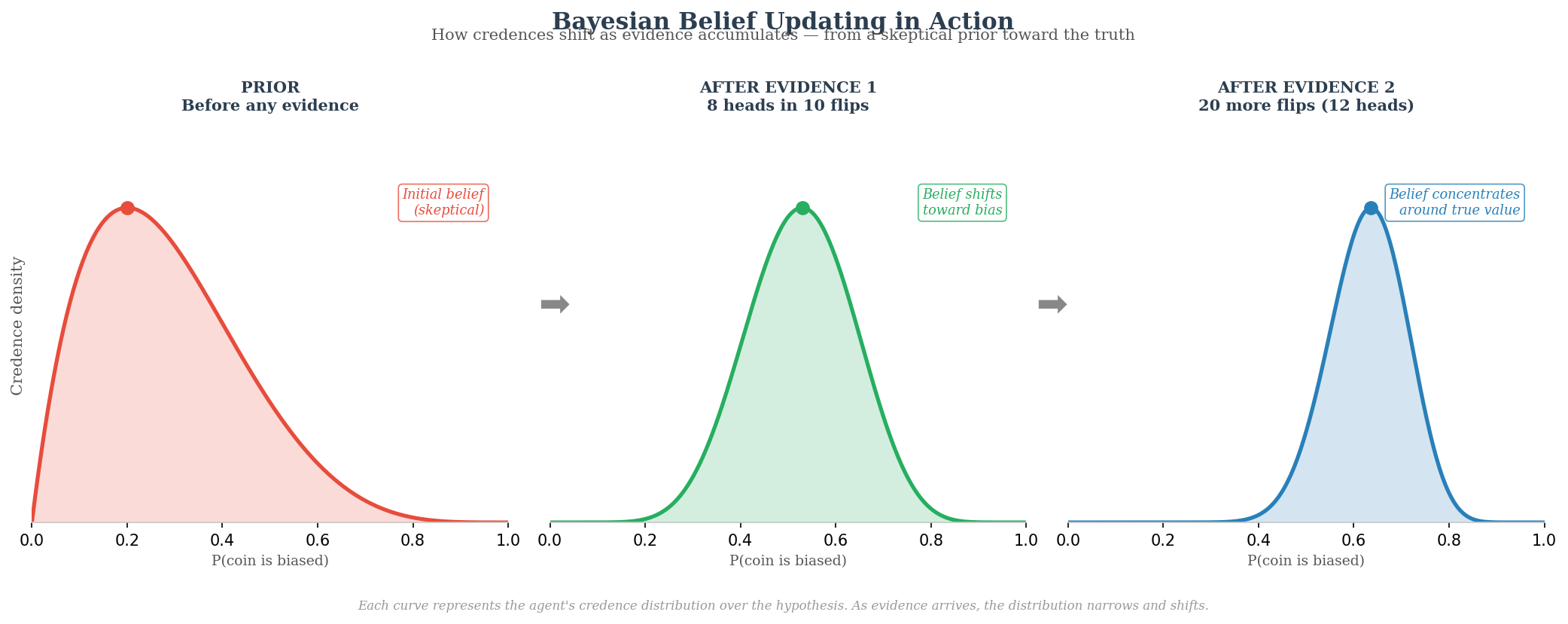
Consider a concrete example. Suppose you are wondering whether a particular coin is fair (hypothesis HF: the coin has a 50-50 chance of heads) or biased toward heads (hypothesis HB: the coin lands heads 80 percent of the time). Before flipping the coin, you think it is probably fair — your prior is P(HF) = 0.9 and P(HB) = 0.1. You flip the coin ten times and get eight heads. The likelihood of eight heads in ten flips under a fair coin is about 0.044, while under a biased coin it is about 0.302. Plugging these into Bayes' theorem, the posterior probability of the biased hypothesis rises substantially — from 0.1 to roughly 0.43. A single run of evidence has not made you certain, but it has shifted your confidence in a precise, quantifiable way.
What makes Bayes' theorem powerful is not just the arithmetic but the normative claim that accompanies it: a rational agent ought to update credences in this way. This is the doctrine of Bayesian conditionalization. It says that the only rational response to new evidence is to update your prior by the formula above, and that any other response — ignoring the evidence, overweighting it, or adjusting by gut feeling rather than calculation — is a departure from ideal rationality. The Bayesian agent is, in this sense, a perfectly calibrated learning machine: she starts with whatever credences her initial evidence supports, and she adjusts them systematically as new data comes in.
Priors, Subjectivity, and the Problem of the Starting Point
The most persistent objection to Bayesian epistemology concerns the priors — the credences you bring to the table before any evidence has been encountered. Bayes' theorem tells you how to update, but it does not tell you where to start. If you begin with a prior of 0.9 that the coin is fair and I begin with a prior of 0.1, our posteriors after the same evidence will differ. Over time, with enough evidence, our credences will converge — this is a mathematical result known as the merging-of-opinions theorem — but in the short run, the choice of prior matters enormously, and Bayes' theorem itself is silent on what the right prior is.
This silence has struck many philosophers as a serious problem. If the prior is subjective — if it simply reflects whatever confidence the agent happens to start with — then Bayesian reasoning is merely a machine for processing prejudice. Two agents with different priors, both updating by Bayes' theorem, can look at the same evidence and reach opposite conclusions. This seems to violate the intuition that rationality should produce agreement, at least among agents who share the same evidence.
Bayesians have responded in several ways. Some embrace the subjectivity of priors and argue that the convergence theorem is sufficient: in the long run, the evidence will overwhelm any reasonable starting point, and all rational agents will converge on the same credences. Others have proposed constraints on priors — principles like the principle of indifference, which says you should assign equal credence to all possibilities when you have no reason to favour one over another, or the principle of maximum entropy, which says you should choose the prior that is maximally uncommitted given your background information. Still others have argued that the prior should be understood not as a subjective psychological state but as an objective feature of the evidential situation — a view sometimes called objective Bayesianism. The debate is unresolved, but the practical power of the Bayesian framework remains enormous, and its influence on epistemology, statistics, artificial intelligence, and the philosophy of science continues to grow.
The Architecture of Justification
Internalism and the Access Condition
When you justify a belief, you point to reasons. But what kind of access must you have to those reasons for the justification to count? This question divides epistemologists into two broad camps. Internalists hold that justification depends on factors that are internal to the believer's perspective — factors the believer can, in principle, become aware of through reflection alone. If your justification for believing that it is raining is your perceptual experience of seeing rain through the window, an internalist will say that the justification is constituted by the experience itself, which is available to you through introspection. You do not need to know anything about the causal chain that produced the experience, or about the reliability of your visual system, or about the physical properties of rain. What matters is that you have a reason, and that the reason is accessible to you from the inside.
The appeal of internalism is that it respects the intuition that justification is something you can be held responsible for. If justification depended on factors entirely outside your awareness — factors you could not detect, reflect on, or articulate — then it would seem odd to praise or blame you for the quality of your epistemic conduct. Internalism preserves the connection between justification and epistemic responsibility: a justified believer is one who has done their epistemic duty by forming beliefs on the basis of reasons they can identify and evaluate.
The challenge for internalism is that it seems to exclude forms of justification that many epistemologists find perfectly legitimate. Consider the case of a young child who perceives a cat and forms the belief that there is a cat in front of her. The child has no conception of perceptual reliability, no understanding of the optics of vision, and no ability to articulate why her perceptual experience constitutes a reason for her belief. On a strict internalist account, the child's belief might lack justification, since the child cannot access the justificatory basis through reflection. Yet most epistemologists would say the child knows there is a cat — her belief is true, her perception is functioning properly, and nothing has gone epistemically wrong. Cases like this motivate the externalist alternative.
Externalism and the Reliability Requirement
Externalists hold that justification can depend on factors external to the believer's perspective — factors the believer need not be aware of or able to articulate. The most influential form of externalism is reliabilism, introduced by Alvin Goldman. On Goldman's account, a belief is justified if it is produced by a reliable cognitive process — one that tends to produce true beliefs and avoid false ones. The child who perceives the cat and forms the true belief that there is a cat is justified because her visual system is reliable, regardless of whether she knows or can reflect on the fact that it is reliable.
Externalism has the advantage of accommodating the knowledge we attribute to children, animals, and unreflective adults who form true beliefs through well-functioning cognitive processes without being able to articulate the basis of their justification. It also fits naturally with the scientific picture of cognition, which treats belief-formation as a causal process that can be evaluated for reliability in much the same way that a thermometer or a blood-pressure monitor can be evaluated for accuracy. A reliable process produces good results; an unreliable process does not; and the quality of the process is what matters, not the agent's awareness of it.
The challenge for externalism is the mirror image of the challenge for internalism. If justification does not require the believer to have any access to the factors that make their belief justified, then it becomes difficult to explain why epistemic reflection matters at all. The clairvoyant who reliably forms true beliefs about distant events through an entirely mysterious process would count as justified on a simple reliabilist account, even if she has no evidence for the reliability of her clairvoyance and every reason to doubt it. This consequence strikes many philosophers as unacceptable, since it severs the connection between justification and the kind of reflective self-awareness that seems central to the epistemic life of rational agents. The debate between internalism and externalism is not merely a technical dispute within epistemology; it concerns what we think justification is for, and what role the believer's own perspective plays in the story of how knowledge is achieved.
The Regress Problem and Its Four Resolutions
Every justified belief appears to rest on other beliefs. You believe that it will rain because you believe the forecast is reliable; you believe the forecast is reliable because you believe meteorological science has a good track record; you believe this because you believe in the general reliability of well-confirmed scientific methods. But what justifies that belief? And what justifies whatever justifies that? The chain of justification, when you pull on it, seems to extend indefinitely, and this generates the regress problem — one of the oldest and most persistent puzzles in the theory of knowledge.
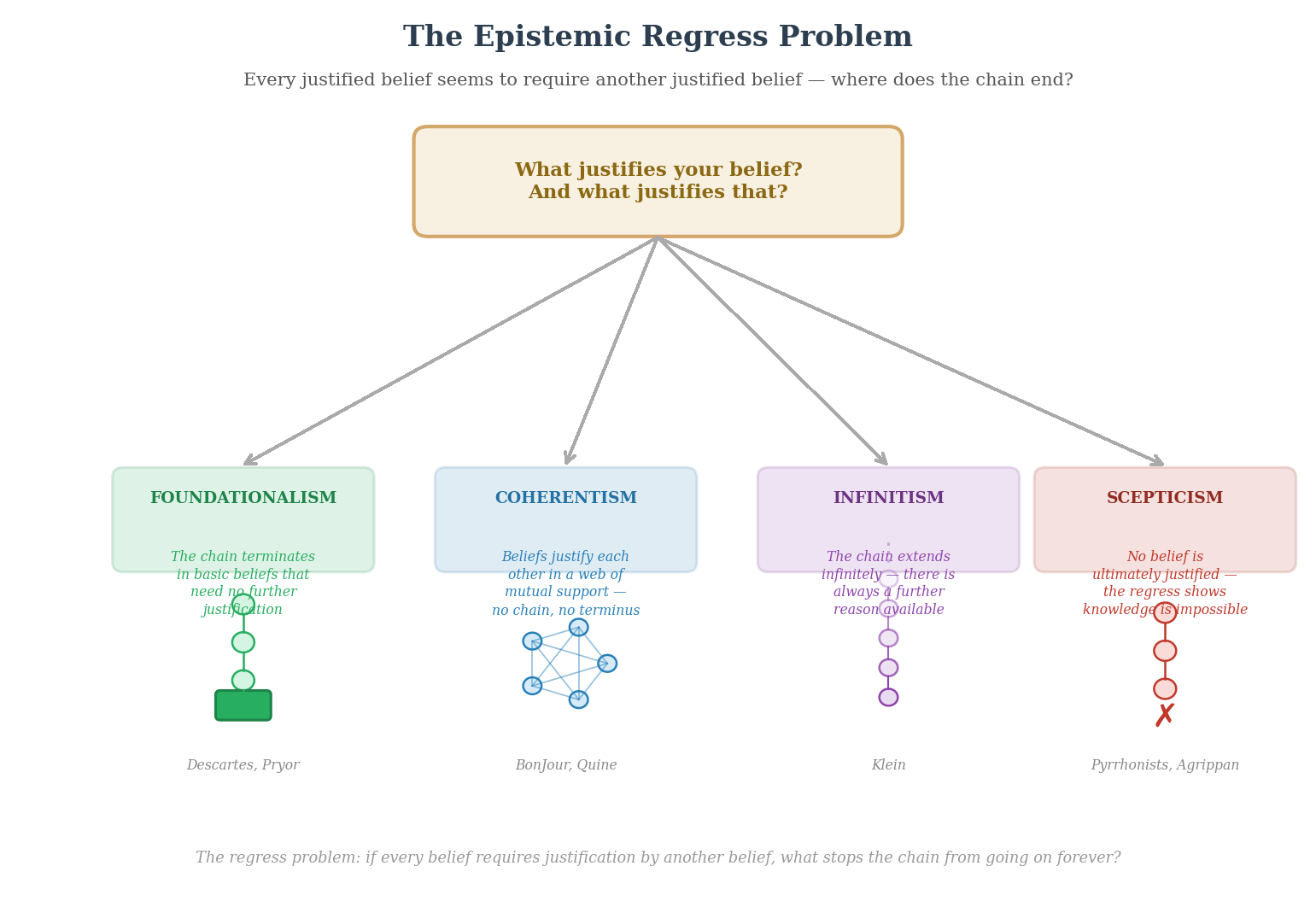
The problem admits exactly four logical possibilities, and each has been defended by serious philosophers. The first is infinitism, which accepts that the chain of justification extends infinitely and argues that this is not a defect but a feature. The infinitist holds that there is always a further reason available, and that justification consists in the availability of reasons all the way down, even if no finite agent can actually traverse the entire chain. Peter Klein is the most prominent contemporary defender of this view, arguing that what matters is the disposition to offer further reasons when challenged, not the actual completion of an infinite series. Critics object that an infinite chain is no more comforting than no chain at all — if no reason is ultimately self-supporting, the whole structure floats.
The second possibility is foundationalism, which holds that the chain of justification terminates in basic beliefs — beliefs that are justified without needing further justification from other beliefs. These basic beliefs serve as the foundation on which all other justified beliefs rest. Candidates for basic beliefs include perceptual experiences (my visual experience of red justifies my belief that something red is before me), self-evident truths (the law of non-contradiction), and introspective reports (I am in pain). Classical foundationalism, associated with Descartes, required the basic beliefs to be infallible and incorrigible. Modern foundationalism, associated with philosophers like James Pryor, is more modest: basic beliefs need not be certain, only prima facie justified — justified unless and until a defeater comes along.
The third possibility is coherentism, which denies that justification has the linear structure the regress assumes. On the coherentist picture, beliefs are justified not by standing at the end of a chain but by fitting into a web of mutually supporting beliefs. No single belief is the foundation; instead, the justification of any given belief derives from its coherence with the rest of the belief system. Laurence BonJour developed this position in detail, arguing that coherence involves not merely logical consistency but explanatory integration — beliefs that explain each other, that make each other more probable, and that form a comprehensive and unified picture of the world. Critics of coherentism worry about the isolation problem: a perfectly coherent set of beliefs might be entirely disconnected from reality, like a well-constructed novel that is internally consistent but entirely fictional.
The fourth possibility is scepticism about justification — the conclusion that no belief is ultimately justified because the regress cannot be stopped. This is the possibility most epistemologists try to avoid, but it looms as a logical consequence if none of the other three positions is found satisfactory. The regress problem is not a puzzle to be solved once and set aside; it is a structural feature of the justificatory landscape that every theory of knowledge must confront.
The Philosophy of Perception
Direct Realism and the Transparency of Experience
Perception is the most immediate source of knowledge about the external world. You open your eyes and the world seems to present itself to you directly — the red of the apple, the hardness of the table, the warmth of the sunlight. This commonsense picture of perception is called direct realism or naive realism, and it holds that in ordinary perceptual experience, you are directly aware of mind-independent objects and their properties. There is no intermediary between you and the world; the apple you see is the apple itself, not a representation or image of it.
Direct realism has considerable intuitive appeal. It matches the phenomenology of perception — the way perception feels from the inside. When you see an apple, you do not feel as though you are inspecting a mental image of an apple; you feel as though you are seeing the apple. The philosopher J. L. Austin mounted a spirited defence of direct realism in his 1962 book Sense and Sensibilia, arguing that the arguments against it rested on confusions about the ordinary use of words like "real," "directly," and "perceive." More recently, philosophers like John Campbell and M. G. F. Martin have developed sophisticated versions of direct realism that attempt to preserve its core insight — that perception puts us in direct contact with the world — while accommodating the phenomena that seem to challenge it.
Those phenomena are not trivial. The argument from illusion points out that perceptual experience can misrepresent the world: a stick half-submerged in water looks bent; a distant mountain looks blue; a white wall lit by a red light looks red. In these cases, the way things appear differs from the way things are. If perception were simply a direct presentation of reality, it is hard to see how appearances could diverge from reality in this way. The argument from hallucination goes further: in a full-blown hallucination, the subject has an experience that is subjectively indistinguishable from genuine perception, even though there is no external object present at all. If a hallucination can be phenomenally identical to a veridical perception, what guarantee do we have that any perception is a direct encounter with reality rather than a mere appearance? A line of response developed by Martin and others, now usually called disjunctivism, denies the assumption that this similarity forces us to posit a common inner state. On this view a veridical perception and a matching hallucination are two fundamentally different kinds of occurrence that happen to be indistinguishable from the subject's own point of view; veridical perception is a relation to a mind-independent object, whereas hallucination is not, and the shared phenomenology is a fact about what the subject can tell rather than about what the two cases have in common.
Sense Data and the Retreat to the Inner Theatre
The problems of illusion and hallucination motivated a tradition in early twentieth-century philosophy that abandoned direct realism in favour of a theory of sense data. On this view, what you are directly aware of in perception is not the external object itself but a mental entity — a sense datum — that mediates between your mind and the world. When you see a red apple, your direct object of awareness is a red, apple-shaped sense datum; the apple itself is known only indirectly, as the probable cause of the sense datum. This view was held in various forms by Bertrand Russell, G. E. Moore (in some of his moods), and A. J. Ayer.
The sense-data theory had the advantage of explaining illusion and hallucination neatly. When the stick looks bent in water, your sense datum is genuinely bent, even though the stick is not; there is no error in your perception of the sense datum, only in your inference from the sense datum to the external world. When you hallucinate, you have a genuine sense datum with no corresponding external object; the sense datum itself is real even if nothing outside your mind corresponds to it.
One attempted repair was phenomenalism, which identified physical objects not with any single mental entity but with the permanent possibility of experience: to say that a table exists is to say that suitably placed observers would have the appropriate experiences, so that physical objects turn out to be logical constructions out of experience rather than mind-independent things standing behind it. But the costs of the sense-data theory were severe. It opened an unbridgeable gap between the perceiver and the world. If all you ever directly perceive are sense data — private, mental entities — then your knowledge of the external world must be inferred from these inner representations. But what could justify the inference? You have never perceived an external object directly, on this view, so you have no independent evidence that your sense data correspond to an external world at all. The sense-data theory seemed to lead inexorably toward the kind of scepticism about the external world that Descartes had raised and that most epistemologists desperately wished to avoid. The retreat to the inner theatre turned perception from a window onto the world into a screen that might or might not correspond to anything beyond it.
Sellars, the Myth of the Given, and Conceptual Perception
One of the most influential attacks on the sense-data tradition came from the American philosopher Wilfrid Sellars, whose 1956 essay "Empiricism and the Philosophy of Mind" introduced the phrase the myth of the given. Sellars argued that the foundationalist picture of perception — the picture on which raw, unconceptualised sensory experience provides a self-justifying foundation for empirical knowledge — rests on a confusion between causal and justificatory relations.
Sellars's argument proceeds as follows. For a perceptual experience to justify a belief, the experience must have propositional content — it must represent the world as being a certain way. But propositional content requires concepts: to perceive that something is red, you must possess the concept of redness and be able to locate the experience within a network of inferential relations (red things are not blue, red is a colour, this shade of red is darker than that shade). If this is right, then perception is never merely given; it is always already shaped by the conceptual resources the perceiver brings to the experience. There is no level of pure, unconceptualised awareness that could serve as an epistemically independent foundation. What we call perceptual experience is always already interpretation — not in the sense that we consciously interpret our sensory input, but in the sense that the very capacity to have perceptual experiences with content presupposes a background of conceptual competence.
Sellars's critique did not eliminate the problem of perception, but it shifted the terms of the debate decisively. After Sellars, it became much harder to maintain that perception provides a neutral, theory-free foundation for knowledge. Instead, philosophers had to reckon with the idea that perception and conceptual thought are intertwined from the start — that the world does not simply imprint itself on a passive mind, but is grasped by a mind already equipped with categories, expectations, and inferential dispositions. John McDowell developed this line of thought in his influential 1994 book Mind and World, arguing that perceptual experience is conceptual "all the way down" — that there is no nonconceptual layer of experience that could serve as an epistemic given. The philosophy of perception remains one of the most active areas of epistemology, precisely because the question of how perception connects the mind to the world is inseparable from the question of how knowledge of the external world is possible at all.
The Varieties of Reasoning
Deduction, Validity, and the Price of Certainty
Reasoning comes in several forms, and understanding the differences among them is essential for understanding how knowledge is built. The most familiar form is deductive reasoning, in which the conclusion follows necessarily from the premises. If the premises of a valid deductive argument are true, the conclusion must be true; there is no possible world in which the premises hold and the conclusion fails. The classic example is the syllogism: all humans are mortal; Socrates is a human; therefore Socrates is mortal. The conclusion is not merely probable or well-supported — it is guaranteed by the logical structure of the argument.
The certainty of deduction comes at a price, however. Deductive arguments are truth-preserving: they cannot generate conclusions that go beyond what is already contained, implicitly or explicitly, in the premises. This means that deduction is fundamentally conservative. It can make explicit what was implicit, draw out consequences, and reveal contradictions, but it cannot extend knowledge beyond what the premises already provide. To learn genuinely new things about the world — things not already implicit in what you know — you need a form of reasoning that goes beyond the information given. Deduction alone cannot do this. It can sharpen and systematise knowledge, but it cannot create it from raw observation.
This is why deduction, though indispensable, is only one part of the epistemic toolkit. The sciences do not proceed by deduction alone. They observe, hypothesise, test, and revise — a process that involves forms of reasoning that are not deductively valid but that nonetheless provide genuine evidential support for their conclusions. Understanding these non-deductive forms of reasoning, and understanding why they are rationally respectable despite their lack of deductive certainty, is one of the central tasks of epistemology.
Induction, Uniformity, and the Shadow of Hume
Inductive reasoning moves from particular observations to general conclusions. You observe that the Sun has risen every morning of your life, and you conclude that it will rise tomorrow. You observe that every sample of pure water you have tested freezes at zero degrees Celsius, and you conclude that pure water always freezes at zero degrees. These inferences are not deductively valid — it is logically possible that the Sun will not rise tomorrow, or that some sample of water will not freeze at zero — but they seem perfectly rational, and they provide the evidential foundation for virtually all of empirical science.
David Hume raised a devastating challenge to the rationality of inductive reasoning. The challenge is this: inductive reasoning presupposes the uniformity of nature — the assumption that unobserved cases will resemble observed cases, that the future will be like the past. But what justifies this assumption? You cannot justify it by deduction, because there is no logical contradiction in supposing that nature is not uniform. You cannot justify it by induction, because that would be circular — using induction to justify the presupposition on which induction depends. And there seems to be no third option. Therefore, Hume concluded, induction has no rational foundation. We engage in it out of psychological habit, not out of rational compulsion.
Philosophers have spent nearly three centuries trying to solve or dissolve Hume's problem. Karl Popper argued that science does not actually use induction at all; instead, it proceeds by conjecture and refutation, proposing bold hypotheses and attempting to falsify them. Hans Reichenbach offered a pragmatic justification: even if we cannot prove that induction will work, we can prove that if any method of prediction will succeed, induction will succeed at least as well. P. F. Strawson argued that the demand for a justification of induction is confused, because induction just is what we mean by rational inference from evidence — asking whether induction is rational is like asking whether the law is legal. The Bayesian framework offers yet another angle: induction can be understood as a special case of Bayesian updating, in which repeated observations of a regularity systematically raise the posterior probability of the corresponding generalisation. None of these responses has achieved universal acceptance, and the problem of induction remains one of the deepest unsolved problems in philosophy.
Abduction and Inference to the Best Explanation
A third form of reasoning, distinct from both deduction and induction, is abduction — also known as inference to the best explanation. In abductive reasoning, you begin with a puzzling observation and infer the hypothesis that, if true, would best explain it. The detective who finds footprints in the mud, a broken window, and a missing painting infers that a burglar entered through the window. The physician who observes a cluster of symptoms infers the disease that best explains them. The astronomer who observes the wobble of a distant star infers the existence of an unseen planet whose gravitational pull accounts for the wobble. In each case, the reasoning moves not from premises to a logically entailed conclusion, nor from particular observations to a general law, but from an observation to the hypothesis that would make the observation intelligible.
The philosopher Charles Sanders Peirce introduced the term abduction in the late nineteenth century, and the concept was subsequently developed under the name inference to the best explanation by Gilbert Harman and Peter Lipton. Lipton's 2004 book Inference to the Best Explanation argued that this form of reasoning is not merely a heuristic shortcut but a fundamental mode of rational inference, one that underlies not only everyday reasoning but also the methodology of science. When scientists choose between competing hypotheses, they do not simply count confirming instances (as a pure inductivist might suggest); they evaluate which hypothesis provides the most elegant, comprehensive, and fruitful explanation of the data. Simplicity, explanatory scope, coherence with established theory, and the capacity to generate novel predictions all contribute to what makes one explanation better than another.
Abduction faces its own philosophical challenges. The most pressing is the question of what makes an explanation good. If the best explanation is the one that is simplest, most comprehensive, and most coherent, then the quality of an abductive inference depends on substantive assumptions about the structure of the world — that the world is, in fact, simple rather than complex, that coherent explanations are more likely to be true than ad hoc ones, that nature prefers elegance to brute contingency. These assumptions are not self-evident, and their justification circles back to many of the same issues that plague the justification of induction. Nevertheless, abduction remains indispensable in practice, and understanding its logic is essential for anyone who wants to think clearly about how evidence supports theory.
Knowledge Beyond Propositions
Ryle's Distinction: Knowing How and Knowing That
The epistemological tradition surveyed so far has focused almost exclusively on propositional knowledge — knowledge that something is the case. You know that water is H₂O, that Paris is the capital of France, that the square root of nine is three. But the British philosopher Gilbert Ryle, in his 1949 book The Concept of Mind, argued that this focus was far too narrow. Alongside propositional knowledge, there exists a distinct and equally important category that Ryle called knowing how — the practical knowledge embodied in skills, abilities, and competences. A skilled pianist knows how to play a sonata; a native speaker knows how to form grammatical sentences; a seasoned chess player knows how to exploit a weak pawn structure. These forms of knowledge are genuine knowledge, but they are not, on Ryle's analysis, reducible to knowledge of propositions.
Ryle's argument was directed against what he called the intellectualist legend — the assumption that all intelligent action is guided by the prior contemplation of rules or propositions. On the intellectualist picture, the pianist who plays a sonata is first consulting an internal rule book that specifies which keys to press in which order, and then executing those instructions. Ryle pointed out that this picture generates a regress: if intelligent action requires the prior contemplation of a rule, then the contemplation of the rule is itself an intelligent act, which must require the prior contemplation of a further rule, and so on. The regress can be stopped only by admitting that some intelligent performances are not guided by the contemplation of propositions — that know-how is a form of knowledge in its own right, not a derivative of know-that.
The intellectualist challenge to Ryle has been revived in recent decades by philosophers like Jason Stanley and Timothy Williamson, who have argued that knowing how is, in fact, a species of knowing that — specifically, knowing that a certain way of doing something is a way of doing it. On this view, the pianist who knows how to play a sonata knows, of a particular way of moving her fingers, that this way is a way of playing the sonata. The debate is ongoing and technically intricate, but its significance for epistemology is clear: if know-how is genuinely distinct from propositional knowledge, then the theory of knowledge must be broadened considerably, and the conditions for knowledge — justification, truth, belief — may not apply to all forms of knowing in the same way.
Understanding as an Epistemic Achievement
In recent years, a growing number of epistemologists have argued that the traditional focus on knowledge has obscured an equally important epistemic state: understanding. You might know a set of facts about a phenomenon without understanding it, and you might understand a phenomenon in a way that goes beyond merely knowing facts about it. A student who has memorised the facts about photosynthesis — that plants convert carbon dioxide and water into glucose and oxygen using sunlight — knows those facts. But a student who understands photosynthesis grasps how the light reactions power the Calvin cycle, why chlorophyll absorbs specific wavelengths, and how the entire process fits into the broader web of biochemical energy transfer. Understanding involves seeing connections, grasping explanatory structures, and being able to answer why-questions, not just what-questions.
The philosopher Jonathan Kvanvig has argued that understanding is more valuable than knowledge and that epistemology has been impoverished by its almost exclusive focus on the latter. Kvanvig's 2003 book The Value of Knowledge and the Pursuit of Understanding contended that what we really care about, in most epistemic contexts, is not the accumulation of isolated items of knowledge but the achievement of a coherent, integrated grasp of a domain — the kind of grasp that enables you to explain, predict, and reason creatively within that domain. Understanding, on this view, is the higher epistemic achievement, and knowledge is merely one of the materials from which understanding is built.
Catherine Elgin has pushed this line of thought further, arguing that understanding need not even require truth in the strict sense. Scientific models, she points out, are almost always idealisations — simplified, distorted representations that deliberately omit or misrepresent certain features of reality in order to make other features perspicuous. The ideal gas law, for example, assumes that gas molecules have no volume and exert no intermolecular forces. These assumptions are false. Yet the ideal gas law provides genuine understanding of how pressure, volume, and temperature relate, precisely because its simplifications make the underlying relationships visible. If understanding required strict truth, then scientific models would provide no understanding at all, which seems absurd. Elgin's conclusion is that understanding is a factive attitude not toward individual propositions but toward explanatory structures — structures that can illuminate reality even when they simplify or idealise it.
Epistemic Virtues and the Character of the Good Knower
Virtue epistemology, developed through the work of Ernest Sosa and Linda Zagzebski, represents a broader shift in epistemology from asking about the properties of individual beliefs to asking about the character of the believer. Just as virtue ethics asks what kind of person one should be rather than what individual actions one should perform, virtue epistemology asks what kind of thinker one should be rather than what individual beliefs one should hold. The epistemic virtues — intellectual courage, open-mindedness, intellectual humility, thoroughness, and fair-mindedness, among others — are dispositions of character that tend to produce good epistemic outcomes: true beliefs, genuine understanding, and appropriate calibration of confidence.
Zagzebski's version of virtue epistemology, developed in her 1996 book Virtues of the Mind, treats intellectual virtues as analogous to moral virtues in the Aristotelian tradition. An intellectual virtue is a deep, stable character trait involving a motivation to achieve epistemic goods — primarily truth and understanding — combined with reliable success in achieving those goods through the exercise of the motivation. Intellectual courage, for instance, is the disposition to pursue and defend ideas that one has good reason to believe are true, even in the face of social pressure or personal cost. Open-mindedness is the disposition to give fair consideration to views that challenge one's own, not out of weak-willed capitulation but out of a genuine commitment to getting things right.
The virtue-theoretic approach has important practical implications for how we think about education and intellectual development. If what matters epistemically is not just the beliefs a person holds but the dispositions they bring to the process of forming beliefs, then education should aim to cultivate those dispositions, not merely to transmit information. A student who has acquired the virtue of intellectual humility — who recognises the limits of her own knowledge and is disposed to revise her beliefs in light of good evidence — is better equipped epistemically than a student who has memorised a larger number of facts but lacks the disposition to evaluate them critically. The epistemic virtues are, in this sense, meta-cognitive: they govern not the content of belief but the process by which belief is formed, maintained, and revised.
Knowledge in Its Natural Habitats
Scientific Knowledge and the Demarcation Problem
The sciences are our most impressive engines of knowledge production, but the question of what makes science distinctive — what separates genuine scientific inquiry from pseudoscience, superstition, and ideology — is one of the most contested questions in the philosophy of knowledge. This is the demarcation problem, and it has occupied philosophers of science from the Vienna Circle through Karl Popper, Thomas Kuhn, and Imre Lakatos to the present day.
Popper's answer was elegant and influential: science is distinguished from non-science by the property of falsifiability. A theory is scientific if and only if it makes predictions that could, in principle, be shown to be false by observation. Einstein's general relativity predicted that starlight would be bent by the Sun's gravitational field — a prediction that could have been falsified during the 1919 solar eclipse but was instead spectacularly confirmed. Astrology, by contrast, makes predictions so vague that no observation could definitively falsify them. On Popper's criterion, general relativity is science and astrology is not.
The falsifiability criterion has been enormously influential, but it faces serious objections. The philosopher Pierre Duhem pointed out that scientific hypotheses are never tested in isolation; they are tested only in conjunction with a large body of auxiliary assumptions about instruments, conditions, and background theories. When a prediction fails, you can always save the hypothesis by revising an auxiliary assumption — and this is often the right thing to do, because the auxiliary assumption may be the one that is wrong. Kuhn argued that what Popper described as falsification is not how science actually works: scientists do not abandon a theory at the first sign of a recalcitrant observation but instead treat anomalies as puzzles to be solved within the existing framework, abandoning the theory only when a better alternative becomes available. Lakatos proposed a more nuanced criterion based on research programmes — families of theories that are progressive (generating novel predictions that are confirmed) or degenerating (patching themselves against refutations without producing new predictions). The demarcation problem remains open, but the debate has deepened our understanding of how scientific knowledge is produced, tested, and revised.
Mathematical Knowledge and the Puzzle of the A Priori
Mathematical knowledge presents a puzzle of a different kind. Mathematical truths appear to be necessary — true in all possible worlds — and knowable a priori — knowable independently of sensory experience. You do not need to conduct an experiment to discover that the sum of the angles of a Euclidean triangle is 180 degrees, or that there are infinitely many prime numbers. These truths are established by proof, not by observation, and they seem to hold with a certainty that empirical claims can never match.
But how is mathematical knowledge possible? If mathematical objects — numbers, sets, functions, geometric structures — are abstract entities that exist outside space and time, as the position known as mathematical platonism holds, then they have no causal connection to our minds. You cannot see the number seven, touch it, or interact with it in any way that would produce a perceptual experience. Yet you seem to have reliable knowledge of its properties. This is what the philosopher Paul Benacerraf called the epistemological problem for platonism: if mathematical objects are causally inert, how do we come to know anything about them? The causal theories of knowledge that work well for empirical knowledge — you know there is a cat because the cat causes your perceptual experience — have no purchase on mathematical knowledge, because mathematical objects cause nothing.
Anti-platonist philosophies of mathematics attempt to dissolve this problem by denying that mathematical objects exist as abstract entities. Formalism treats mathematics as a game played with symbols according to formal rules, with no commitment to the existence of mathematical objects. Fictionalism treats mathematical claims as literally false — there are no numbers — but instrumentally useful, like the claims of a well-constructed fiction. Structuralism holds that mathematics is about structures rather than objects: what exists is not the number two as an individual entity but the structural position that two occupies in the number system. Each of these positions has strengths and costs, and the epistemology of mathematics remains one of the most challenging areas in the philosophy of knowledge, precisely because it resists the empiricist assumption that all knowledge ultimately traces back to sensory experience.
The Epistemology of Everyday Life
The philosophical theories surveyed in this material — Bayesian reasoning, the internalism-externalism debate, the regress problem, the philosophy of perception, the varieties of reasoning, the nature of understanding — might seem remote from the practical business of forming beliefs and making decisions in daily life. But their implications run deep into the texture of ordinary epistemic practice.
When you read a news article and find yourself persuaded, you are performing an abductive inference: you are judging that the journalist's account is the best available explanation of the facts reported, and you are relying on your assessment of the source's credibility. When you hear two experts disagree and feel uncertain about whom to believe, you are confronting in miniature the same problem of priors that exercises Bayesian epistemologists: your judgement will be shaped by the background credences you bring to the disagreement, and those credences are themselves products of your epistemic history. When you recognise that you might be wrong about something important and resolve to investigate further, you are exercising the epistemic virtue of intellectual humility. And when you notice that your confidence in a belief exceeds the evidence you actually have for it, you are performing the kind of calibration that the Bayesian framework makes precise.
The theories of this material do not replace ordinary epistemic practice; they illuminate it. They give us vocabulary for describing what we are already doing when we reason well and for diagnosing what has gone wrong when we reason badly. They reveal that the everyday activities of believing, doubting, investigating, and revising are not philosophically innocent — they presuppose answers, however implicit, to deep questions about the nature of evidence, the structure of justification, and the relationship between mind and world. The tools developed here — the language of credences, the architecture of justification, the analysis of reasoning — remain indispensable for thinking clearly about knowledge in its social and political dimensions.