In 1970, George Akerlof predicted that markets saturated with private information would unravel — that rational behaviour on both sides of a transaction could destroy the very trade that both parties wished to conduct. The prediction was elegant, logically airtight, and deeply disturbing. It was also, at the time, almost entirely untested. The lemons model was a thought experiment grounded in careful reasoning about used cars, health insurance, and credit markets, but its empirical credentials were theoretical credentials: the argument convinced because its logic was sound, not because anyone had gone into a real market and measured the adverse selection it described.
This gap between theoretical prediction and empirical verification is not unusual in economics, but in the case of information asymmetry it proved particularly stubborn. The central difficulty is that adverse selection, by its nature, operates through mechanisms that are invisible to the econometrician. The cars that are not sold, the insurance policies that are not purchased, the loans that are not made — these are absences, and absences leave no entries in any dataset. The economist who wants to test Akerlof's predictions must find a way to observe the shadow cast by information that one party holds and the other does not, using only the data that the market actually generates. This is harder than it sounds, and the ingenuity required to do it has produced some of the most creative empirical work in the discipline.
The decades following Akerlof's paper saw a sustained programme of empirical research that did exactly this — and the results were neither a straightforward confirmation nor a clean refutation. In some markets, the adverse selection dynamic operated exactly as the theory predicted, with measurable consequences for prices, participation, and quality. In others, the evidence was ambiguous, complicated by institutional features, behavioural patterns, and technological changes that the original model had not anticipated. The real world, it turned out, was more interesting than the theory had assumed — not because the theory was wrong, but because the mechanisms through which information asymmetry manifests are themselves shaped by the contexts in which they operate.
This opens a prior question: how do we know? How do economists detect adverse selection in real markets, what do they find when they look, and what does the evidence tell us about the conditions under which Akerlof's prediction holds, fails, or takes forms the original model did not foresee?
1. Testing Akerlof: The Empirical Challenge
Why Adverse Selection Is Difficult to Measure
The fundamental obstacle to testing for adverse selection is that the variable of central interest — private information — is, by definition, unobservable to the researcher. An econometrician studying the used car market can observe transaction prices, vehicle characteristics, and perhaps some measure of subsequent repair costs or resale values. What she cannot observe is what the seller knew at the point of sale that the buyer did not. The informational gap that drives the theory is precisely the variable that the dataset lacks.
This creates a severe identification problem. Suppose we observe that used cars sell for substantially less than new cars of comparable specifications. Is this because of adverse selection — because buyers correctly anticipate that sellers are disproportionately offloading lemons — or is it because of ordinary depreciation, because buyers simply prefer new cars, or because dealer markups on new vehicles inflate the baseline? The price discount is consistent with Akerlof's model, but it is also consistent with explanations that have nothing to do with private information. Distinguishing among these explanations requires either a natural experiment that varies the degree of information asymmetry while holding other factors constant, or a structural test that identifies a specific prediction that adverse selection makes and competing explanations do not.
The methodological breakthrough came from recognising that adverse selection generates a specific empirical signature: a correlation between the choice of contract or coverage level and the subsequent realisation of the risk being insured against. If adverse selection is present in an insurance market, individuals who choose more comprehensive coverage should, on average, experience more claims — not because coverage causes claims, but because the same private information that makes an individual high-risk also makes comprehensive coverage attractive. This positive correlation between coverage and risk, conditional on all observable characteristics, became the empirical workhorse for detecting adverse selection, and the test designed to exploit it opened an entire research programme.
The Chiappori-Salanié Test
In 2000, Pierre-André Chiappori and Bernard Salanié published a paper that became the standard reference for empirical testing of adverse selection in insurance markets. Their approach was disarmingly simple in conception, though technically demanding in execution. They proposed testing for the positive correlation between coverage choice and claim frequency that adverse selection predicts, while controlling for every observable characteristic available to the insurer.
The logic runs as follows. In a market without adverse selection, two individuals who look identical to the insurer — same age, same gender, same driving record, same vehicle type — should have the same expected claim frequency regardless of which coverage level they choose. If one chooses comprehensive coverage and the other chooses basic coverage, and their subsequent claim rates are indistinguishable, then the coverage choice does not reveal private information about risk type. If, however, the comprehensive-coverage individual has systematically higher claim rates than the basic-coverage individual even after controlling for all observables, then the coverage choice is correlated with unobserved risk — precisely the signature of adverse selection.
Chiappori and Salanié applied this test to the French automobile insurance market using a large administrative dataset. Their initial finding was striking and, for proponents of the adverse selection hypothesis, somewhat deflating: they found no statistically significant positive correlation between coverage and claims among young drivers, the population where adverse selection concerns might be expected to be strongest. This null result did not mean that adverse selection was absent from all insurance markets — subsequent studies found the predicted positive correlation in other contexts — but it demonstrated that the relationship between theory and evidence was not automatic.
The Chiappori-Salanié test also revealed a deeper methodological issue. The positive correlation between coverage and risk can arise from adverse selection, but it can also arise from moral hazard — the possibility that having more coverage causes individuals to take more risks, not that riskier individuals select more coverage. Separating these two mechanisms empirically requires additional structure, because both predict the same observable correlation. The distinction matters enormously for policy: adverse selection calls for pooling mechanisms that prevent market unravelling, while moral hazard calls for cost-sharing provisions that restore incentives for careful behaviour. The empirical programme that Chiappori and Salanié inaugurated has spent the subsequent decades trying to disentangle these competing explanations, with results that vary by market and by the specific institutional features of the contracts under study.
Used Cars After Akerlof: What the Data Show
Akerlof's used car example was a pedagogical device — a vivid illustration of a general mechanism, chosen for its intuitive accessibility rather than for its empirical precision. When economists actually examined the used car market with data, the picture that emerged was more complicated than the clean theoretical prediction of total market unravelling.
The most influential early empirical study was conducted by Eric Bond in 1982, who examined pickup trucks. Bond reasoned that if adverse selection were operating, vehicles sold in the used market should have higher maintenance costs than comparable vehicles that were not sold — because sellers of lemons would disproportionately enter the market, while sellers of good trucks would hold onto them. He found little evidence of this pattern. Used trucks did not systematically require more maintenance than trucks retained by their original owners, conditional on observable characteristics. The lemons prediction, in this specific market at least, did not hold.
Subsequent work by Daniel Genesove, studying the wholesale used car market in the early 1990s, found more support for Akerlof's mechanism but also revealed important moderating factors. Genesove showed that dealers, who had better information about vehicle quality than private sellers, earned higher prices for comparable vehicles — consistent with the idea that the dealers' informational advantage allowed them to credibly distinguish high-quality from low-quality inventory. The market had developed an institutional response to the information problem: the dealership itself functioned as a partial quality signal, reducing but not eliminating the adverse selection discount.
Gregory Lewis, in a 2011 study of eBay's used car auctions, found evidence more directly consistent with Akerlof. Sellers who provided more detailed vehicle descriptions — including disclosure of known defects — received higher prices on average, even when the disclosed information was negative. This counterintuitive result makes perfect sense through the lens of adverse selection: buyers, aware that undisclosed defects are likely to exist, penalise silence more than they penalise honesty. The seller who admits to a dent signals that there is nothing worse to hide, and the market rewards the signal. The asymmetry persists, but the market partially addresses it through voluntary disclosure patterns that Akerlof's original model treated as impossible.
The cumulative empirical record on used cars suggests that adverse selection is real but partial. Markets do not unravel completely because a variety of institutional features — dealership reputations, inspection services, vehicle history reports, and disclosure norms — intervene to narrow the information gap. The theoretical prediction of complete market collapse was always a limiting case, and the empirical evidence confirms that most real markets operate somewhere between the extremes of perfect information and complete unravelling.
2. Credit Rationing and the Lending Problem
The Stiglitz-Weiss Model
Of all the extensions and applications of Akerlof's adverse selection framework, the one with the most far-reaching policy implications may be the Stiglitz-Weiss model of credit rationing, published in 1981. Joseph Stiglitz and Andrew Weiss asked a question that classical economics had difficulty answering: why do banks sometimes refuse to lend to willing borrowers at the prevailing interest rate, rather than simply raising the rate until supply equals demand?
The classical answer would be that credit markets should clear like any other market. If there are more borrowers wanting loans than banks willing to supply them, the interest rate should rise until some borrowers drop out and the market reaches equilibrium. Stiglitz and Weiss showed that this logic breaks down when borrowers have private information about the riskiness of their investment projects.
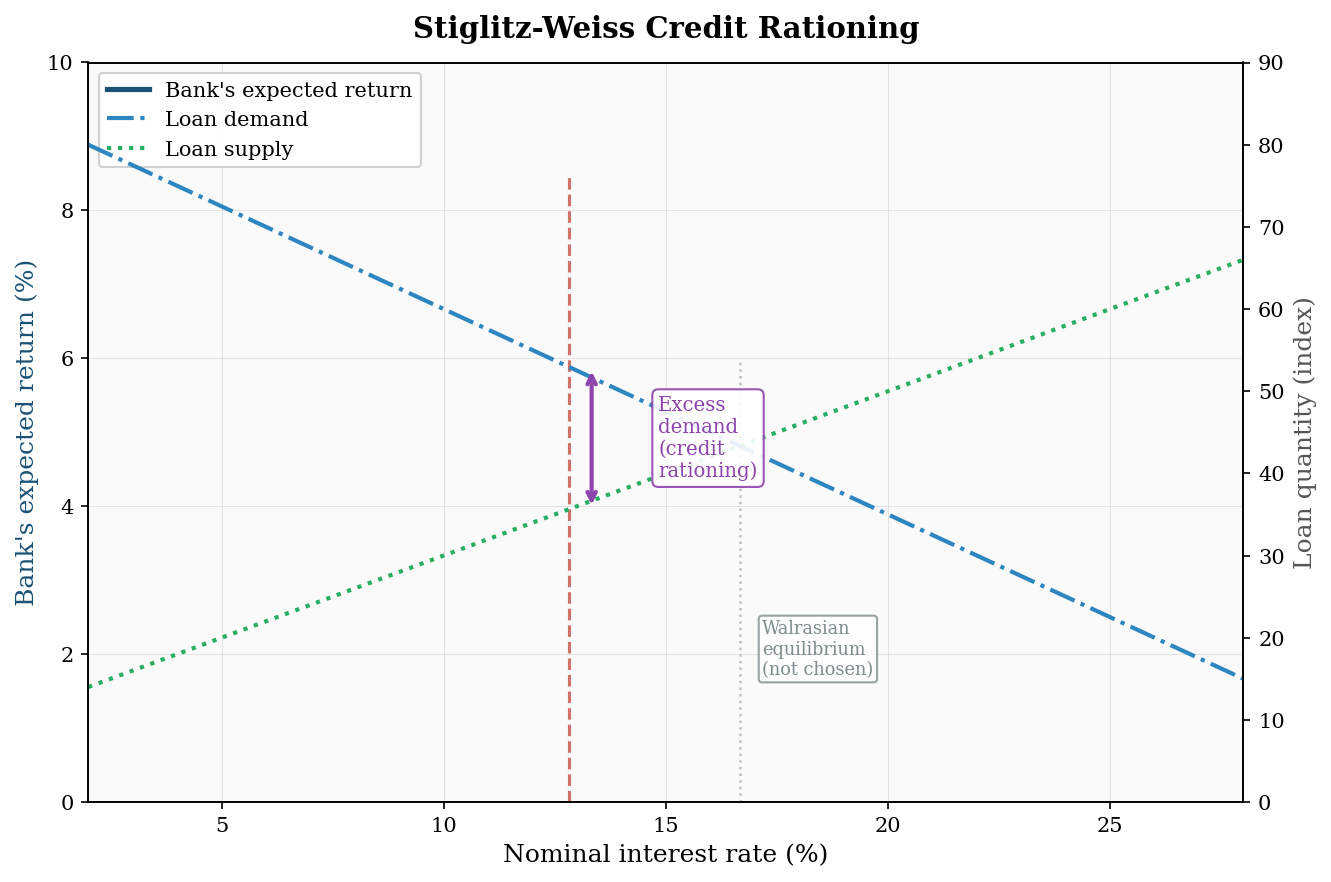
The mechanism operates through two channels that both work in the same adverse direction. The first is the adverse selection effect: as the interest rate rises, the safest borrowers — those with low-risk, moderate-return projects — drop out first, because the higher interest cost makes their prudent investments unprofitable. The borrowers who remain at the higher rate are disproportionately those with high-risk, high-return projects: they are willing to pay more because they expect to profit enormously if the project succeeds and to default if it fails, leaving the loss with the bank. The composition of the borrower pool deteriorates as the rate increases, in exact analogy to the lemons problem.
The second channel is the moral hazard effect: as the interest rate rises, even a given borrower may shift toward riskier projects. When the borrower must pay a higher return to the bank in good states, the payoff from a safe project shrinks relative to the payoff from a risky one. The borrower is effectively gambling with the bank's money: if the risky project succeeds, the borrower captures the upside after paying the now-higher interest; if it fails, the bank absorbs the loss. Higher interest rates therefore encourage precisely the behaviour that banks most want to avoid.
The combined effect of these two channels is that the expected return to the bank is not monotonically increasing in the interest rate. There exists an optimal rate at which the bank's expected return is maximised, and beyond this rate, further increases reduce expected returns because the deterioration in borrower quality outweighs the higher payments from those who do repay. The bank therefore sets the rate at this optimum and rations credit — refusing loans to some applicants who would gladly borrow at the posted rate — rather than raising the rate further and attracting a worse pool of borrowers.
Why Interest Rates Cannot Solve the Lending Problem
The Stiglitz-Weiss result overturns one of the most basic intuitions in economics: that prices clear markets. In a standard competitive market, excess demand is resolved by price increases until supply and demand are balanced. In credit markets under information asymmetry, this mechanism fails because the price of credit — the interest rate — does double duty. It is simultaneously the price of the product and a screening device that selects the composition of buyers. When raising the price worsens the quality of the buyer pool, the seller may prefer to leave the price unchanged and ration quantity instead.
The analogy to Akerlof's lemons is precise. Just as raising the price a buyer offers for a used car does not guarantee a better car — because the sellers attracted at a higher price are not necessarily those with better vehicles — raising the interest rate does not guarantee a more profitable loan portfolio. In both cases, the price fails to perform its usual allocative function because it interacts with the private information held by the other party to the transaction.
The practical implications are substantial. In developing countries, formal interest rates for small-business lending are often far above rates in developed economies, and yet credit remains scarce. The naive interpretation is that rates are too low, that higher rates would attract more lending capital. The Stiglitz-Weiss interpretation is precisely the opposite: rates are already at or above the point where further increases would worsen the quality of the borrower pool, and the binding constraint is not the price of credit but the informational structure of the market. Raising rates would not bring more capital into the market; it would drive the remaining safe borrowers out and replace them with gamblers.
This insight has shaped the design of development lending institutions, microfinance programmes, and credit guarantee schemes worldwide. It explains why subsidised lending rates — which classical economics would condemn as price controls that create shortages — can sometimes improve credit market outcomes by pulling the interest rate back below the point where adverse selection accelerates. And it explains why collateral requirements, while superficially about securing repayment, also function as screening devices: borrowers with real assets at stake are less likely to undertake reckless gambles, so collateral requirements improve the composition of the borrower pool independently of their recovery value.
Group Lending and the Grameen Innovation
The Stiglitz-Weiss model predicted that information asymmetry would exclude many creditworthy borrowers from formal credit markets, particularly in settings where collateral was scarce and credit histories nonexistent. This prediction was confirmed with devastating precision in rural South Asia, sub-Saharan Africa, and parts of Latin America, where hundreds of millions of productive small-scale entrepreneurs operated entirely outside the formal banking system. The capital that could have financed productive investment sat in the vaults of commercial banks that refused to lend, not because no good projects existed but because the banks could not distinguish good projects from bad ones.
Muhammad Yunus and the Grameen Bank, founded in Bangladesh in 1983, proposed a radical institutional innovation that attacked the information problem from an entirely different direction. Rather than trying to give the bank more information about individual borrowers — which would have been prohibitively expensive in the rural Bangladeshi context — Grameen transferred the screening and monitoring function to the borrowers themselves through group lending. Under the Grameen model, loans are made to individuals but repayment responsibility is shared by a group of five borrowers. If any member defaults, the entire group loses access to future credit. The group therefore has a powerful incentive to screen its own members, to monitor each other's use of funds, and to enforce repayment through social pressure.
The economic logic is an elegant application of information theory. The villagers who form a lending group have exactly the private information that the bank lacks. They know who among their neighbours is hardworking and who is not, whose business plan is sound and whose is fanciful, who will repay and who will abscond. This is private information from the bank's perspective but common knowledge within the village. Group lending harnesses this local information by giving villagers the incentive to act on it. The adverse selection problem is solved not by eliminating the information gap between bank and borrower, but by recruiting informed third parties — the borrower's peers — as screeners and monitors.
The empirical record on group lending is substantial and generally positive, though not without qualification. Repayment rates in the early Grameen programmes were above ninety-five percent, far exceeding the performance of individual lending in comparable populations. Subsequent research, including randomised controlled trials by Banerjee and Duflo and their collaborators, confirmed that access to microcredit produced modest but measurable gains in entrepreneurial activity and income, though the transformative poverty-reduction effects that early advocates had claimed proved difficult to replicate at scale. The mechanism worked, but it worked within limits — limits set partly by the same information problems that motivated its design.
3. The Digital Transformation of Information Markets
How Online Platforms Attack the Lemons Problem
The rise of internet commerce in the late 1990s and 2000s created what appeared to be the worst possible environment for markets plagued by information asymmetry. Online transactions separated buyers and sellers by vast distances, eliminated the possibility of physical inspection before purchase, and made it trivially easy for fraudulent sellers to create convincing storefronts. Every prediction of Akerlof's model suggested that these markets should unravel spectacularly — and indeed, early online marketplaces were plagued by fraud, misrepresentation, and buyer distrust.
What happened instead was one of the most remarkable institutional innovations in the history of market design. Platforms like eBay, Amazon, and their successors developed trust infrastructure — reputation systems, buyer protection guarantees, escrow services, and standardised product descriptions — that collectively attacked the information problem from multiple directions simultaneously. The result was not the elimination of information asymmetry but its management at a level sufficient to support transactions worth hundreds of billions of dollars annually among parties who had never met and would never interact again.
The eBay feedback system, introduced in 1998, was a pioneering application of reputation technology. After each transaction, both buyer and seller could rate the other, and these ratings accumulated into a public reputation score visible to all future counterparties. A seller with thousands of positive ratings and a 99.5 percent satisfaction score could command prices close to those of established retailers, because the accumulated feedback functioned as a quality signal analogous to a brand reputation — but built from the ground up through distributed, verified interactions rather than through advertising or institutional history.
The economic significance of this innovation is best understood in terms of the Akerlof framework. In a market without reputation, buyers discount all goods to reflect the average quality of the seller pool, driving high-quality sellers out. In a market with effective reputation, buyers can condition their willingness to pay on the seller's track record, allowing high-quality sellers to differentiate themselves and earn prices that reflect their actual quality. The reputation system breaks the pooling equilibrium by creating an observable, costly signal — the accumulated record of satisfied customers — that low-quality sellers cannot easily replicate.
Reputation Systems: Strengths and Vulnerabilities
The success of online reputation systems in reducing information asymmetry is genuine, but it coexists with vulnerabilities that reveal the persistent challenge of managing private information in market settings. Reputation systems work because they aggregate dispersed private information — the individual experiences of thousands of buyers — into a public signal that subsequent buyers can use. But the aggregation process is itself susceptible to manipulation, strategic behaviour, and systematic biases that limit its effectiveness.
The first vulnerability is review manipulation. Sellers can and do purchase fake positive reviews, either from professional review farms or through incentivised deals that exchange products for favourable ratings. The prevalence of this practice has been difficult to measure precisely, but studies using linguistic analysis and statistical anomaly detection have consistently found that a non-trivial fraction of online reviews are inauthentic. When fake reviews contaminate the signal, the reputation system's ability to separate high-quality from low-quality sellers is degraded, and the market moves back toward the pooling equilibrium that Akerlof described.
The second vulnerability is the cold-start problem. A new seller with no reviews faces the same credibility deficit as an unknown used car of uncertain quality. Buyers rationally discount the new seller's offerings, which means the new seller must accept lower prices or invest in costly quality signals — promotional discounts, money-back guarantees, or advertising — to build an initial reputation. This creates a barrier to entry that favours established sellers and may reduce competition in the long run. The reputation system, by solving one information problem, creates another: the problem of credibly communicating quality when no track record exists.
The third vulnerability is retaliation dynamics. In bilateral rating systems where both parties rate each other, the fear of retaliatory negative feedback can suppress honest reporting. A buyer who receives a substandard product may hesitate to leave a negative review if the seller can respond with a negative buyer rating that affects the buyer's future transactions. This strategic restraint biases reported satisfaction upward, reducing the informativeness of the signal. Platforms have responded by redesigning rating systems — eBay, for example, shifted to a system where sellers cannot leave negative feedback for buyers — but each redesign creates new strategic dynamics that must be anticipated and managed.
Despite these limitations, the net effect of online reputation systems on market efficiency has been overwhelmingly positive. Research by Chris Nosko and Steven Tadelis, using eBay transaction data, estimated that the platform's trust infrastructure increased the volume of transactions by a factor that would have been impossible without it. The lemons problem was not solved — asymmetric information persists in every online marketplace — but it was managed to a degree that allowed billions of dollars in trade to occur among strangers who would otherwise have had no basis for trust.
When Data Becomes the Asymmetry
The digital economy has not only developed tools for reducing traditional forms of information asymmetry — it has also created entirely new forms that Akerlof's generation of economists could not have anticipated. The most consequential of these is the asymmetry between platforms and the users who transact on them. In the classical lemons model, the seller knows more than the buyer about the quality of the good. In the modern platform economy, the platform knows more than either buyer or seller about the aggregate patterns of behaviour, pricing, demand, and risk that characterise the market as a whole.
This informational advantage gives platforms an extraordinary degree of market power. A ride-sharing platform that collects data on every trip — origin, destination, time, route, driver rating, rider cancellation history, surge pricing acceptance — accumulates a body of knowledge about the market's participants that no individual driver or rider possesses. The platform can use this knowledge to set prices, allocate rides, and design incentive structures in ways that maximise its own revenue, while individual participants operate with only the fragment of information that pertains to their own experience.
The asymmetry extends to the design of the marketplace itself. When a platform changes its algorithm — adjusting the ranking of search results, modifying the visibility of seller listings, or altering the factors that determine which products are recommended — it is exploiting information about user behaviour that the affected parties cannot observe or verify. A seller whose products are downranked by an algorithmic change may experience a sharp decline in sales without knowing why, and without any practical ability to determine whether the change was driven by legitimate quality assessments, competitive dynamics, or the platform's own commercial interests.
This new form of information asymmetry has attracted increasing attention from regulators and competition authorities. The European Union's Digital Markets Act, for example, imposes transparency requirements on large platforms that are explicitly designed to reduce the informational advantage that platforms hold over their users. These requirements are a direct descendant of the mandatory disclosure philosophy long applied in financial and consumer markets — but adapted to an informational environment that the original architects of disclosure regulation could not have imagined.
4. Behavioural Dimensions of Information Asymmetry
Why Real People Fail to Use Available Information
Akerlof's model, like most of the information economics that followed it, assumes that market participants are fully rational: they correctly process all available information, form accurate beliefs about the distribution of quality, and make optimal decisions given their informational constraints. The model's predictions follow from these assumptions with clean logical force. But a substantial body of evidence from behavioural economics suggests that real people depart from these assumptions in systematic ways that interact with, and sometimes amplify, the effects of information asymmetry.
The most basic departure is limited attention. Even when information is publicly available and freely accessible, individuals often fail to process it. Nutritional information on food packaging is a mandatory disclosure intended to reduce the information asymmetry between manufacturers and consumers. Yet studies consistently find that a majority of consumers do not read, understand, or use nutritional labels when making purchasing decisions. The information has been supplied — the asymmetry has been formally eliminated — but the behavioural gap between availability and utilisation means that the practical asymmetry persists.
This phenomenon has deep implications for the effectiveness of mandatory disclosure as a policy tool. If consumers cannot or do not process the information that regulation makes available, then disclosure requirements reduce asymmetry on paper while leaving it intact in practice. The seller who buries unfavourable terms in page forty-seven of a mortgage contract has technically disclosed the information, but the borrower who signs without reading page forty-seven remains as uninformed as if the disclosure had never been made. The problem is not that information is hidden but that the cognitive costs of processing it exceed what most individuals are willing to bear.
The implications extend to financial markets, where the complexity of the products being sold often exceeds the analytical capacity of the buyers. A retail investor evaluating a structured financial product — a collateralised debt obligation, for example, or a complex insurance-linked security — faces an information environment in which full understanding would require expertise in mathematics, law, and financial engineering that few individuals possess. Mandatory disclosure of the product's structure and risks does not give the average investor the knowledge necessary to evaluate it. The information is available, in the same sense that a textbook on quantum mechanics is available to anyone who walks into a university library. The gap between availability and comprehension is the gap that behavioural economics has forced information theory to take seriously.
The Winner's Curse and Common-Value Uncertainty
Not all information asymmetry involves one party knowing more than another about a fixed characteristic. In many economically important settings, the relevant private information concerns estimates of a common but uncertain quantity — the value of an oil lease, the worth of a company in a takeover, or the profitability of a government contract. In these common-value settings, each participant observes a noisy private signal of the true value, and the challenge is not to detect hidden quality but to aggregate dispersed estimates correctly.
The winner's curse, first identified empirically in the context of offshore oil-lease auctions in the 1950s and formalised theoretically in the 1970s, demonstrates what happens when bidders in such settings fail to account for the informational content of winning. In a sealed-bid auction for a common-value item, the bidder who wins is typically the one who has the most optimistic estimate of the item's value. If all bidders estimate honestly and bid accordingly, the winner is systematically the one whose estimate is furthest above the true value — a selection effect that produces regret. The winner, by the very fact of winning, should infer that all other bidders estimated the item to be worth less, and should revise their own estimate downward.
Rational bidders who understand this dynamic will shade their bids to correct for it — they will bid below their private estimate, anticipating the selection bias that winning imposes. In equilibrium, sophisticated bidders avoid the curse entirely. But laboratory experiments and field studies have consistently found that many real bidders fail to make this adjustment. In experimental auctions with common values, inexperienced bidders routinely overbid and incur losses, even after experiencing the curse repeatedly. The learning curve is slow, and the departure from rational behaviour is persistent enough to have measurable consequences in real markets.
The winner's curse has been documented in corporate takeover auctions, where acquiring firms systematically overpay for target companies; in construction bidding, where the lowest bidder on a government contract frequently underestimates costs and either incurs losses or must renegotiate; and in initial public offerings, where the shares allocated to investors who bid most aggressively tend to be those that the market subsequently revalues downward. In each case, the common thread is a failure to extract the correct inference from the act of winning: that winning in a competitive auction is informative about the value of what you have won, and that the information is typically unfavourable.
Overconfidence and the Illusion of Symmetric Knowledge
Perhaps the most pervasive behavioural distortion relevant to information asymmetry is overconfidence — the tendency of individuals to overestimate the precision of their own knowledge and to underestimate the extent of their ignorance. In a world of perfectly calibrated agents, information asymmetry would be recognised and priced: a buyer who knew she lacked relevant information would demand a discount, and the market would adjust accordingly. In a world of overconfident agents, the information gap is underestimated, its consequences are underpriced, and market outcomes deviate from what the rational model predicts.
The evidence for overconfidence is extensive and robust across domains. Surveys of drivers consistently find that a majority rate themselves above average in driving skill. Medical professionals overestimate the accuracy of their diagnoses relative to subsequent outcomes. Financial analysts systematically produce forecast intervals that are too narrow, reflecting excessive confidence in the precision of their estimates. In each case, the overconfident individual operates as if the informational environment is more favourable than it actually is — as if they know more than they do, or as if what they do not know is less consequential than it is.
In the context of information asymmetry, overconfidence has specific and testable implications. A buyer who overestimates their ability to detect a lemon will not demand the discount that a rational buyer would, which means that adverse selection exerts weaker downward pressure on prices than the theoretical model predicts. This can paradoxically sustain markets that the Akerlof model predicts should unravel: if buyers are not sufficiently pessimistic about unobservable quality, they will transact at prices high enough to keep some high-quality sellers in the market, preventing the complete unravelling that fully rational behaviour would produce.
The interaction between overconfidence and information asymmetry also helps explain patterns in financial markets that are otherwise difficult to account for. The volume of trading in equity markets is far higher than models of rational trade would predict, because rational agents with symmetric information and common priors should rarely disagree about value. Overconfidence — the belief that one's own information or analysis is superior to the market consensus — generates disagreement that fuels trading volume. Each trader believes she is the informed party in a market full of the uninformed, creating a Lake Wobegon economy in which everyone thinks they are above average. The resulting trading activity is, from the perspective of the rational model, largely wasteful: resources are consumed in transactions that shuffle wealth rather than create it.
5. Information Asymmetry in Developing Economies
Why Poor Countries Have Worse Information Problems
The adverse selection and moral hazard problems that Akerlof, Stiglitz, and Spence identified in the abstract are experienced most acutely in economies where the institutional infrastructure for managing information is weakest. Developing countries face information problems that are not merely more severe versions of those in wealthy countries but are qualitatively different in ways that affect the design of appropriate institutional responses.
The most fundamental difference is the absence of formal record-keeping systems. In developed economies, credit histories, employment records, medical files, property registries, and corporate accounts provide a dense informational network that reduces — though it does not eliminate — the scope for private information to distort market outcomes. In many developing countries, these records either do not exist, are incomplete, or are unreliable. A farmer seeking a loan in rural Bangladesh cannot point to a credit score because no agency has collected the data necessary to compute one. An insurer considering a health policy for a village in sub-Saharan Africa cannot access the medical history because no medical history has been recorded. The informational baseline from which markets begin is far lower, and the adverse selection consequences are correspondingly more severe.
The second difference is the importance of informal institutions. Where formal record-keeping is absent, information flows through social networks, community reputation, and kinship ties. A village moneylender knows her borrowers' character, work ethic, and family circumstances through decades of proximity and shared community life. This local knowledge is precisely the private information that formal lenders lack, and the moneylender's informational advantage explains why informal credit markets, despite charging interest rates that formal banking would consider usurious, persist as the dominant source of finance for hundreds of millions of people. The high interest rates are not simply exploitative — they reflect the real costs of lending in an environment where the informational infrastructure that supports formal lending does not exist.
The third difference is the vulnerability of poor populations to adverse selection consequences. When a health insurance market fails in a wealthy country, the uninsured can still access emergency care, charity hospitals, and publicly funded safety nets. When a crop insurance market fails to develop in a poor country, the uninsured farmer who loses a harvest to drought may face destitution. The welfare costs of information-driven market failure are not proportional to income; they are inversely proportional, falling most heavily on those with the fewest resources to absorb them.
Agricultural Insurance and the Problem of Basis Risk
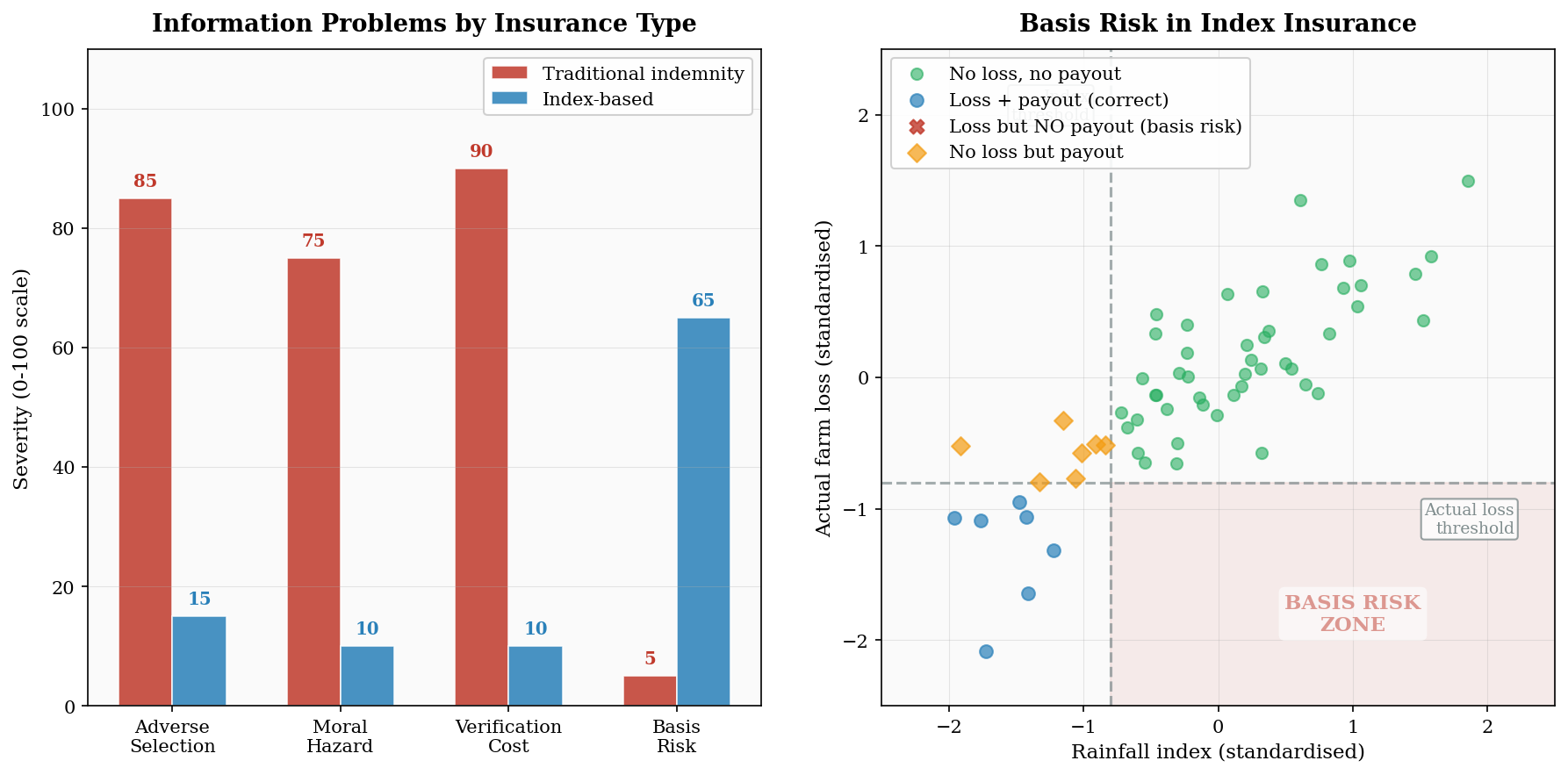
The absence of agricultural insurance markets in developing countries is one of the starkest examples of Akerlof's prediction that severe information asymmetry can prevent markets from forming entirely. The potential gains from insuring agricultural risk are enormous: weather-related and pest-related crop failures impose devastating costs on smallholder farmers, costs that could in principle be pooled across large populations at manageable premiums. Yet traditional indemnity-based crop insurance — where the insurer pays out based on the farmer's actual loss — has repeatedly failed in developing country contexts, for reasons rooted directly in information asymmetry.
The adverse selection problem is immediate. Farmers know more about the quality of their land, the reliability of their water sources, and the likelihood of localised pest damage than any insurer can feasibly determine. The farmers who buy insurance will be disproportionately those who face the highest risks — those farming marginal land, using unreliable irrigation, or planting in areas historically prone to flooding. The resulting pool is adversely selected, premiums must rise to cover the above-average risk, and the familiar unravelling dynamic follows.
The moral hazard problem is equally severe. A farmer who is fully insured against crop failure has reduced incentive to invest in the costly precautions — pest management, irrigation maintenance, soil conservation — that would prevent or mitigate losses. The insurer who cannot observe these precautions faces the prospect of paying claims for losses that the farmer's own behaviour contributed to or failed to prevent.
Index-based insurance, which pays out based on an objectively measured index — such as rainfall at a nearby weather station — rather than on the farmer's actual loss, was developed specifically to address these dual information problems. Because the payout is determined by a variable that no individual farmer can influence, moral hazard is eliminated. Because the payout does not depend on individual farm characteristics that only the farmer knows, adverse selection is greatly reduced. The index is publicly observable, independently verifiable, and immune to the strategic behaviour that undermines indemnity-based schemes.
The limitation of index insurance is basis risk: the imperfect correlation between the index and the farmer's actual loss. A farmer whose crops fail because of a localised pest outbreak that does not trigger the rainfall index receives no payout despite suffering the loss the insurance was meant to cover. Conversely, a farmer whose crops survive a regional drought because of fortunate micro-local conditions receives a payout without having suffered a loss. Basis risk reduces the value of the insurance to risk-averse farmers, and empirical take-up of index insurance products has been lower than early proponents hoped — a finding that has prompted ongoing refinement of index design, including the use of satellite imagery and high-resolution weather data to reduce the gap between the index and individual outcomes.
Mobile Technology and Financial Inclusion
The rapid diffusion of mobile telephone networks across the developing world has produced what may be the most significant natural experiment in reducing information asymmetry since the development of credit reporting systems in the nineteenth century. Mobile technology affects information problems through multiple channels simultaneously, and the combined effect on financial inclusion has been transformative.
The most direct channel is the creation of digital transaction records. When a farmer in Kenya uses M-Pesa to pay suppliers, receive payments for produce, and transfer money to family members, each transaction generates a data point. Over time, these transactions compose a financial history that is functionally equivalent to the credit history that formal banking systems rely on in developed economies. Companies like Tala and Branch have built lending businesses on exactly this data, using algorithms to assess creditworthiness from mobile phone usage patterns — call frequency, network diversity, airtime purchases, and transaction regularity — that correlate with repayment behaviour. The information that the Stiglitz-Weiss model identified as the binding constraint on credit market development is now being generated as a byproduct of everyday communication.
The second channel is the reduction of verification costs. Before mobile money, confirming that a borrower had repaid required a physical visit or a paper record that could be lost, forged, or delayed. Digital records are instantaneous, tamper-resistant, and remotely accessible. The cost of monitoring repayment — a key component of the moral hazard problem — has fallen by orders of magnitude. This cost reduction does not eliminate moral hazard, but it shifts the trade-off between monitoring and incentive provision in favour of monitoring, allowing lenders to offer contracts that would previously have been uneconomic.
The third channel is peer information aggregation. Social media, messaging platforms, and community forums create networks through which information about sellers, products, and service providers circulates at negligible cost. A farmer considering whether to buy fertiliser from a particular supplier can consult WhatsApp groups, read reviews on local platforms, or simply ask contacts in neighbouring villages about their experience. This distributed information-sharing performs the same function as the formal reputation systems developed by eBay and Amazon, but through informal social networks that are already embedded in the community's daily life.
The cumulative effect has been measurable. Research by Tavneet Suri and William Jack, studying the impact of M-Pesa in Kenya, found that mobile money access lifted approximately two percent of Kenyan households out of poverty, with the effect concentrated among female-headed households — the population most excluded from formal financial services and most vulnerable to the information-driven credit rationing that the Stiglitz-Weiss model describes.
6. From Diagnosis to Design
What the Evidence Tells Us About When Markets Fail
The empirical programme launched by Akerlof's theoretical insight has, over five decades, produced a body of evidence that is nuanced, context-dependent, and occasionally contradictory — but that converges on several conclusions robust enough to guide both theory and policy.
The first conclusion is that adverse selection is real and measurable, but its severity varies enormously across markets and institutional contexts. In markets with strong reputation mechanisms, effective certification systems, or mandated disclosure, the adverse selection dynamic is attenuated and markets function at something approaching efficiency. In markets without these institutional supports — particularly in developing countries and in markets for complex or novel products — adverse selection can be severe enough to produce the quality degradation and market thinning that Akerlof's model predicts.
The second conclusion is that the line between adverse selection and moral hazard is empirically blurred, and that most real markets exhibit both problems simultaneously. A health insurance market is affected by adverse selection, since sicker individuals are more likely to buy coverage, and by moral hazard, since insured individuals may consume more healthcare than they would if paying out of pocket. Disentangling these effects requires careful empirical design, and the failure to do so leads to policy interventions that address the wrong problem.
The third conclusion is that technology has fundamentally altered the information landscape in ways that create new opportunities and new risks. Digital platforms have reduced some traditional forms of information asymmetry while creating new ones. Mobile financial technology has brought formal credit and insurance within reach of populations that were previously excluded. But the concentration of data in the hands of platforms creates informational advantages that may prove as consequential as the asymmetries they replaced.
The Spectrum from Adjustment to Collapse
The empirical evidence suggests that markets under information asymmetry do not simply work or fail — they occupy a spectrum of performance that ranges from modest price adjustments at one end to complete non-existence at the other. Understanding where a particular market sits on this spectrum, and why, is essential for designing appropriate institutional responses.
At the mild end of the spectrum are markets where information asymmetry produces measurable but manageable price distortions. The used car market in a developed country with vehicle history reports, inspection services, and dealer reputations is a market where adverse selection depresses prices for privately sold vehicles relative to dealer-sold vehicles, but where trade continues at substantial volume. The information problem is real but contained, and private market mechanisms — though imperfect — are sufficient to prevent serious market failure.
In the middle of the spectrum are markets where information asymmetry produces substantial inefficiency — lower volume of trade, exclusion of some willing participants, or systematic quality degradation — but where the market continues to function. Many health insurance markets before regulatory reform occupied this region: coverage was available but expensive, the pool of insured individuals was adversely selected, and significant populations were uninsured despite willingness to pay actuarially fair premiums. The market existed but performed badly, and the welfare losses were large enough to justify regulatory intervention.
At the severe end of the spectrum are markets that fail to form at all, or that collapse to the point of near-non-existence. Agricultural insurance in developing countries, certain categories of professional liability insurance, and credit markets for small enterprises in low-income environments are examples. In these cases, the information asymmetry is so severe, and the institutional infrastructure for managing it so weak, that no market price clears the gap between what informed sellers know and what uninformed buyers can discover. The potential gains from trade are large — perhaps larger than in any of the less severe cases — but they remain unrealised because the informational preconditions for market function are not met.
The Architecture of Response
The empirical journey from Akerlof's theoretical prediction to the measured realities of insurance markets, credit markets, and digital platforms points toward a concluding theme: that information asymmetry is not a problem with a single solution but a structural feature of markets that demands a repertoire of institutional responses, each calibrated to the specific form the asymmetry takes and the specific context in which it operates.
Warranties address the problem when the seller can credibly stake resources on the quality of their product. Reputation addresses it when interactions are repeated and the future matters. Certification addresses it when an independent expert can observe what the buyer cannot. Mandatory disclosure addresses it when the seller holds information that can be made comprehensible to the buyer at reasonable cost. Credit rationing, group lending, and index insurance address it through institutional designs that transform the structure of the information problem itself — changing who observes what, who bears what risk, and who has incentives to monitor whom.
The common thread running through all of these responses is that none eliminates the underlying asymmetry. What they do, at their best, is manage it — reducing the gap between informed and uninformed parties to a level at which markets can function, though never at the level they would reach under symmetric information. The distance between the world we inhabit and the first-best world of complete information is the permanent cost of privacy, complexity, and the irreducible limits of human knowledge. Understanding that cost — measuring it, modelling it, and designing institutions to minimise it — is what the economics of information asymmetry is about.