1. Two systems of thinking
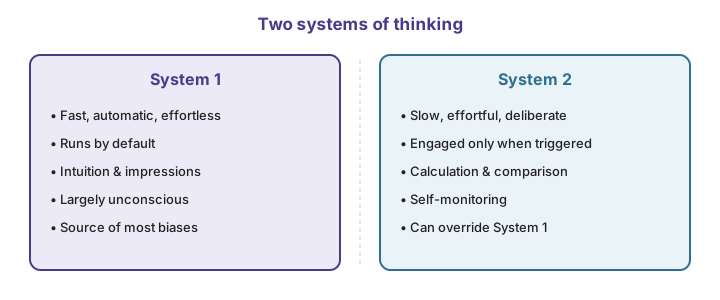
People form judgments and decide under conditions that rarely allow full, careful analysis. Research in the psychology of judgment describes thought as operating through two loosely distinct modes. System 1 is fast, automatic, effortless, and largely unconscious: it generates impressions, intuitions, and snap associations without a sense of voluntary control. System 2 is slow, effortful, deliberate, and conscious: it allocates attention to demanding mental activities such as complex calculation, comparison, and self-monitoring. The two systems cooperate. System 1 proposes impressions and feelings that System 2 may endorse, modify, or block.
A core finding is that System 1 runs by default. Unless something triggers effort, people answer with the first coherent interpretation that comes to mind. System 2 is "lazy": it accepts the suggestions of System 1 unless they are clearly implausible or the stakes are high. This division explains why intelligent, attentive people repeatedly make predictable errors — the errors arise from the automatic machinery of intuition, not from a lack of ability.
The mistakes studied here are called cognitive biases: systematic deviations from the prescriptions of logic, probability, or rational choice. "Systematic" matters. A bias is not a random slip; it is a directionally consistent tendency shared across people and repeated across problems. Because the tendencies are predictable, they can be described, measured, and — to a limited extent — corrected.
The organizing question of this material is not "Are people irrational?" but "Under what conditions does intuitive judgment depart from a normative standard, and what mental shortcut produces the departure?" Each later section isolates one family of shortcuts — representativeness, availability, anchoring, the evaluation of gains and losses, and framing — and shows the specific error it generates.
2. The representativeness heuristic
When asked how likely an object or person belongs to a category, people often judge by similarity to a stereotype rather than by the actual base rate. This is the representativeness heuristic: an instance is judged probable to the degree it resembles the prototype of its parent class. The heuristic is useful — similar things are often alike — but it ignores information that is not captured by resemblance.
One consequence is insensitivity to base rates. Given a description of a person that fits the stereotype of a librarian, people will estimate a high probability that the person is a librarian, even when told that the sample contains far more farmers than librarians. The base rate (the prior frequency) is neglected in favor of the match to the stereotype.
A second consequence is the misconception of chance, sometimes called the "law of small numbers." People expect a random sequence to look random at every scale. After a run of heads in coin flips, they predict tails — the gambler's fallacy — as if the process were self-correcting. Conversely, they see meaningful patterns in short sequences that are fully compatible with chance. A sequence H-T-H-T-T-H is judged more "fair" than H-H-H-T-T-T, although both are equally likely from a fair coin.
The most famous demonstration is the conjunction fallacy. Consider Linda: a person described as bright, outspoken, and concerned with social justice. People rank "Linda is a bank teller and active in the feminist movement" as more probable than "Linda is a bank teller." This violates a basic rule of probability — a conjunction cannot be more probable than one of its constituents. The error occurs because the richer description is more representative of the mental image of Linda, even though it is logically narrower.
A related failure is insensitivity to sample size. People predict the same accuracy for an estimate drawn from ten observations as from one thousand, because the small sample feels as representative as the large one. The heuristic equates "looks like the population" with "is reliably the population," forgetting that small samples are noisier.
Representativeness also produces regression neglect. When two variables are imperfectly correlated, extreme performances tend to be followed by milder ones. Observers instead expect the extreme to persist, treating natural fluctuation as a signal of character or skill.
3. The availability heuristic
To judge how frequent or likely an event is, people often ask how easily examples come to mind. This is the availability heuristic: retrievable events feel common; hard-to-retrieve events feel rare. Availability is a reasonable clue — frequent events are usually easier to recall — but it is distorted by factors unrelated to true frequency.
Salience and vividness inflate availability. Dramatic, concrete, or recent events are easier to bring to mind than routine ones. A widely reported accident or a memorable anecdote can lead people to overestimate the risk of that specific hazard, while quietly common causes with no narrative pull are underestimated.
Media coverage amplifies the effect. Events that receive sustained attention — certain crimes, disasters, or diseases — are judged far more likely than their base rates warrant, simply because the news makes them continuously retrievable. The same mechanism makes rare but televised perils feel more threatening than mundane but deadly ones.
Availability also distorts self-assessment of risk. People compare the ease of recalling instances of their own cautious behavior with instances of reckless behavior, and conclude they are safer than average when the cautious examples happen to be more memorable.
A subtler form is availability by imaginability. When asked to estimate the number of ways a plan can fail, people generate scenarios; the more fluent the generation, the higher the estimated risk. Imaginability stands in for probability even when the imagined scenarios are not the most probable ones. The heuristic thus conflates "I can picture it" with "it will happen."
The practical upshot is that availability biases both probability judgments and the prioritization of actions. Decisions driven by what is easy to recall can diverge sharply from what the base rates recommend.
4. Anchoring and insufficient adjustment
When people face a quantitative estimate, they begin from an anchor — an initial value suggested by the problem or the environment — and adjust away from it. The signature error is insufficient adjustment: the final estimate stays too close to the anchor, regardless of whether the anchor is relevant.
In a classic demonstration, people first observe a random number (e.g., from a spun wheel) and then estimate a quantity such as the percentage of African nations in the United Nations. Their estimates are pulled toward the arbitrary number, even though they know it is irrelevant. The anchor does not merely bias the answer; it shifts the entire distribution of responses.
Anchoring survives even when people are warned that the anchor is uninformative and are instructed to correct for it. Deliberate efforts to "throw out" the anchor often fail, because the adjustment is typically a small move in the direction of the true value, stopped as soon as a plausible number is reached.
Anchors also arise from priming. Exposure to unrelated high or low numbers beforehand shifts subsequent numerical estimates. The effect is not limited to numbers: a briefly presented word associated with the elderly can slow a person's walking speed afterward, an instance of behavioral priming that operates outside awareness.
In applied settings, the first offer in a negotiation or the listed price of a good acts as an anchor. Later counter-offers and final agreements gravitate toward it, because both sides adjust insufficiently from the opening number. The anchor sets the range of what feels reasonable.
Anchoring is distinct from the earlier heuristics in that it concerns quantitative judgment rather than categorical similarity or retrievability. Yet all three share a common shape: a mentally available value (a stereotype, a retrieved example, an initial number) is given too much weight, and correction is partial.
5. Prospect theory: value is judged from a reference point
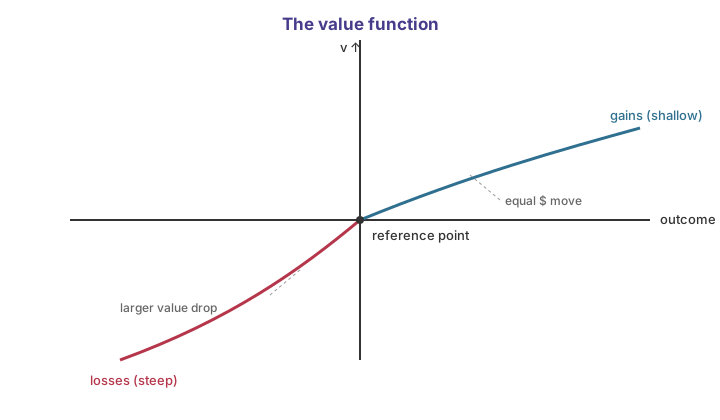
The heuristics above concern how people form beliefs. A separate family of biases concerns how they evaluate outcomes, especially gains and losses. Prospect theory proposes that people do not assess wealth in absolute terms; they evaluate changes relative to a reference point (usually the status quo or a recent expectation).
The value function is concave for gains (diminishing sensitivity: the difference between 100 and 200 feels larger than between 1,100 and 1,200) and convex for losses. Crucially, it is steeper for losses than for gains — a phenomenon called loss aversion. Losing a sum hurts more than gaining the same sum pleases. Typical estimates place the aversion ratio near 2:1.
Because value is reference-dependent, the same final outcome can be experienced as a gain or a loss depending on the framing of the reference point. A rebate presented as "keep $100 of a $1,000 fee" feels like a gain; the same net payment presented as "pay $900 after a $100 discount" can feel like a loss, even though the money moved is identical.
Prospect theory also replaces expected value with decision weights. People do not weight outcomes by their objective probabilities. Small probabilities are overweighted (which sustains lottery play and fear of rare disasters), and moderate-to-high probabilities are underweighted. The weighting function is not a simple linear map of chance.
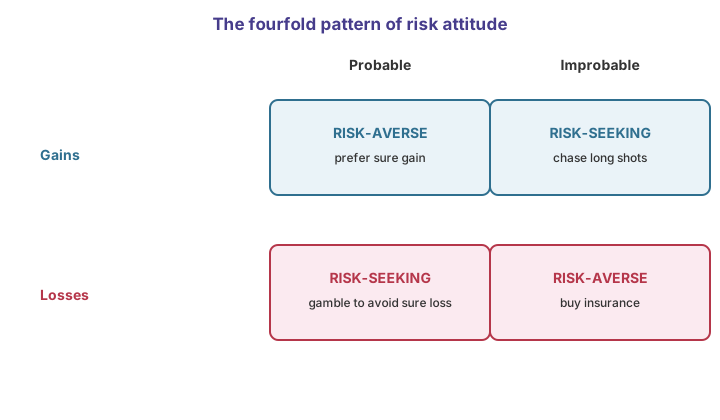
These properties predict a fourfold pattern of risk attitudes. People are risk-averse for gains that are likely (they prefer a sure gain to a gamble) but risk-seeking for gains that are unlikely (they chase long-shot wins). For losses, the pattern reverses: risk-seeking for likely losses (they take a gamble to avoid a sure loss) and risk-averse for unlikely losses (they buy insurance).
6. Framing effects
When the same decision is described in different words, choices change. This is a framing effect, and it violates the normative principle that logically equivalent descriptions should not alter preference.
In the Asian disease problem, respondents choose between policies to combat an outbreak expected to kill 600 people. In the gain frame, one policy is "saves 200 lives" (certain) versus "a one-third chance of saving 600, two-thirds chance of saving none." Most choose the certain saving. In the loss frame, the same policies are "400 will die" (certain) versus "a one-third chance that nobody dies, two-thirds that 600 die." Most now choose the gamble. The outcomes are identical; only the reference point (lives saved vs. lives lost) differs.
Framing exploits loss aversion and the fourfold pattern. A loss frame makes the certain option feel like a sure loss, pushing people toward the risky alternative; a gain frame makes the certain option feel like a sure gain, pushing them toward safety. The switch is driven by wording, not by the facts.
An analogous effect appears in attribute framing: describing a surgery as having a "90% survival rate" yields more acceptance than the same procedure described as having a "10% mortality rate." Positive and negative labels for the identical statistic produce different choices.
Framing is not confined to personal health. It shapes consumer and policy choices: a product "90% fat-free" outsells the same product "10% fat"; a penalty framed as a "fee for late payment" is resented more than the same amount framed as a "discount for early payment." The reference point embedded in the words determines whether the number is read as a gain or a loss.
The normative problem is clear: a rational chooser should react to the state of the world, not to which of two equivalent descriptions happens to be presented. Framing effects show that description, not just reality, moves the decision.
7. Overconfidence, hindsight, and the planning fallacy
Several biases concern how people assess their own knowledge and foresight. The broad label is overconfidence: people systematically place their own judgments, predictions, and abilities above the level the evidence supports.
Calibration failure is one form. When people say they are "90% sure" of answers to general-knowledge questions, they are typically correct only about 70–80% of the time. The gap between stated confidence and actual accuracy is the miscalibration. Overconfidence is largest on hard items, where people are wrong but do not know it.
Better-than-average effects are another. Majorities rate themselves above the median on driving skill, health, and fairness — a mathematical impossibility in aggregate. People compare their best moments with others' typical moments, and they explain away others' successes while crediting their own.
Hindsight bias makes past events feel inevitable once known. After an outcome is revealed, people mistakenly believe they "knew it all along" and overestimate how predictable it was. Hindsight flattens the uncertainty that was actually present beforehand, which corrupts learning: if the past feels predetermined, its lessons are misread.
The planning fallacy is the tendency to underestimate the time, cost, and risk of future actions while focusing on the narrative of the plan rather than the distribution of similar past projects. People plan inside view (the specific case) and neglect the outside view (the base rate of analogous efforts). The result is systematic overrun.
These biases reinforce one another. Overconfidence feeds the planning fallacy; hindsight converts surprise into false foresight; better-than-average beliefs protect the self from the feedback that would correct them.
8. Why the biases persist, and what slows them
The biases are not signs of low intelligence. They are the predictable side effects of mental shortcuts that are usually fast and useful. Representativeness, availability, and anchoring are heuristics that exploit structure in the world; they mislead mainly at the margins, where the shortcut's assumption fails.
Correction is hard because the shortcuts operate automatically and below awareness. System 2 can override them, but only when it is engaged and given a clear standard. Three conditions help:
- Statistical training and explicit base rates. Teaching people to retrieve and apply prior frequencies reduces base-rate neglect, though the benefit is uneven and fades without practice.
- Debiasing by structure, not willpower. Checklists, predefined ranges, and "consider-the-opposite" prompts outperform exhortations to "be careful." A written plan that states the reference point neutralizes some framing effects.
- Externalizing the reference point. Stating gains and losses in the same units, and computing expected values before choosing, exposes framing and anchoring that pure intuition hides.
The limits are real. Even experts who know the biases remain susceptible when tired, rushed, or invested. Awareness alone is a weak vaccine; institutions that build the correction into the procedure outperform individuals who merely intend to be careful.
The durable lesson is methodological. Because intuitive errors are systematic, they can be anticipated. A person who knows that an anchor will pull an estimate, that a vivid case will inflate a risk, and that a loss frame will shift a choice, can arrange the decision so that the shortcut has less room to do damage. The goal is not to abolish intuition but to place it where its predictable failures are visible and correctable.