Language does not simply happen to change. It was the recognition that change follows patterns — deep, recurring, law-like patterns — that transformed the casual observation of linguistic difference into a science. Change takes many forms — the slow metamorphosis of English from the impenetrable verse of Beowulf to the familiar cadences of modern speech, the Great Vowel Shift that rewrote English pronunciation over three centuries, the borrowing and semantic drift that replenish and reshape the lexicon in every generation. Grammar can dissolve, words can reverse their meanings, and spelling can fossilise while speech marches on. What turns this from a collection of curiosities into a science is the intellectual revolution that made sense of all of it — the discovery that the languages of the world fall into families descended from common ancestors, and that the changes connecting parent to descendant are not random accidents but systematic processes whose regularity can be demonstrated, tested, and used to reconstruct languages that were never written down.
This is the material that turns the raw evidence of change into the conceptual architecture that organises it. It begins with the moment, in the late eighteenth century, when European scholars first grasped that Sanskrit, Greek, and Latin were siblings rather than strangers. It moves through the mechanics of sound change at the level of the mouth and the ear, through the slow reshaping of grammatical systems, through the restless life cycle of words, through the peculiar relationship between writing and speech, and finally to the geographical dimension — how change radiates outward through space as well as forward through time.
The Discovery of Language Families
Sir William Jones and the Sanskrit Connection
On 2 February 1786, Sir William Jones, a British judge serving in Calcutta, delivered a lecture to the Asiatic Society of Bengal that would eventually redirect the course of the humanities. Jones was a polyglot of extraordinary range — he had studied Arabic, Persian, and several European languages before taking up Sanskrit in India — and what he told his audience that evening was something that no amount of casual multilingualism could have produced without careful comparative analysis. Sanskrit, the ancient literary and liturgical language of India, bore a resemblance to Greek and Latin that was, in his words, too strong to have been produced by accident. The resemblance was not a matter of a few stray words that might have been borrowed through trade. It was structural. It ran through the verb conjugations, through the noun declensions, through the basic vocabulary of kinship and number and body parts. Jones proposed that all three languages had sprung from some common source which, perhaps, no longer existed.
Jones was not the first person to notice resemblances between European and South Asian languages. The Florentine merchant Filippo Sassetti had remarked on similarities between Italian and Sanskrit in the sixteenth century. But Jones's formulation was different in a crucial respect: he proposed a genealogical relationship, a shared descent from a single ancestor. This was not merely a claim about similarity. It was a claim about history — about the existence of a vanished community whose speech had given rise, through centuries of divergence, to the languages of India and Europe alike. The claim was speculative in 1786. Within a few decades it would be the foundation of a new science.
What made Jones's observation powerful was not any single word pair but the sheer density of the correspondences. The Sanskrit word for "father" is pitar, the Latin is pater, the Greek is pater, the Gothic (an ancient Germanic language) is fadar. The Sanskrit for "three" is trayas, the Latin is tres, the Greek is treis. The Sanskrit for "is" is asti, the Latin est, the Greek esti. These are not borrowings — the languages were spoken by communities separated by thousands of kilometres and centuries of independent development. They are cognates: words inherited from a single ancestral form in a language that linguists would later call Proto-Indo-European.
The Family Tree and Proto-Languages
The image that took hold most firmly in the decades following Jones's lecture was the family tree. Just as a family of human beings can be traced backward through generations to a common ancestor, a family of languages can be traced backward through centuries of documented and reconstructed change to a proto-language — the single ancestral variety from which all the members of the family descend. The family tree model was formalised most influentially by the German linguist August Schleicher in the 1860s, who drew explicit parallels between linguistic descent and the branching diagrams that Charles Darwin had recently made famous in biology.
The proto-language is not a fiction invented for convenience. It is a hypothesis — a reconstruction of the most recent common ancestor that could have given rise to the attested daughter languages through the kinds of changes that are independently documented in the history of every known language. Proto-Indo-European is the most extensively reconstructed of all proto-languages, but the same method has been applied to dozens of other families. Proto-Bantu is reconstructed from the several hundred Bantu languages of sub-Saharan Africa. Proto-Austronesian is reconstructed from the languages of Taiwan, island Southeast Asia, and the Pacific. Proto-Uralic is reconstructed from Finnish, Hungarian, Estonian, and their relatives. In each case, the reconstruction proceeds by the same logic: identify the systematic correspondences between daughter languages, determine the direction of change using internal and comparative evidence, and infer the ancestral form.
The family tree model captures something essential about language history — the fact that communities split and then diverge independently — but it also simplifies. Languages do not merely diverge. They also come into contact, borrow from one another, and sometimes converge in ways that the branching tree cannot represent. The tree is a starting point, not the whole story, and later we will encounter an alternative model that accommodates the messier realities of geographical spread.
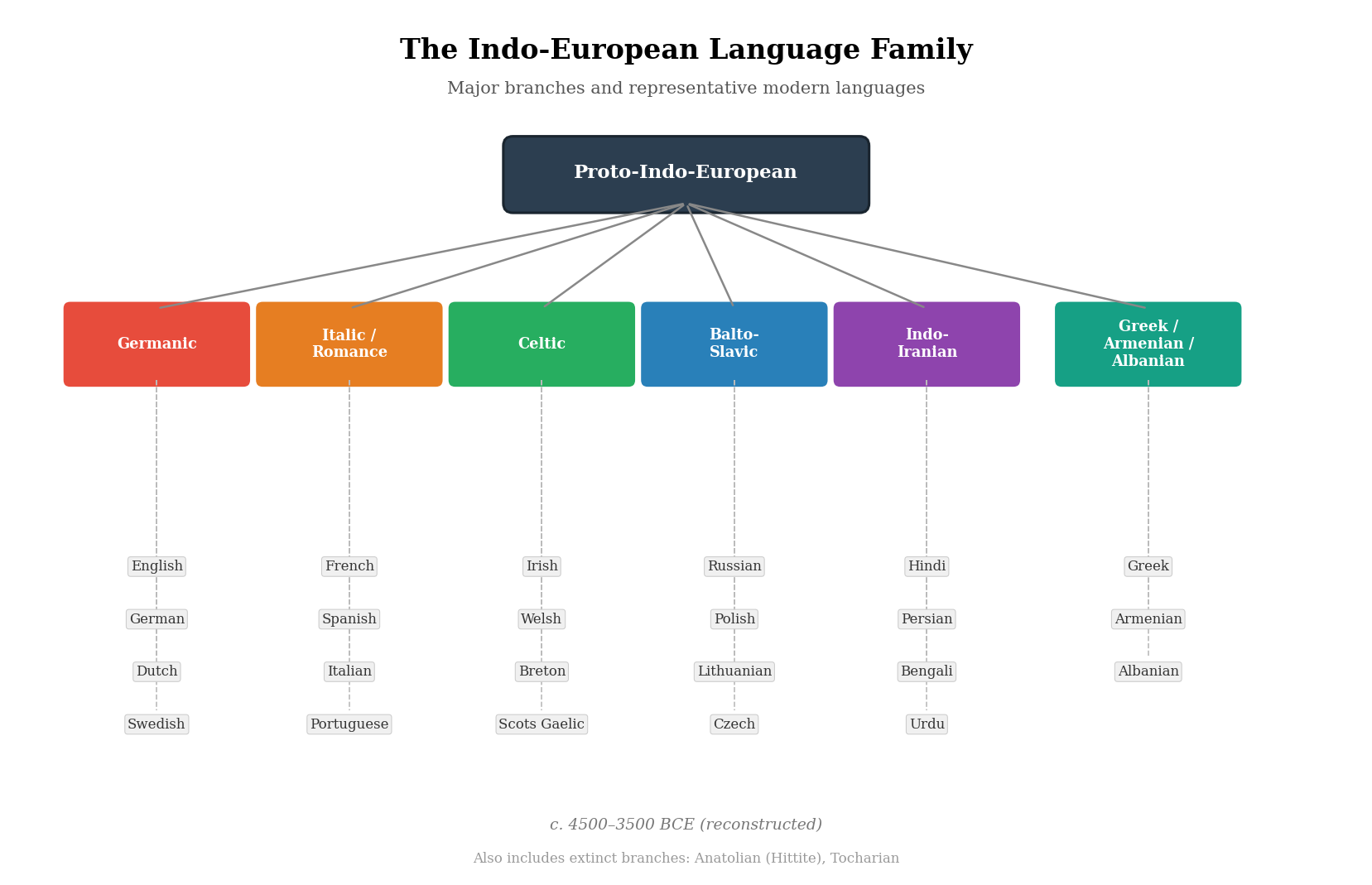
Beyond Indo-European — Mapping the World's Language Families
The Indo-European family is the largest by number of speakers, but it is far from the only family, and the recognition that languages could be grouped into families by shared descent quickly extended beyond the languages that Jones had discussed. By the middle of the nineteenth century, linguists had identified Semitic as a family (linking Arabic, Hebrew, Aramaic, and Amharic), Uralic as a family (linking Finnish, Estonian, Hungarian, and a cluster of smaller languages across northern Eurasia), and Austronesian as a family (linking hundreds of languages scattered from Madagascar to Hawaii). Each identification rested on the same kind of evidence: systematic sound correspondences, shared basic vocabulary, and structural similarities too deep and too regular to be attributed to chance or borrowing.
The number of established language families in the world today stands at roughly 150, depending on which groupings are accepted and how the boundaries are drawn. Some families are enormous. Niger-Congo, the family to which most of the languages of sub-Saharan Africa belong, contains over 1,500 languages. Austronesian contains over 1,200. Others are tiny — a handful of related languages in a single river valley or island chain. And some languages appear to belong to no family at all: language isolates, of which Basque (spoken in the western Pyrenees) is the most famous European example, are languages for which no demonstrable genealogical relationship to any other known language has been established. Whether an isolate is truly unrelated to all other languages or whether the evidence of its relationships has simply been erased by time is a question that varies from case to case and that, for the deepest time depths, may be unanswerable.
The mapping of the world's language families is one of the great intellectual achievements of the nineteenth and twentieth centuries, and it rests entirely on the principle that language change is regular enough to leave recoverable traces. Without regularity, there would be no systematic correspondences. Without correspondences, there would be no reconstruction. Without reconstruction, there would be no family tree, no proto-language, no window into the deep human past. The regularity of change is not merely a technical observation about phonology. It is the foundation on which the entire science of language history is built.
Inside Sound Change
How Sounds Shift — The Phonetic Engine
Every sound change begins in the mouth. The vocal tract is a physical instrument — a tube of muscle, cartilage, and soft tissue extending from the larynx to the lips and the nasal cavity — and the sounds it produces are governed by the same physical constraints that govern any mechanical system. Sounds that require less articulatory effort tend, over time, to replace sounds that require more. Sounds that are produced in rapid sequence tend to influence one another, each pulling the next toward its own articulatory position. Unstressed syllables, produced with less force and less precision, tend to erode. These are not metaphors. They are descriptions of what happens when millions of speakers produce billions of utterances over decades and centuries, each utterance a tiny physical event subject to the constraints of human anatomy.
The process by which a consonant produced at one point in the mouth shifts to a nearby point is called lenition when the shift involves a reduction in the degree of closure or the force of articulation. A stop consonant — one that completely blocks the airflow, like the /p/ in "pin" or the /t/ in "tin" — may weaken to a fricative, which only partially blocks the airflow, producing turbulence rather than silence. Latin "ripa" (riverbank) became Spanish "riba" and eventually "rivera" — the /p/, a voiceless bilabial stop, weakened to a voiced bilabial fricative and eventually to a voiced alveolar tap. The trajectory is from more effortful to less effortful, from a full closure of the lips to a partial closure to a brief tap of the tongue. This is lenition in action, and it is one of the most common pathways of consonant change across the world's languages.
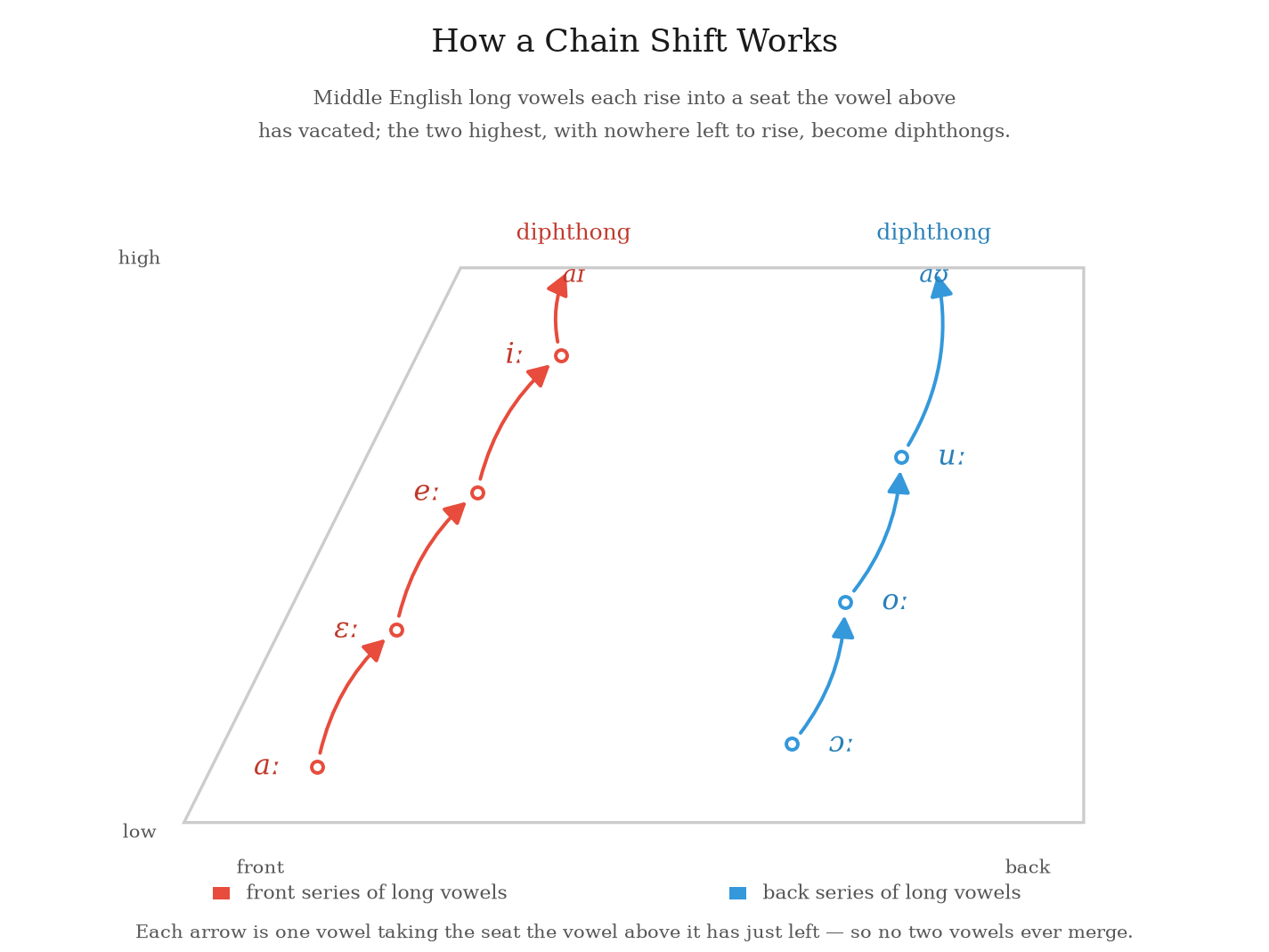
Vowels shift by a different mechanism. A vowel is defined by the position of the tongue in the mouth (high or low, front or back) and by the rounding of the lips. When a vowel shifts, it means that speakers are systematically producing it with the tongue slightly higher, or slightly lower, or slightly further forward or back, than the previous generation did. The shift is initially a matter of phonetic degree — a few millimetres of tongue position — but over generations those millimetres accumulate until the vowel has moved to a position that a previous generation would have identified as a different vowel entirely. The Great Vowel Shift was precisely this kind of accumulation, operating across the entire long vowel system of English over roughly three centuries.
Chain Shifts and System-Wide Reorganisation
The Great Vowel Shift was not simply a collection of independent vowel changes that happened to occur around the same time. It was a chain shift — a coordinated series of movements in which the repositioning of one vowel triggered the repositioning of others. Chain shifts are among the most dramatic and theoretically important phenomena in historical phonology because they reveal that the vowel system is not a loose collection of independent sounds but an integrated system in which each vowel occupies a position defined partly by its relationship to the others.
The mechanics of a chain shift can be understood through a spatial analogy. Imagine the vowel space — the range of positions where the tongue can be placed to produce vowels — as a room with a limited number of seats. Each long vowel of Middle English occupied one seat. When the lowest long vowels began to rise (moving the tongue higher in the mouth), they encroached on the space occupied by the vowels above them. Those higher vowels had two choices: they could merge with the rising vowel below (which would mean that two formerly distinct vowels became identical, and all the words containing them would become homophones), or they could themselves rise to maintain the distinction. In the Great Vowel Shift, the vowels rose rather than merged — each pushing the one above it higher, in a chain reaction that propagated upward through the entire system. The highest vowels, with nowhere left to rise, broke into diphthongs — two-element vowel sounds — which is why the Middle English pronunciation of "time" (which rhymed with modern "teem") became the modern diphthongal pronunciation.
Chain shifts are not unique to English. The Northern Cities Shift, first documented by William Labov in American cities such as Detroit, Chicago, Cleveland, and Buffalo, is a rotation of short vowels in which the vowel of "cot" moves toward the vowel of "cat," "cat" moves toward "key-at," and the other short vowels rotate through positions that their neighbours have vacated. The shift is currently in progress and is socially stratified — it is more advanced among younger speakers and among certain social groups — which means that modern linguists can observe in real time the same kind of process that the Great Vowel Shift completed centuries ago.
Mergers, Splits, and the Loss of Distinctions
Not every vowel change is a chain shift. Sometimes two vowels that were formerly distinct converge on the same acoustic target, producing a merger — the permanent collapse of a distinction. Mergers are among the most consequential sound changes because they are, for practical purposes, irreversible. Once speakers can no longer hear the difference between two sounds, there is no mechanism by which the distinction can be spontaneously restored.
The cot-caught merger in North American English is a merger currently spreading across the continent. For speakers who have the merger, the vowels in "cot" and "caught," "Don" and "dawn," "stock" and "stalk" are identical. For speakers who retain the distinction (concentrated in the northeastern United States and parts of the Upper Midwest), these are different vowels — as different as the vowels in "cat" and "cut." The merger has no effect on intelligibility in practice because context almost always disambiguates, but it permanently reduces the number of distinct vowel contrasts in the dialect. Words that were formerly distinguished by vowel quality alone become homophones, and future generations of speakers will have no acoustic evidence that a distinction ever existed.
Splits are the opposite process: a single sound divides into two distinct sounds, typically because of a conditioning environment that causes one subset of occurrences to shift while the other remains in place. The short /a/ vowel in English once had a uniform pronunciation, but in many dialects it has split into two distinct vowels depending on the following consonant. In Australian English, the /a/ before voiceless fricatives and nasals (as in "dance," "bath," "can't") is a long back vowel, while the /a/ before stops (as in "cat," "cap," "bad") remains short and front. The conditioning environment — the identity of the following consonant — determined which words participated in the split and which did not. Over time, as the conditioning environment became opaque through further changes, the two sounds came to be perceived as genuinely different vowels rather than as variants of one vowel, and the split became phonemic — a permanent addition to the vowel inventory of the dialect.
Morphology in Motion
The Erosion of Inflection
The story of English morphology is a story of loss. Old English was a richly inflected language: nouns carried endings that marked four cases (nominative, accusative, genitive, dative), three genders (masculine, feminine, neuter), and two numbers (singular, plural). Adjectives agreed with their nouns in case, gender, and number, and had separate strong and weak declension patterns. Verbs conjugated for person, number, tense, and mood, with a productive system of strong verbs that formed the past tense by changing the root vowel (a process called ablaut) alongside the weak verbs that used a dental suffix (the ancestor of modern "-ed").
By late Middle English, most of this apparatus had disappeared. The four cases collapsed first to three, then to two (a general form and a possessive), then effectively to a single uninflected form for nouns. Grammatical gender vanished entirely — modern English assigns no gender to "table" or "chair" or "river," though Old English did. Adjective agreement evaporated. The strong verb system shrank as analogy pulled verb after verb into the regular weak class. What remained was a language that expressed its grammatical relations overwhelmingly through word order and prepositions rather than through inflectional endings — a shift from what linguists call a synthetic structure to an analytic one.
The cause of this erosion is phonological. The inflectional endings of Old English were carried in unstressed final syllables, and unstressed syllables are precisely the syllables that undergo the most aggressive phonological reduction. As the stress patterns of English concentrated force on the root syllable and bled energy from the endings, the vowels in those endings reduced to schwa, and the consonants that distinguished one ending from another became harder and harder to hear. When the endings of the nominative and accusative cases sounded identical, the case distinction they encoded became inaudible, and speakers began to rely on word order to convey the same information. The loss of inflection was not a grammatical decision. It was a phonological consequence that had grammatical effects — an illustration of how sound change and grammatical change are not independent processes but deeply interconnected ones.
New Structure from Old — How Languages Rebuild Grammar
If the erosion of inflection were the whole story, languages would steadily simplify over time until they had no grammar left at all. This does not happen, because the erosion of old grammatical structure is accompanied by the construction of new grammatical structure from other sources. The process by which new grammar is built is called grammaticalisation, and it is worth seeing how the process works in outline, because it reveals something fundamental about the nature of grammatical change: grammar is not a fixed endowment that a language either has or lacks. It is a dynamic system, continuously under construction, with old elements crumbling and new elements rising from the lexical material that surrounds them.
Consider the English future tense. Old English had no dedicated future tense marker. Futurity was expressed through the present tense, often with an adverbial signal ("tomorrow I go"). Modern English has two future constructions: "will" and "be going to." Neither of these was a future marker in Old English. "Will" was a full lexical verb meaning "to wish" or "to desire" — "I will go" originally meant "I wish to go," not "I shall go at a future time." "Going to" was a directional construction indicating physical movement toward a destination — "I am going to eat" originally meant "I am on my way in order to eat," not "I am about to eat at some future time." Both constructions drifted, through centuries of use in contexts where the boundary between desire and futurity, or between purposive motion and intention, was blurred. The lexical meaning faded. The grammatical function sharpened. The phonological form reduced — "going to" became "gonna," "will" became "'ll." What was once a content word became a function word, and what was once a phrase became a grammatical marker.
This is not unique to English. Every language in the world is undergoing grammaticalisation at every moment. French "pas" (the second element of the negative construction "ne...pas") was originally the noun "pas," meaning "step" — "je ne marche pas" meant "I do not walk a step," and the emphasis of the "step" gradually took over the negative function until "pas" alone could negate a sentence. Mandarin Chinese is in the process of grammaticalising the verb "zai" (to be at a location) into a progressive aspect marker. The Tok Pisin word "baimbai" (from English "by and by") has grammaticalised into a future marker "bai." The raw materials differ, but the process is universal.
The Typological Cycle
The observation that languages both lose and gain grammatical structure led some linguists to propose that languages cycle through typological stages — from analytic (few inflections, reliance on word order and free morphemes) to synthetic (rich inflections encoding grammatical relations on the word itself) and back again. This idea, associated with the French linguist Antoine Meillet and developed by later scholars, suggests that the trajectory of English from synthetic Old English to analytic Modern English is not a one-way decline but one arc of a recurring cycle.
The cycle works, in broad terms, as follows. An analytic language uses free words — prepositions, auxiliary verbs, pronouns — to mark grammatical relations. Over time, through grammaticalisation, these free words fuse with the content words they accompany: prepositions become case suffixes, auxiliary verbs become tense or aspect markers on the main verb, pronouns fuse with verbs to become person-number endings. The language becomes synthetic. Over further time, the inflectional endings that were built through this fusion erode phonologically — exactly as Old English endings eroded — and the language returns to an analytic state, relying once more on word order and free morphemes. Then the cycle begins again, as new free morphemes begin the journey toward affixhood.
The evidence for this cycle is suggestive rather than conclusive. Not every language at every stage fits neatly into the pattern, and the cycle is better thought of as a tendency than a law. But the underlying mechanism is well established: grammaticalisation builds structure up, phonological erosion wears it down, and the interplay between these two forces ensures that grammatical systems are never static. A language photographed at any moment in its history is always somewhere in the middle of multiple overlapping cycles of construction and erosion, which is part of what makes the synchronic description of any language's grammar both interesting and incomplete — a snapshot of a system in motion.
The Life Cycle of Words
Where New Words Come From
The vocabulary of a language is the most visibly changing part of its structure, and the processes that create new words are both more varied and more creative than the processes of sound change or grammatical change. New words enter a language through several distinct channels, each of which leaves characteristic traces.
Borrowing is the most prolific source. English absorbed a massive influx of French vocabulary after the Norman Conquest, and an earlier layer of Norse borrowings from the Viking Age. But borrowing is not confined to moments of invasion and settlement. English has borrowed continuously and omnivorously throughout its history, drawing from Latin (via the Church and later via Renaissance scholarship), from Greek (via Latin and directly), from Arabic (algebra, algorithm, alchemy, zenith, nadir, cotton), from Hindi (jungle, thug, avatar, shampoo, bungalow), from Malay (bamboo, ketchup, amok), from Nahuatl (chocolate, tomato, avocado, coyote), from Japanese (tsunami, karate, emoji), and from dozens of other languages. The domains of borrowing reveal the nature of the contact: culinary terms from languages whose cuisines were adopted, scientific terms from the prestige languages of scholarship, commercial terms from the languages of trade.
Compounding creates new words by joining existing ones: "blackbird," "doorknob," "sunflower," "earthquake." English is moderately productive in compounding, but German and Dutch are spectacularly so — German compounds can extend to remarkable lengths because the language permits the chaining of nouns without limit, as in "Donaudampfschifffahrtsgesellschaftskapitän" (Danube steamship company captain). Derivation creates new words by attaching affixes to existing stems: "un-happy," "happi-ness," "re-write," "writ-er." Blending fuses parts of two words into one: "brunch" from "breakfast" and "lunch," "smog" from "smoke" and "fog," "motel" from "motor" and "hotel." Back-formation creates a new word by removing what looks like an affix from an existing word: "edit" was back-formed from "editor" (which was borrowed from Latin as a whole word, not derived from "edit" plus "-or"), "burgle" from "burglar," "televise" from "television."
Conversion, sometimes called zero derivation, creates a new word by shifting an existing word to a different grammatical category without changing its form: "to email" from the noun "email," "to Google" from the proper noun "Google," "a must" from the verb "must." And outright coinage — the invention of a word from scratch, with no etymological basis — is rarer than most people suppose. "Kodak" was deliberately invented by George Eastman in 1888 to be distinctive and meaningless. "Googol" (the number ten to the hundredth power) was coined by a nine-year-old boy, Milton Sirotta, when his mathematician uncle asked him to think of a name for a very large number. Most apparent coinages turn out, on closer inspection, to be derived from existing words by one of the processes above.
Semantic Change — The Wandering Meaning
Words do not merely enter and leave a language. They change meaning while they remain, sometimes so dramatically that the modern meaning bears no recognisable relationship to the original. The shift of "nice" from "foolish" to "pleasant," of "awful" from "inspiring awe" to "terrible", is only a glimpse of the processes of semantic change, which are more varied and more systematic than a few striking examples might suggest.
Pejoration is the process by which a word acquires a more negative meaning over time. "Villain" originally meant a farm worker, from the Latin "villanus" (a worker on a villa or estate). The social contempt of the medieval elite for the rural poor gradually transferred from the referent to the word itself, until "villain" came to mean a morally wicked person. "Silly" meant "blessed" or "innocent" in Old English, passed through "pitiable" and "simple," and arrived at its modern meaning of "foolish" — a trajectory that tracks the social evaluation of simplicity from a virtue to a deficiency. "Wench" originally meant simply "a young woman" with no negative connotation; its pejoration reflects the gendered dynamics of social evaluation.
Amelioration is the opposite process: a word acquires a more positive meaning. "Knight" originally meant "a boy" or "a servant" — its elevation to the meaning of a mounted warrior of noble rank reflects the social rise of the military class it came to designate. "Nice," as noted, underwent one of the most thorough ameliorations in the history of English, climbing from "foolish" through "precise" and "delicate" to the vaguely positive compliment it is today.
Narrowing restricts the meaning of a word to a smaller range of referents. "Meat" once meant any food at all (surviving in the archaic phrase "meat and drink," which meant food and drink in general); it narrowed to mean specifically the flesh of animals. "Deer" once meant any animal; it narrowed to mean the specific family of antlered mammals. "Hound" once meant any dog; it narrowed to mean a specific type of hunting dog. Broadening extends a word's meaning to a wider range: "bird" originally meant a young bird or fledgling, then broadened to mean any bird. "Dog" originally referred to a specific breed; it broadened to become the general term.
Folk Etymology and the Reshaping of the Unfamiliar
When speakers encounter a word whose form is opaque — whose internal structure does not connect to any familiar pattern — they tend to reshape it so that it does. This process, called folk etymology, is not a matter of ignorance or carelessness. It is the natural operation of the pattern-seeking human mind on linguistic material that has lost its transparency through historical change or through borrowing from another language.
The English word "asparagus" was borrowed from Latin, where it had a transparent etymology (from the Greek "asparagos"). In English, the word's form suggested no familiar meaning, and in many dialects it was reshaped to "sparrow-grass" — a form that contains two recognisable English words even though the vegetable has nothing to do with sparrows or grass. The reshaping made the word easier to remember and to pronounce, at the cost of obliterating its etymological connection to the Latin and Greek originals. "Sparrow-grass" was the standard form in educated English usage through the seventeenth and eighteenth centuries; "asparagus" was eventually restored by prescriptive effort, but "sparrow-grass" survives in some regional dialects.
"Chaise longue," borrowed from French (where it means "long chair"), is frequently reshaped to "chaise lounge" in American English — a reanalysis that replaces the opaque French "longue" with the familiar English "lounge," a word whose meaning (a place for reclining) happens to be semantically appropriate. "Cockroach" derives from the Spanish "cucaracha," reshaped by English speakers into two recognisable English morphemes, neither of which has any etymological connection to the original. "Bridegroom" preserves a folk etymology: the "groom" element derives from Old English "guma," meaning "man," which was reshaped to "groom" (a word meaning a servant who tends horses) when "guma" became obsolete.
Folk etymology is not merely a curiosity. It is evidence of the same cognitive pressure toward regularity and transparency that drives analogy in morphology and grammar — the desire to make linguistic forms make sense, to connect them to the patterns the speaker already knows. When a borrowed word or an archaic survival resists this pressure by remaining opaque, speakers reshape it until it yields, and the etymological history is overwritten by the transparent form.
Writing, Print, and the Illusion of Stability
Script and Sound — Why Spelling Lies
Writing is not language. This distinction, which seems obvious once stated, is routinely blurred in popular discussion, where "the English language" and "written English" are treated as synonymous. In fact, writing is a technology — a method for representing speech on a durable medium — and the relationship between the written representation and the spoken reality is, in most languages with a long written tradition, profoundly imperfect. English spelling is among the most opaque in the world, and the opacity is not an accident or a design flaw. It is a historical record, a series of fossilised pronunciations preserved in ink long after the sounds they once represented have changed beyond recognition.
The word "knight" is spelled with a "k," an "n," an "igh," and a "t." In modern pronunciation, the "k" is silent, the "n" is pronounced, the "igh" represents a diphthong, and the "t" is pronounced. But in Middle English, every one of those letters was sounded: the "k" was a velar stop, the "n" was pronounced, the "gh" was a voiceless velar fricative (the sound in the Scottish pronunciation of "loch"), and the "t" was a dental stop. "Knight" was pronounced roughly as "k-NIKHT," with every letter earning its place. The sounds changed — the initial /k/ before /n/ was dropped, the velar fricative was lost, the vowel shifted — but the spelling, fixed in place by the conventions of printers, did not follow.
The same fossilisation explains "write" (the "w" was once pronounced), "gnaw" (the "g" was once pronounced), "lamb" (the "b" was once pronounced), "sword" (the "w" was once pronounced), and dozens of other words whose spellings contain silent letters that are the ghosts of sounds that disappeared centuries ago. English spelling is, in effect, a kind of archaeological deposit: each layer of silent letters and unexpected vowel spellings preserves the pronunciation of the era in which the spelling was fixed. Reading English spelling with an understanding of historical phonology is like reading tree rings — each anomaly tells a story about the conditions that prevailed when it was laid down.
The Printing Press and Standardisation
The technology that froze English spelling in place was the printing press. When William Caxton set up the first printing press in England in 1476, English spelling was still fluid — different scribes in different regions used different conventions, and there was no single standard to which all writers adhered. Caxton and the printers who followed him made choices about which spellings to use, and because printed books reached a far wider audience than manuscripts ever had, those choices gradually became normative. The dialect of London, which was already the prestige variety because of the city's political and commercial dominance, became the basis for the printed standard.
But Caxton's printers fixed the spellings at a moment when English pronunciation was in the middle of the Great Vowel Shift. The long vowels that the spellings represented were already changing, and by the time the Shift was complete, the spellings no longer matched the sounds. The letter "a" in "name" had once represented the vowel /aː/ (as in modern "father"); by the end of the Shift it represented /eɪ/ (as in modern "day"). The spellings remained, monuments to a pronunciation that no living speaker used. And because the authority of print was immense — far greater than the authority of any individual writer or teacher — the spellings became the standard against which speech was measured, rather than the other way around. The tail was wagging the dog.
The result is the peculiar situation that modern English speakers inherit: a writing system in which the same letter can represent multiple sounds ("c" is /k/ in "cat" and /s/ in "city"), the same sound can be represented by multiple letters or letter combinations (the /iː/ sound is spelled differently in "me," "see," "sea," "receive," "machine," "key," "quay," "people"), and some letters represent no sound at all. This is not a universal feature of writing systems. Finnish spelling is remarkably transparent — each letter corresponds to one sound and each sound to one letter, because the Finnish spelling system was designed relatively recently and has been kept up to date with pronunciation. Italian and Spanish are nearly as transparent. The opacity of English spelling is a direct consequence of the historical accident that the spelling was fixed at a particularly volatile moment in the language's phonological history.
Spelling Reform and Its Discontents
The absurdities of English spelling have provoked reform proposals for centuries. Benjamin Franklin devised a reformed alphabet in the 1760s. Noah Webster, the American lexicographer, successfully introduced some simplifications into American English (dropping the "u" from "colour" and "honour," replacing "-re" with "-er" in "center" and "theater") but failed to push through more radical changes. George Bernard Shaw left a substantial bequest in his will for the development of a new English alphabet, and the resulting Shavian alphabet was actually published and used to print a version of his play "Androcles and the Lion" — but it gained no traction beyond a small community of enthusiasts.
The failure of spelling reform is not a failure of logic. The reformers' arguments are, on their face, unanswerable: English spelling is inefficient, difficult to learn, and a barrier to literacy. The failure is a failure of social and institutional inertia. Spelling reform requires the simultaneous agreement of millions of literate adults to abandon the system they learned at considerable effort and adopt a new one. It requires the reprinting of every book, every sign, every legal document. It requires agreement on which pronunciation the reformed spellings should represent — and since English is spoken with different pronunciations across the world, any reformed spelling that is phonetically transparent to one dialect will be opaque to another. The reformed spelling that perfectly represents the pronunciation of a speaker from London will misspell the pronunciation of a speaker from Glasgow, Atlanta, or Sydney.
There is also a deeper issue. The irregularities of English spelling, for all their inconvenience, carry information that a perfectly phonetic spelling would destroy. The silent "b" in "debt" (added by Renaissance scholars who wanted to show the word's derivation from Latin "debitum") links the word visually to "debit" and "debenture." The silent "p" in "psychology," "pneumonia," and "pterodactyl" links these words to their Greek roots. A reformed spelling that stripped away these etymological signals would make the writing system more efficient for the beginning reader but less informative for the advanced one — a trade-off that every reform proposal must confront and that, so far, the advanced readers have won.
Mapping the Paths of Change
Isoglosses and Dialect Geography
When a sound change or a grammatical innovation spreads through a population, it does not spread everywhere at once. It radiates outward from a centre — typically an urban centre of economic or cultural prestige — and its progress can be mapped geographically. The boundary between the area where the innovation has been adopted and the area where it has not is called an isogloss, and the study of isoglosses across a region constitutes the discipline of dialect geography.
The most famous isogloss bundle in European linguistics is the Benrath line, which runs roughly east-west across Germany and marks the northern boundary of the High German consonant shift. South of the Benrath line, Proto-Germanic /p/, /t/, and /k/ shifted to the affricates and fricatives of High German: "Appel" became "Apfel," "water" became "Wasser," "make" became "machen." North of the line, the older consonants were preserved, giving the Low German dialects that are much closer to Dutch and English in their consonant inventory. The Benrath line is not a single sharp boundary but a bundle of isoglosses, each marking the northern limit of a different aspect of the shift. Some features of the High German shift extend further north than others, so the bundle fans out across the landscape rather than converging into a single clean border.
The implications of dialect geography for the study of language change are profound. Changes do not spread uniformly. They spread along trade routes and river valleys. They jump from city to city before filling in the rural hinterland. They are blocked by mountains, by political borders, by social barriers between communities that do not interact. The geographical pattern of an isogloss is, in effect, a map of the social and economic networks through which the change traveled, and reading that map can reveal things about historical patterns of contact and isolation that the written records do not preserve.
The Wave Model vs the Family Tree
The family tree model of language diversification, introduced earlier, captures the process of divergence: a speech community splits, and the resulting communities evolve independently. But the tree model cannot represent convergence — the influence of one language or dialect on another after they have separated. For this, linguists developed an alternative model: the wave model, proposed by Johannes Schmidt in 1872 as a direct challenge to Schleicher's tree.
Schmidt's insight was that innovations in language spread outward from their point of origin like waves in a pond. Each innovation has its own centre and its own range, and different innovations have different centres and different ranges. The result is that any two neighbouring varieties share some innovations but not others, and the pattern of shared innovations defines the relationship between varieties far more accurately than a branching tree can. Where the tree says "these languages split at a single point in time," the wave model says "these languages share some innovations because they were close enough to be reached by the wave, and they differ on other innovations because the wave did not reach that far."
The wave model is particularly useful for understanding dialect continua — situations where neighbouring dialects differ only slightly, and mutual intelligibility decreases gradually with distance rather than dropping off at a sharp boundary. The West Germanic dialect continuum, stretching from the Netherlands through northern Germany and into central Germany, is a classic example. Speakers in any village can understand their neighbours, and those neighbours can understand their neighbours, and so on across hundreds of kilometres. But a speaker from Amsterdam and a speaker from Munich, connected by an unbroken chain of mutual intelligibility, cannot understand each other. The tree model would say they speak different languages; the wave model says they are points on a gradient, separated not by a discrete split but by the accumulated effect of hundreds of innovations, each of which spread a certain distance from its centre and no further.
Neither model is sufficient on its own. Language history involves both splitting (when communities separate completely and evolve independently) and diffusion (when innovations spread across communities that remain in contact). The most accurate picture of language history uses both models simultaneously: the tree to represent the major branching events, and the wave to represent the contact and diffusion that blur the boundaries between branches. The essential insight is already clear: language change has both a temporal dimension (descent from a common ancestor) and a spatial dimension (spread through geography and social networks), and a complete account of any language's history must attend to both.