Sometime around 330 BCE, Aristotle wrote that "the greatest thing by far is to be a master of metaphor. It is the one thing that cannot be learnt from others; and it is also a sign of genius, since a good metaphor implies an intuitive perception of the similarity in dissimilars." The sentence appears in the Poetics, and for more than two thousand years it was read as a compliment to poetic talent, a tip of the philosophical hat to the rare individual who could perceive hidden resemblances and render them in language that delighted an audience. Metaphor, on this reading, was a gift of vision that a fortunate few could exercise and the rest could admire. It belonged to poetry and oratory, not to the architecture of everyday thought.
That reading was not wrong about what Aristotle valued. It was wrong about what his observation implied. The "intuitive perception of similarity in dissimilars" is not a decorative skill. It is a description of a cognitive operation so fundamental that without it most of what passes for abstract reasoning would be impossible. To see similarity between two things that belong to different categories is to perform a conceptual mapping, a projection of structure from one domain of experience onto another. This is exactly the operation that George Lakoff and Mark Johnson would identify, twenty-three centuries later, as the engine of conceptual metaphor. The revolution that transformed metaphor from rhetorical ornament into cognitive architecture did not repudiate the classical tradition. It revealed what the classical tradition had been describing all along, without quite understanding the magnitude of its own discovery.
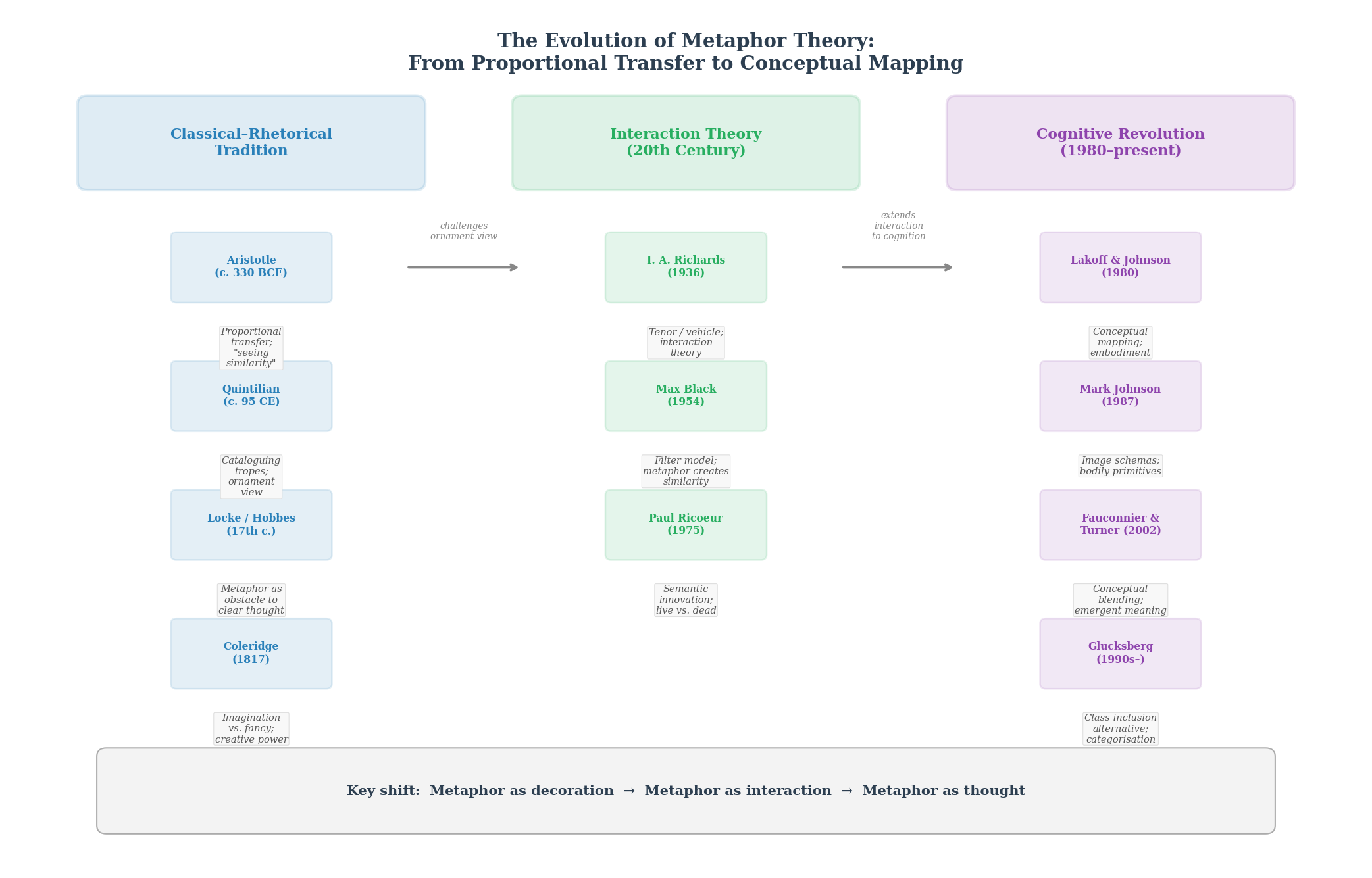
The journey from ornament to architecture was neither sudden nor smooth. It passed through the rhetorical handbooks of Rome, the theological commentaries of the Middle Ages, the Romantic elevation of imagination, the analytical philosophy of I. A. Richards and Max Black, and the embodied cognition programme that gave Lakoff and Johnson the theoretical framework for their 1980 book Metaphors We Live By. Each of these moments contributed something essential, and several of them contained insights that anticipated the cognitive revolution by decades or centuries. What follows is the story of how the understanding of metaphor changed, why it changed when it did, and what the change reveals about the relationship between language, thought, and the body that thinks.
The Aristotelian Legacy Reconsidered
What Aristotle Actually Said
The standard account of metaphor in Western intellectual history begins with Aristotle and then immediately simplifies him. The simplification runs like this: Aristotle defined metaphor as the transfer of a name from one thing to another, treated it as a species of ornamental language appropriate to poetry and public speaking, and thereby established the decorative view that would dominate Western thinking about figurative language for two millennia. This account is not entirely false, but it is misleading in ways that matter.
Aristotle's actual treatment of metaphor is spread across two very different works. In the Poetics, he defines metaphor as "the application of a word that belongs to something else" and identifies four types based on the logical relationship between the terms: genus to species, species to genus, species to species, and analogy. The analogical type is the one that matters most for subsequent theory, because it involves a structural correspondence between two pairs of terms. When Homer describes the evening of life, the metaphor works because evening stands in the same relation to day as old age stands to life. The transfer is not arbitrary. It preserves a relational structure, a proportional mapping between domains. This is precisely what Lakoff and Johnson would later call a structural metaphor, and the fact that Aristotle identified its proportional character in the fourth century BCE is a theoretical achievement that deserves more recognition than it typically receives.
In the Rhetoric, Aristotle goes further. He argues that metaphors "set things before the eyes" and produce learning, because they cause the listener to perceive something new about the subject through the unexpected comparison. The phrase "before the eyes" is itself revealing. Aristotle is describing a cognitive effect, not merely an aesthetic one. The good metaphor does not simply decorate an idea that the audience already possesses. It produces a new perception, a way of seeing the subject that was not available before the metaphor was encountered. The audience learns something, and the learning happens through the act of recognising the similarity that the metaphor proposes. This is remarkably close to what modern cognitive linguists call conceptual mapping, and it sits uneasily with the decorative reading that later centuries would impose on Aristotle's text.
The Reduction Through Transmission
What happened between Aristotle and the modern era is a story of progressive simplification. The Roman rhetorical tradition, codified in handbooks by Cicero, Quintilian, and the anonymous author of the Rhetorica ad Herennium, inherited Aristotle's taxonomy of figures but stripped away much of its theoretical depth. Metaphor became one item in a catalogue of tropes, sitting alongside metonymy, synecdoche, irony, and hyperbole as tools in the orator's kit. The emphasis shifted from Aristotle's interest in why metaphors work to a practical concern with how to deploy them effectively. The rhetorician needed to know which metaphors would move an audience, which would seem strained, which were appropriate to forensic as opposed to deliberative oratory. The question of what metaphor reveals about the nature of thought receded into the background.
The medieval period continued this reduction while adding a theological dimension. Figurative language in Scripture required interpretation, and the elaborate systems of biblical exegesis developed by Origen, Augustine, and the later scholastic commentators treated metaphor as a veil placed over divine truth. The literal sense of a passage was the surface; the figurative sense was the deeper meaning that trained readers could extract through allegorical, moral, and anagogical reading. This hermeneutic tradition took metaphor seriously as a vehicle of meaning, but it located the meaning in the divine intention behind the text rather than in the cognitive operations of the human reader. Metaphor was meaningful because God had placed meaning in it, not because the human mind constructed meaning through it. The cognitive dimension that Aristotle had glimpsed was thereby subordinated to a theological framework that would persist, in various forms, until the Enlightenment.
The Enlightenment itself posed a different kind of threat to the serious study of metaphor. John Locke, in his Essay Concerning Human Understanding, mounted a famous attack on figurative language as an obstacle to clear reasoning. "All the artificial and figurative application of words eloquence hath invented," Locke wrote, "are for nothing else but to insinuate wrong ideas, move the passions, and thereby mislead the judgment." Thomas Hobbes was equally suspicious, calling metaphors "ignes fatui" that lead reasoning astray. For the empiricist tradition, metaphor was not merely decorative but actively dangerous, a source of confusion that rigorous thinkers should eliminate from their discourse. This hostility had the paradoxical effect of confirming the decorative theory while inverting its valuation: metaphor was still understood as an addition to plain meaning, but now that addition was treated as contamination rather than enhancement.
The Romantic Counter-Movement
The first serious challenge to the ornament doctrine came not from linguistics or philosophy of language but from literary theory. Samuel Taylor Coleridge, writing in the early nineteenth century, drew a distinction between fancy and imagination that would prove more consequential than it initially appeared. Fancy, in Coleridge's account, is the faculty that rearranges existing materials into new combinations. It is mechanical, aggregative, and ultimately superficial. Imagination, by contrast, is the faculty that dissolves, diffuses, and dissipates existing materials in order to recreate them. It is organic, unifying, and creative in a fundamental sense. The imagination does not merely combine pre-existing elements. It generates new wholes that are greater than the sum of their parts.
Coleridge's distinction mattered for metaphor because it implied that the best figurative language is not ornamental combination but genuine creation. When Shakespeare writes that "life is a walking shadow," the metaphor does not assemble two pre-existing ideas (life, shadow) into a decorative package. It creates a new perception that did not exist before the words were written, a way of understanding the transience and insubstantiality of human existence that could not be paraphrased without loss. This is the Romantic thesis about metaphor, and it anticipates two key elements of the cognitive revolution: the idea that metaphors are cognitively productive rather than merely decorative, and the idea that metaphorical meaning cannot be reduced to literal paraphrase.
Percy Bysshe Shelley went further in A Defence of Poetry, claiming that "language is vitally metaphorical" and that all language marks "the before unapprehended relations of things." This is an extraordinary anticipation of the Lakoff-Johnson thesis, stated more than a century and a half before Metaphors We Live By. Shelley is claiming not merely that poetry uses metaphor but that all language is fundamentally metaphorical, that the apparently literal vocabulary of everyday speech is composed of dead metaphors whose origins have been forgotten. The word "comprehend" originally meant to grasp physically. The word "express" originally meant to press out. The word "understand" may derive from standing among or beneath. If Shelley is right, then the decorative theory has the relationship exactly backwards: it is not that metaphor is an addition to literal language but that literal language is what remains when metaphor has been forgotten.
The Bridge Figures: From Rhetoric to Cognition
I. A. Richards and the Tenor-Vehicle Framework
The twentieth century produced three thinkers whose work bridged the gap between the classical rhetorical tradition and the cognitive revolution. The first was Ivor Armstrong Richards, whose 1936 book The Philosophy of Rhetoric introduced a vocabulary and a theoretical framework that made the cognitive study of metaphor possible. Richards argued that the traditional view of metaphor, which he called the "proper meaning superstition," rested on a fundamental error. It assumed that words have fixed, determinate meanings that metaphor temporarily displaces. Richards countered that meaning is always contextual, always the product of interaction between words, and that metaphor is not an exception to the normal operation of language but its most characteristic expression.
Richards introduced two terms that became standard in subsequent discussion: tenor and vehicle. The tenor is what the metaphor is about, the subject under discussion. The vehicle is the image or concept imported to illuminate the tenor. In the metaphor "life is a journey," life is the tenor and journey is the vehicle. The crucial point that Richards insisted upon is that the meaning of the metaphor is not located in either the tenor or the vehicle alone but in the interaction between them. The metaphor does not simply transfer properties from journey to life. It creates a new meaning that emerges from the co-presence of the two terms, a meaning that neither term possesses independently. This interaction theory of metaphor was a decisive break from the substitution theory that had dominated since Quintilian, which held that a metaphor is simply a substitution of one word for another, reversible by paraphrase.
The interaction theory had an immediate and important consequence. If the meaning of a metaphor is generated by the interaction of tenor and vehicle, then metaphorical meaning cannot be fully paraphrased in literal language. Any literal paraphrase would eliminate the interaction and thereby lose the meaning that the interaction produces. This is the cognitive analogue of what literary critics had long recognised as the untranslatability of great metaphors: that "Juliet is the sun" says something that "Juliet is radiant and life-giving" does not fully capture. Richards gave this intuition a theoretical foundation by locating metaphorical meaning in a cognitive process, the interaction of two conceptual domains, rather than in a rhetorical effect.
Max Black and the Interaction Model
Max Black, the analytic philosopher, took Richards's interaction theory and gave it the precision that analytic philosophy demands. In his 1954 essay "Metaphor" and the 1979 follow-up "More About Metaphor," Black developed what he called the interaction view into a systematic account of how metaphors generate meaning. His central concept was the system of associated commonplaces. When a metaphor states that "man is a wolf," the word "wolf" does not simply transfer a single property (ferocity, say) from wolves to humans. It activates an entire system of beliefs, stereotypes, and associations connected to wolves: they are predatory, they hunt in packs, they are cunning, they are wild, they are outside the social contract. This system functions as a filter or screen through which the subject (man) is perceived. The metaphor selects, emphasises, and organises features of the subject by projecting the associated system of the subsidiary subject onto the primary subject.
Black's contribution went beyond Richards in two important respects. First, he emphasised that the interaction is bidirectional. The metaphor "man is a wolf" does not only make us see men differently. It also, subtly, makes us see wolves differently, colouring our perception of lupine behaviour with anthropomorphic associations. The mapping runs in both directions, and this bidirectionality distinguishes genuine interaction from simple comparison or substitution. Second, Black introduced the idea that a metaphor creates similarity rather than merely expressing pre-existing similarity. Before the metaphor "man is a wolf" was coined, the similarities between human and lupine behaviour were not simply waiting to be noticed. The metaphor itself established a new way of seeing the resemblance, constructed it as a cognitive object that could then be explored, extended, and contested. This constructive power of metaphor, the capacity to bring new similarities into existence rather than merely reporting old ones, would become a central tenet of conceptual metaphor theory.
Paul Ricoeur and the Power of Semantic Innovation
The French philosopher Paul Ricoeur completed the bridge between rhetoric and cognition with his 1975 work La Métaphore Vive, translated as The Rule of Metaphor. Ricoeur's contribution was to take the interaction theory to its philosophical conclusion by arguing that live metaphors are acts of semantic innovation. They do not merely rearrange existing meanings. They produce new meaning that enters the language and, through the language, enters the way a community thinks.
Ricoeur drew a sharp distinction between dead and living metaphors that illuminated the stakes of the debate. A dead metaphor is one whose figurative origin has been forgotten and whose meaning has been absorbed into the literal vocabulary of the language. The "leg" of a table, the "mouth" of a river, the "body" of an argument are all dead metaphors in this sense. They have lost their capacity to surprise, to create new perception, to generate the interaction between domains that Richards and Black described. A living metaphor, by contrast, retains its tension, its capacity to juxtapose two domains that do not ordinarily belong together and to produce meaning from that juxtaposition. Ricoeur argued that the death of metaphors is not merely a historical curiosity but a fundamental process in the evolution of language: metaphors are the mechanism through which new concepts are introduced into the vocabulary, and the gradual death of those metaphors is the mechanism through which figurative meaning becomes literal meaning.
What Ricoeur added to Richards and Black was a temporal and historical dimension. Metaphor is not a static relationship between two terms but a process, a movement from innovation to convention to literalisation. Every word in the language that now seems perfectly literal, perfectly transparent, was once a metaphor. The history of meaning is the history of metaphorical creation followed by metaphorical death, in an endless cycle. This insight would prove essential to Lakoff and Johnson's programme, because it provided the theoretical basis for their most provocative claim: that the apparently literal language of everyday speech is pervaded by conceptual metaphors whose figurative origins have been forgotten but whose structuring power remains active.
The Architecture of Conceptual Mapping
How Structural Metaphors Organise Entire Domains
When Lakoff and Johnson published Metaphors We Live By in 1980, the most immediate and verifiable claim of the book was that conventional everyday language is systematically structured by conceptual metaphors. The metaphor ARGUMENT IS WAR is not a single isolated comparison. It is a mapping between two entire conceptual domains that generates a coherent family of expressions: we attack positions, defend claims, shoot down arguments, marshal evidence, adopt strategies, win and lose debates. These expressions are not random. They are systematically related to each other because they all derive from the same underlying mapping, the same projection of the structure of warfare onto the domain of argumentation.
The systematicity of the mapping is what distinguishes conceptual metaphor from the isolated comparisons of the classical tradition. Aristotle would have recognised "his argument was demolished" as a metaphor, a transfer of a word from the domain of buildings to the domain of argument. But what Aristotle did not do, and what Lakoff and Johnson did, was to recognise that this particular metaphor belongs to a system that includes "he built a case," "the foundation of the argument is weak," "the theory collapsed," and "the framework of the proposal is sound." These are not independent metaphors that happen to share a thematic similarity. They are expressions of a single conceptual metaphor, THEORIES ARE BUILDINGS, in which the domain of architecture is projected systematically onto the domain of intellectual construction. The foundation maps onto the basic assumptions. The structure maps onto the logical organisation. The collapse maps onto the failure of the reasoning. The mapping preserves the relational structure of the source domain and imposes it on the target domain.
This systematicity has a further consequence that the classical tradition did not anticipate. Because conceptual metaphors are systematic, they generate inferences. If we understand an argument as a building, then the inference that a building with a weak foundation will eventually collapse becomes an inference about arguments: an argument with weak basic assumptions will eventually fail. We do not need to reason about this explicitly. The inference is carried by the metaphor automatically, as part of the mapping between domains. This is what Lakoff and Johnson meant when they said that metaphors are not merely linguistic but conceptual: they do not simply provide alternative words for ideas we already have. They provide alternative inferential structures that shape how we reason about the target domain.
The Invariance Principle and Mapping Constraints
Not all imaginable metaphors work. We can say "time flies" but not, without considerable strain, "time swims." We can say "the economy is overheating" but not "the economy is catching a cold" with the same naturalness. The metaphor LOVE IS A JOURNEY generates expressions like "we are at a crossroads," "we have come a long way," "this relationship is going nowhere," and "we need to go our separate ways." But it does not generate expressions like "our love needs a spare tyre" or "this relationship needs an oil change," even though these would follow from the mapping if it were indiscriminate. Something constrains which elements of the source domain are projected onto the target domain and which are not. Understanding those constraints is essential to understanding why conceptual metaphors work the way they do.
Lakoff proposed the Invariance Principle as the answer: metaphorical mappings preserve the image-schematic structure of the target domain. The target domain has its own inherent structure, its own topology, and the mapping from the source domain must be consistent with that structure. Love has certain inherent properties, relational dynamics, emotional intensities, temporal patterns, that constrain which journey-related elements can be projected onto it. The mechanics of vehicular maintenance do not correspond to anything in the inherent structure of romantic relationships, so those elements are not projected. The crossroads, however, maps naturally onto the experience of having to make a decision about the relationship's direction, because both crossroads and relationship decisions share the image-schematic structure of a path that diverges.
The Invariance Principle solved a problem that had troubled earlier theories: the problem of what prevents metaphorical mappings from being random or unconstrained. If a metaphor is just a comparison, then anything could be compared to anything else, and the theory would have no predictive power. But if the mapping must preserve the image-schematic structure of the target domain, then the range of possible mappings is constrained in principled ways. This constraint is what gives the theory its explanatory power. It explains why certain metaphors feel natural and others feel strained, why certain extensions of a metaphorical mapping work and others do not, and why different languages often converge on similar metaphorical systems for the same target domains despite having no historical contact.
The Question of Directionality
One of the most theoretically significant features of conceptual metaphor is that the mapping is asymmetric. We understand abstract domains in terms of concrete ones, not the other way around. We understand time in terms of space, not space in terms of time. We understand argument in terms of war, not war in terms of argument. We understand quantity in terms of vertical position (more is up), not vertical position in terms of quantity. This directionality is not an arbitrary convention. It reflects something fundamental about how the human mind handles abstraction.
The explanation that Lakoff and Johnson offered is grounded in developmental and experiential priority. The concrete domains that serve as sources for conceptual metaphors are domains that humans experience directly, through sensorimotor interaction with the physical world, from the earliest moments of life. Infants experience spatial position before they understand social hierarchy. They experience physical warmth before they understand emotional closeness. They experience physical containment before they understand category membership. The concrete domains are experientially prior, and the abstract domains are understood through them because there is no other way to understand them. You cannot explain what "more" means without recourse to spatial or physical metaphors of accumulation, height, or expansion. You cannot explain what "understanding" means without recourse to visual metaphors of seeing, grasping, or illumination. The directionality of metaphorical mapping follows from the directionality of human experience.
This asymmetry has a philosophical consequence that is worth pausing over. If abstract concepts are understood through metaphorical mapping from concrete experience, then abstract thought is not the purely rational, disembodied process that the Western philosophical tradition, from Plato through Descartes to the logical positivists, assumed it to be. Abstract thought is grounded in the body. It inherits the structure of physical experience. It carries the imprint of spatial orientation, force dynamics, containment, and motion. This is the thesis of embodied cognition, and it represents a fundamental challenge to the view of mind that had dominated Western philosophy for twenty-five centuries. The mind is not a disembodied calculator operating on abstract symbols. It is a body's way of making sense of a world that the body inhabits, and the metaphors through which it thinks are the traces of that embodiment.
The Body in the Machine: Embodied Cognition and Metaphor
Image Schemas as Cognitive Primitives
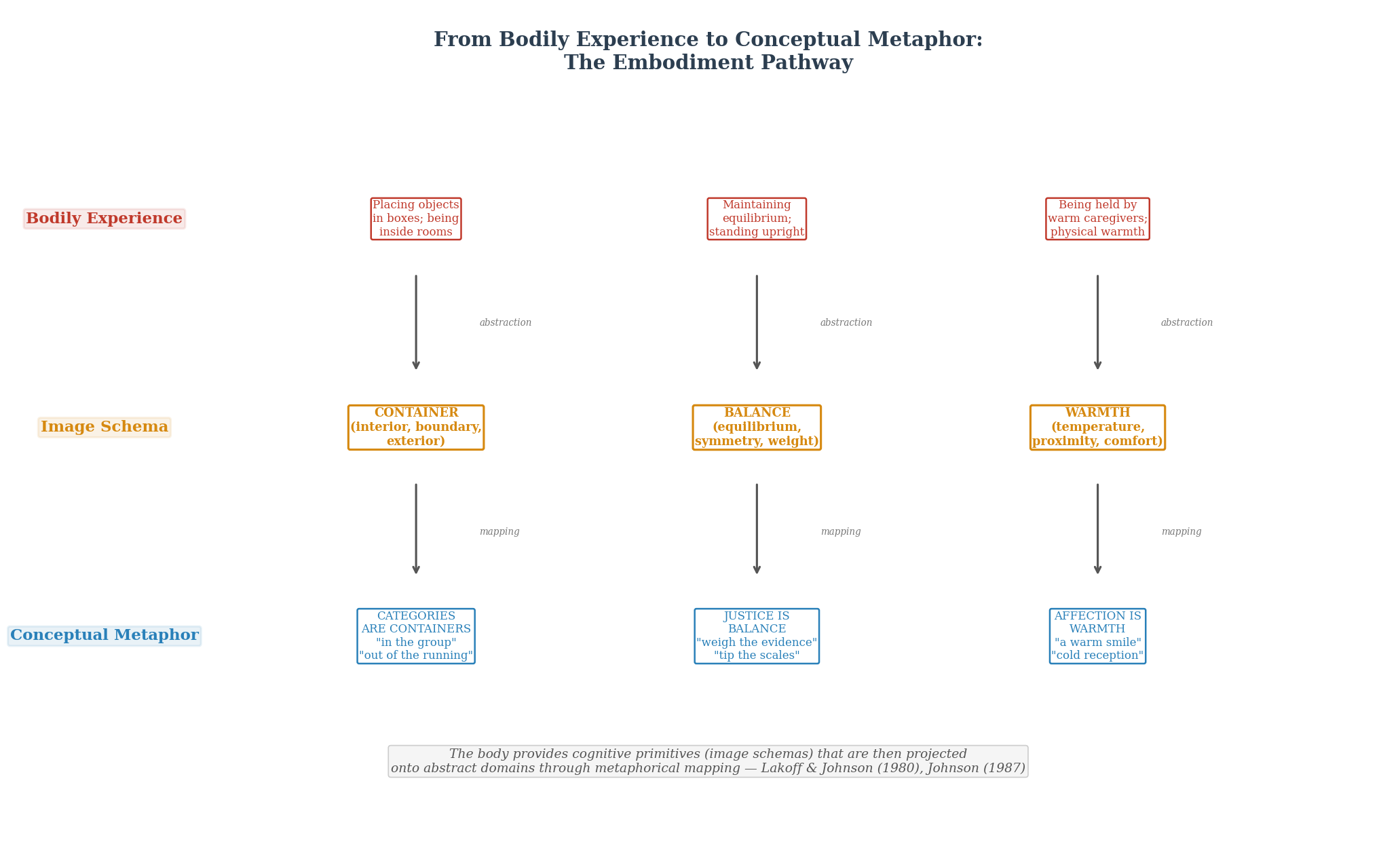
The concept of image schemas, developed by Mark Johnson in The Body in the Mind (1987) and elaborated by Lakoff in Women, Fire, and Dangerous Things (1987), provides the theoretical foundation for the embodied account of conceptual metaphor. Image schemas are recurring patterns of sensorimotor experience that are abstracted from specific instances and stored as general cognitive structures. They are pre-conceptual, in the sense that they emerge from bodily experience before the development of language, and they are schematic, in the sense that they capture the abstract relational structure of an experience rather than its specific content.
The CONTAINER schema, for example, derives from the universal human experience of physical containment: being inside rooms, placing objects inside containers, moving in and out of bounded spaces. The schema has three structural elements, an interior, an exterior, and a boundary, and it supports certain basic inferences: if something is inside the container, it is not outside it; if something crosses the boundary inward, it enters the container; if the container is moved, its contents move with it. These inferences are not learned through language. They are learned through the bodily experience of interacting with physical containers from infancy onward. But once the CONTAINER schema is established as a cognitive primitive, it becomes available as a source for metaphorical mapping onto abstract domains. Categories are understood as containers (things are "in" or "out" of a category). States are understood as containers (one is "in" love, "in" trouble, "in" a good mood). Visual fields are understood as containers (objects come "into" view or pass "out" of sight). The schema travels from the concrete to the abstract, carrying its inferential structure with it.
The PATH schema derives from the equally universal experience of moving from one location to another. It has three structural elements: a source (starting point), a goal (destination), and a trajectory (the route connecting them). The FORCE schema derives from the experience of physical forces acting on the body: gravity pulling, muscles pushing, obstacles resisting. The BALANCE schema derives from the experience of maintaining equilibrium in a gravitational field. Each of these schemas is pre-linguistic, pre-conceptual, and rooted in the physics of being a body in a physical world. Together they constitute a repertoire of cognitive primitives from which more complex conceptual structures are built through metaphorical extension.
The Grounding of Orientational Metaphor
The orientational metaphors that Lakoff and Johnson identified, such as MORE IS UP, HAPPY IS UP, HEALTH IS UP, and CONTROL IS UP, along with their inverses LESS IS DOWN, SAD IS DOWN, SICKNESS IS DOWN, and SUBJECTION IS DOWN, provide some of the clearest evidence for embodied grounding. These metaphors are not arbitrary associations between spatial direction and abstract quality. They are motivated by systematic correlations in bodily experience. When you add more liquid to a container, the level rises. When you stand upright, you are healthy and alert; when you fall or slump, you are injured or defeated. When you are in control, you are physically above your subordinates, on a stage, on a throne, on higher ground. When you are happy, your posture is erect and your energy is directed upward; when you are sad, you slump, droop, and direct your gaze downward.
These experiential correlations are not culturally constructed. They are consequences of living with a human body in a gravitational field. An infant who has never heard a word of any language nevertheless experiences the correlation between vertical position and quantity every time milk rises in a bottle, blocks stack into a tower, or sand accumulates in a pile. The metaphorical mapping from spatial orientation to abstract quality is motivated by these correlations, and this motivation is what gives orientational metaphors their cross-cultural consistency. Though the specific linguistic expressions vary across languages, the underlying mapping from vertical position to evaluative quality appears in language after language, consistent with the prediction that metaphors grounded in universal bodily experience should be universal or near-universal across cultures.
The experimental evidence supports this account with remarkable consistency. Lawrence Williams and John Bargh demonstrated in 2008 that holding a warm cup of coffee caused participants to rate a hypothetical person as warmer in personality, confirming that the metaphor AFFECTION IS WARMTH is not merely linguistic but is grounded in a sensorimotor coupling between physical temperature and social evaluation. Meier and Robinson showed in 2004 that positive words are processed faster when they appear at the top of a computer screen and negative words are processed faster when they appear at the bottom, consistent with the GOOD IS UP mapping. Casasanto and Dijkstra found in 2010 that upward physical motion facilitated the retrieval of positive autobiographical memories, while downward motion facilitated negative retrieval. The metaphor is not merely in the language. It is in the body, shaping perception and memory at a level below conscious awareness.
The Neural Evidence for Embodied Metaphor
The strongest evidence for embodied metaphor comes from neuroscience, which can directly test whether the processing of metaphorical language activates the sensorimotor regions that the theory predicts should be involved. If the metaphor GRASPING AN IDEA is grounded in the physical experience of grasping objects, then comprehending phrases like "grasp the concept" should activate motor cortex regions associated with hand movement. If the metaphor MORAL PURITY IS PHYSICAL CLEANLINESS is grounded in sensorimotor experience, then encountering descriptions of moral transgression should activate disgust-related neural circuits.
Vittorio Gallese and George Lakoff published a landmark paper in 2005 arguing that the neural theory of language provides the mechanism for conceptual metaphor. Their proposal was that metaphorical mappings are implemented as neural circuits linking sensorimotor areas to higher-order association areas, and that the activation of a metaphorical expression literally reactivates the sensorimotor experience from which the metaphor derives. This neural reuse hypothesis holds that the brain does not develop entirely separate systems for abstract and concrete thought. Instead, it reuses the neural machinery developed for sensorimotor interaction to handle abstract concepts, through the mediating mechanism of metaphorical mapping.
Subsequent neuroimaging studies have provided partial support for this hypothesis. Desai and colleagues found in 2011 that action-related metaphors like "grasping a concept" activated premotor and motor cortex regions, though less strongly than literal action sentences. Lacey, Stilla, and Sathian showed in 2012 that texture-related metaphors like "a rough day" activated somatosensory cortex regions involved in tactile processing. The activation is real but reduced in magnitude compared to literal sensorimotor processing, suggesting that metaphor comprehension involves a partial simulation of the source domain experience rather than a full reactivation. This finding is consistent with a moderate embodiment position: metaphorical meaning is grounded in sensorimotor experience, but the grounding becomes attenuated as metaphors become conventional and their processing becomes more automatic. The body is present in metaphorical comprehension, but it is present as an echo rather than a shout.
Dead Metaphors and the Archaeology of Meaning
The Life Cycle of a Metaphor
Every metaphor that now seems transparently literal was once a living figure that sparked a moment of cognitive recognition. The word "comprehend" derives from the Latin comprehendere, meaning to seize or grasp physically. When it was first used to describe mental understanding, it was a metaphor: understanding is grasping, the mind seizes an idea the way a hand seizes an object. The word "depend" derives from dependere, to hang from. When we say that a conclusion depends on a premise, we are using a dead metaphor from the domain of physical suspension. The word "spirit" derives from spiritus, meaning breath. When early thinkers described the animating principle of a living being as its spirit, they were using a metaphor that mapped the experience of breathing, the most basic indicator of life, onto the abstract concept of what makes a being alive.
The trajectory from living metaphor to dead metaphor to literal meaning is one of the most important processes in the history of language, and it occurs along a continuous gradient rather than through discrete stages. At one end of the gradient are fully alive metaphors that retain their capacity to surprise and to generate the interaction between domains that Richards described. "Her grief was an Antarctic expedition" is such a metaphor. At the other end are etymological fossils whose figurative origins are accessible only to specialists. Few speakers of English, when they use the word "window," think of the Old Norse vindauga, meaning wind-eye, though the metaphor perfectly captures the original function of an opening in a wall. Between these extremes lies a vast territory of metaphors in various stages of conventionalisation: "time flies," "the heart of the matter," "a flood of immigrants," "the foot of the mountain."
The process of metaphorical death is not merely linguistic. It is cognitive. A living metaphor requires the simultaneous activation of two domains, the tenor and the vehicle, and the perception of the interaction between them. As a metaphor becomes conventional through repeated use, the dual activation fades. The metaphorical meaning becomes the primary or default meaning, accessed directly without reference to the original source domain. When a contemporary English speaker says "I see what you mean," they do not momentarily activate the domain of visual perception and then map it onto the domain of intellectual understanding. They access the meaning of "see" as "understand" directly, as a polysemous word with both a visual and a cognitive sense. The metaphor has died, and its death is registered in the cognitive processing as a shift from dual-domain activation to single-sense retrieval.
Etymological Residue and Conceptual Persistence
Lakoff and Johnson's most controversial claim about dead metaphors is that their death is only partial. The metaphor may cease to be consciously processed as figurative, but the underlying conceptual mapping, the systematic projection of structure from one domain to another, continues to organise thought. We no longer notice that "I see your point" is a metaphor, but the UNDERSTANDING IS SEEING mapping continues to generate new expressions ("let me shed some light on this," "that observation was illuminating," "the argument is opaque," "I need a clearer picture of the situation") and, more importantly, continues to structure how we reason about understanding. We treat understanding as if it were vision, with all the inferences that follow: understanding requires attention (looking), understanding can be obstructed (something is blocking the view), understanding can be partial (seeing through a fog), and understanding can be shared by directing someone's attention (pointing something out).
The evidence for this conceptual persistence comes from several sources. Corpus studies have shown that dead metaphors cluster into systematic families, exactly as the theory predicts. The UNDERSTANDING IS SEEING family, the ARGUMENT IS WAR family, the TIME IS MONEY family, and the IDEAS ARE FOOD family (digesting information, half-baked ideas, food for thought, swallowing a claim) all exhibit the kind of internal coherence that would be inexplicable if each expression were an independent lexical accident. The coherence is evidence of an underlying mapping that continues to operate even when the individual expressions have lost their figurative feel.
Experimental evidence adds a further dimension. Thibodeau and Durgin showed in 2011 that the systematic structure of dead metaphorical expressions influences how people reason about the target domain, even when participants do not report being aware of the metaphorical framing. Participants who read a passage about crime using disease-related vocabulary subsequently favoured public health interventions, while participants who read the same statistical information embedded in predator-related vocabulary favoured enforcement measures. The vocabulary was dead-metaphorical in both cases: "infected neighbourhoods," "spreading crime" versus "predatory criminals," "lurking danger." But the underlying conceptual mappings, disease versus predator, continued to channel reasoning in predictable directions. The death of the metaphor did not kill the mapping; it merely made the mapping invisible.
The Catachresis Problem and the Boundary of the Literal
The most philosophically interesting category of dead metaphor is catachresis: the use of figurative language to name something for which no literal term exists. The "leg" of a table, the "face" of a clock, the "neck" of a bottle, the "arms" of a chair all exemplify catachresis. There is no literal, non-metaphorical way to refer to these parts of these objects. The metaphor has not replaced a pre-existing literal term. It has filled a lexical gap, providing the only available name for something that needed to be named.
Catachresis poses a challenge for the neat distinction between literal and figurative language that the classical tradition assumed. If a metaphorical expression is the only available term for its referent, in what sense is it figurative? The "leg" of a table does not stand in contrast to a literal term that has been temporarily displaced. There is no non-metaphorical alternative. The catachrestic expression is, in a sense, the literal term, because it is the standard, conventional, dictionary-listed name for the referent. Yet its metaphorical origin is transparent: it is called a "leg" because it bears the same structural relationship to the table (supporting it, extending downward, providing stability) that a leg bears to an animal body.
Jacques Derrida exploited this ambiguity in his critique of the literal-figurative distinction. If the entire vocabulary of abstract concepts has been built through catachrestic extension from concrete domains, as the etymological evidence strongly suggests, then the distinction between literal and figurative language cannot be drawn in the way that the classical tradition assumed. There is no pristine domain of literal meaning from which metaphor departs. Literalness, on this account, is not the ground state of language. It is the sediment left behind when metaphors die and their origins are forgotten. This is a radical conclusion, and it converges from a very different philosophical direction with the central claim of Lakoff and Johnson's programme: that abstract thought is fundamentally and irreducibly metaphorical, and that the appearance of literalness in abstract language is an illusion produced by the conventionalisation of metaphors whose figurative character is no longer perceived.
The Tensions Within the Revolution
Glucksberg's Challenge and the Class-Inclusion Alternative
The cognitive revolution in metaphor theory did not proceed without serious opposition, and the most empirically grounded challenge came from Sam Glucksberg and his collaborators. Glucksberg's class-inclusion model, developed in a series of papers from the 1990s onward, offered an alternative account of metaphor comprehension that did not require the elaborate structural mappings between source and target domains that Lakoff and Johnson postulated. On Glucksberg's account, when we hear "my lawyer is a shark," we do not perform a mapping from the SHARK domain to the LAWYER domain, projecting properties of sharks onto lawyers. Instead, we categorise the lawyer as a member of a superordinate category, a category of ruthlessly predatory agents, for which "shark" serves as the prototype. The metaphor asserts membership, not mapping.
The class-inclusion model has certain empirical advantages. It explains why metaphors are processed asymmetrically, why "my lawyer is a shark" feels natural but "a shark is my lawyer" does not, because the prototypicality relationship runs in one direction. It explains why metaphors are processed as quickly as literal language in response-time experiments, because categorisation is a rapid, automatic process that does not require the elaboration of structural correspondences. And it provides a cleaner account of novel metaphor comprehension, because the creation of an ad hoc category is a simpler cognitive operation than the construction of an entirely new cross-domain mapping.
The debate between conceptual metaphor theory and the class-inclusion model is not resolved, and a sophisticated understanding of the field requires holding both accounts in view simultaneously. Conceptual metaphor theory is stronger when dealing with systematic, conventional metaphorical expressions that form coherent families: the dozens of expressions generated by ARGUMENT IS WAR or TIME IS MONEY are difficult to explain as independent categorisation events. The class-inclusion model is stronger when dealing with isolated, novel metaphors that do not belong to any systematic mapping. The two theories may ultimately prove to be accounts of different phenomena, or of different stages in the processing of metaphorical language: initial comprehension through categorisation, followed by elaboration through structural mapping for metaphors that are sustained or explored in detail.
Blending Theory and the Limits of Two-Domain Mapping
A more sympathetic challenge to classical conceptual metaphor theory came from within the cognitive linguistics tradition itself. Gilles Fauconnier and Mark Turner, in their 2002 book The Way We Think, proposed conceptual blending as an alternative to the two-domain mapping model. Blending theory argues that metaphorical meaning is not produced by a direct mapping from source to target but by the integration of elements from multiple mental spaces into a blended space that has emergent properties not present in any of the inputs.
The canonical example is the "debate as boxing match" blend. The input spaces are the domain of intellectual debate and the domain of boxing. In the blended space, the debaters are boxers, the arguments are punches, the refutation is a knockout, and the audience watches and judges. But the blend contains elements that exist in neither input space alone: the idea of "intellectual knockout," for instance, which combines the finality of a boxing knockout with the conceptual nature of argument, is an emergent structure that belongs only to the blend. Blending theory argues that this kind of emergent structure cannot be explained by simple mapping between two domains, because neither domain contains it. It is produced by the integration process itself.
Blending theory extends the power of cognitive metaphor theory while complicating its architecture. It accounts for phenomena that the two-domain model handles awkwardly, such as metaphors that involve more than two input domains, metaphors that produce meanings not derivable from any single mapping, and the creative elaboration of metaphors in real-time discourse. It also provides a better account of how analogical reasoning works in scientific discovery and artistic creation, where the productive insight often comes not from mapping one domain onto another but from integrating elements of multiple domains into a new configuration that reveals previously invisible structure. The cost of this explanatory power is increased theoretical complexity, and the empirical challenge of distinguishing blending from mapping in specific cases remains considerable.
What the Classical Tradition Still Teaches
The cognitive revolution transformed the study of metaphor, but it did not render the classical tradition obsolete. There are insights in the rhetorical tradition that cognitive linguistics has not fully absorbed, and recognising them is a mark of intellectual maturity rather than theoretical regression. The classical emphasis on the rhetorical context of metaphor use, on the social and persuasive functions of figurative language, on the difference between metaphors that illuminate and metaphors that deceive, remains essential. Lakoff and Johnson's theory is a theory of conceptual structure, not a theory of communicative strategy, and the gap between these two things is precisely the gap that rhetoric has always occupied.
Aristotle's insight that metaphor produces learning through the recognition of similarity remains as valid as it was in the fourth century BCE. Richards's insistence that metaphorical meaning cannot be paraphrased without loss remains a corrective to any theory that treats metaphors as mere vehicles for propositional content. The Romantic elevation of metaphor from decoration to creation anticipated the cognitive revolution by more than a century and provides a philosophical depth that the empirical programme sometimes lacks. The study of metaphor is richer for the revolution, but it would be poorer if the revolution were taken as a mandate to discard everything that came before it.
The deepest lesson of the transition from rhetoric to cognition is that the classical theorists were not wrong about what metaphor does. They were wrong about where it does it. They located metaphor in language, in the verbal surface of communication, and treated it as a departure from the norm of plain speech. The cognitive revolution relocated metaphor in thought, in the conceptual structures that underlie language, and revealed that what had seemed like departure was in fact the norm. The metaphors are not in the words. The words are in the metaphors. Every time we speak of understanding as seeing, argument as war, time as money, or love as a journey, we are not decorating pre-existing thoughts with figurative language. We are thinking. The metaphor is not the clothing of the idea. It is the skeleton.