The Manuscript World
For most of recorded history, a book was a physical object made by hand, one copy at a time. In medieval Europe the work of copying fell mainly to monks in the scriptoria of monasteries, where a single scribe working in a careful hand might produce only a few pages a day. A complete Bible, the largest book of the age, could take a scribe the better part of a year. The labor was not merely slow; it was specialized, repetitive, and easily interrupted. A scribe who fell ill, or whose monastery was raided, or who simply lost interest, could leave a manuscript unfinished for decades. Every additional volume in the world therefore represented hundreds of hours of somebody's concentrated attention, and that simple arithmetic set the ceiling on how much written knowledge could exist at all.
The materials themselves were expensive. The finest books were written on vellum or parchment, prepared from the skins of calves, sheep, or goats, scraped, limed, and stretched until they formed a smooth writing surface. A single large Bible might consume the skins of an entire herd of animals. Cheaper books could be written on rag paper, a technology borrowed from the Islamic world and then from Italy, but paper too had to be manufactured in small batches from pulped linen rags, and it remained costly while supplies of rags were limited. Ink was made from oak-gall tannins and iron salts, which produced the familiar brownish script of medieval manuscripts; it was serviceable but prone to fading and to corrosion of the page over centuries.
Universities developed their own copying economies. At Paris and Bologna a pecia system let students and stationers rent out copies of scholarly texts in loose quires, which were then recopied and returned. This sped things up, but the underlying constraint was unchanged: every further copy meant more hands repeating the same slow labor. A book could not be "multiplied" except by being copied again, by a person, word by word.
Because books were scarce and costly, they tended to accumulate in the places that could afford them: monasteries, cathedral chapters, the libraries of princes and of the wealthiest universities. A few hundred volumes counted as a genuinely great library. Books were often chained to desks so they could not be carried off, and they were treated as treasures rather than as tools. A single fine manuscript could be worth more than a small farm, and a merchant's account book might be the only book his household ever owned. The geography of book-holding mirrored the geography of wealth and power: the Mediterranean centers that had been richest in the early Middle Ages gave way, by the later Middle Ages, to the thriving towns of the north — Paris, Flanders, the Rhineland — where trade and universities created new demand for texts.
Reading itself was unevenly distributed. Literacy — the ability to read, as opposed to the rarer ability to write — was concentrated among clergy, professional scribes, lawyers, and a slice of the urban middle class. Even among the privileged, reading was more common than writing. The language of learning was Latin, which united scholars across Europe but excluded the great majority of people, who spoke only their local vernacular tongue. A peasant in Kent and a peasant in Kent's French possessions might both be illiterate in Latin, and Latin was precisely the language in which the most important books were written. Women, even noblewomen, were far less likely than men to be literate, though convent scribes and a few exceptional readers form a notable exception. The written word therefore moved through a narrow, privileged channel.
Hand copying introduced a quiet problem that grew worse with every generation: error. A scribe who misread a word, skipped a line, or improvised a phrase produced a copy that differed, however slightly, from its parent. The next scribe copying that manuscript reproduced the error, and perhaps added a few of his own. Over decades a text could drift noticeably from its ancestor. There was no single authoritative edition against which to check a suspect copy, because every copy was itself a fresh act of transcription. Two manuscripts of the same work could differ in wording, in the order of passages, or in whole sections present in one and missing in another. Some of the most admired manuscripts are also the most heavily edited, their margins crowded with corrections made by readers trying to repair what earlier scribes had broken.
The result was a world in which knowledge was scarce, slow to move, and locally variable. A discovery made and written down in one city might take years to reach another, arriving in a form already subtly altered. A student who wanted a text had to find a copy and copy it, or pay someone to do so. There was no way to put an identical book into the hands of readers in a hundred different places at once. That limitation was so normal that few people imagined it could be otherwise. It is the background against which the printing press appears not as a clever gadget but as a transformation of the conditions of knowledge itself. To understand what printing changed, one must first grasp how thin the stream of books had been before it.
A few numbers help fix the scale. A modest manuscript Bible might cost the equivalent of a year's wages for a skilled laborer, so only institutions and the very rich owned one. The total number of books in all of Europe on the eve of printing is estimated in the low hundreds of thousands at most — scattered, unique, and slow to grow. Most people encountered the written word not by owning a book but by hearing one: in church, in the courtroom, in a town crier's proclamation. Memory and oral repetition did the work that storage and search do today. A scholar's reputation rested partly on the size of his personal library, because a large collection was both rare and expensive, and lending or copying from it was a favor exchanged among peers. When a book was lost to fire, war, or neglect, the text it carried could vanish for centuries or forever. The manuscript world was, in this literal sense, fragile: knowledge persisted only so long as some person, somewhere, kept copying it. Printing would change that fragility into durability, because a printed edition could be reproduced and survive in many copies across many places at once.
Gutenberg and Movable Type
The man conventionally credited with bringing printing to Europe is Johannes Gutenberg, a goldsmith and businessman from Mainz, a trading city on the Rhine. He was not the first person ever to print — the Chinese had printed from carved wooden blocks centuries earlier, and Europeans had experimented with woodblock printing of single-page images and short texts. But Gutenberg's contribution was a system for printing with movable metal type, and it is the system, not any one part of it, that changed everything.
To see why his approach was different, consider the older method of block printing. A carver would cut an entire page of text into a single block of wood, in reverse. That block could then be inked and pressed onto paper, producing many copies of that one page. But if you wanted a different page, you had to carve a different block. The labor of carving was not reusable. Woodblock books, known as block books, therefore remained small and expensive, because each new page demanded a new carving. For languages with thousands of characters, such as Chinese, carving each page was merely tedious; for a language with an alphabet of a few dozen letters, the waste was glaring, because the same letter recurs constantly and yet had to be re-cut every time it appeared.
Gutenberg's breakthrough was to make the individual letters reusable. Instead of carving a whole page, he cast separate, identical copies of each letter of the alphabet — a tiny metal block, or sort, with the mirror image of a single character raised on its top face. These sorts could be arranged into words and lines, locked into a frame, printed, and then — crucially — taken apart and reused to set an entirely different page. The same 'a' could appear in a thousand different books. This is what movable type means, and the reusability is the whole point. An alphabetic script, with its small inventory of repeating characters, was uniquely suited to this method; that is part of why movable type caught on in Europe even though earlier experiments in Asia had not produced the same breakthrough.
Making large numbers of identical metal letters required solving a manufacturing problem. Gutenberg's method used a punch — a hardened steel rod with the shape of a letter cut into its end — struck into a softer metal matrix. Molten type metal poured into the matrix around the punch, and when it cooled, produced a single sort. The punch and matrix together meant that one master letter-shape could generate endless identical copies. The letters were then trimmed to a uniform height so they would all print with even pressure.
The alloy mattered a great deal. Gutenberg's type was made from a mixture of lead, tin, and antimony. Lead and tin gave the metal a low melting point and made it easy to cast; antimony, added in a smaller proportion, expanded slightly as it cooled, which had the useful effect of filling the fine details of the letter-shape and producing a crisp, durable character that would not squash under the pressure of the press. The choice of alloy was a small but essential engineering decision buried inside the larger invention, and getting it wrong would have yielded letters that blurred or broke.
Ink was another. The water-based inks used by manuscript scribes and by woodblock printers did not adhere well to cold metal type. Gutenberg developed an oil-based ink, made from soot and varnish, that gripped the metal and transferred cleanly to paper. Without the right ink, even perfect type would have yielded smudged, incomplete impressions.
To press the paper against the inked type, Gutenberg adapted the screw press already used in his region for squeezing juice from grapes and oil from olives. A heavy platen was driven down onto the paper by a large screw turned with a bar; the printer pulled the bar, the platen pressed, and an impression was made. This was muscle-powered machinery, but it was machinery that could repeat the same force thousands of times a day, far beyond the patience of any hand burnishing a block onto paper.
The writing surface completed the system. Cheap rag paper — made from pulped linen and cotton rags — was light, absorbent, and far less expensive than vellum. A printing system that demanded vellum for every sheet would have been economically impossible; paper made the arithmetic work.
Gutenberg's achievement is best dated to the early 1450s in Mainz. By around 1455 his workshop had produced what is now called the Forty-Two-Line Bible (named for the number of lines per column), a large, two-volume Latin Bible printed with movable type. Its survival is the proof that the system functioned at scale: this was not a toy or a single experiment but a working means of producing substantial books. The enterprise was backed by a financier, Johann Fust, and when Gutenberg could not repay the loan, Fust took control of much of the equipment — a reminder that printing was as much a commercial gamble as a technical one. Gutenberg himself struggled financially and lost control of his press to business partners, but the technique escaped his workshop and spread.
It is worth stressing that the press was never a single gadget. It was a bundle of coordinated inventions — reusable metal type, a way to make identical letters cheaply, the right alloy, the right ink, the adapted screw press, and cheap paper — held together by the organization of labor that could run them. Remove any one element and the system fails. That is why printing did not arrive earlier, and why, once it arrived, it proved so hard to un-invent. The precursors existed; the assembly of them into a working, profitable whole was the genuine novelty.
It is worth asking why Europe, and why then. Movable type was not unknown in Asia: the artisan Bi Sheng made ceramic movable type in China around the 1040s, and Korean printers cast metal type by the 1230s, with the scholar-official Choe Yun-ui and later the Jikji of 1377 showing what was possible. Yet these experiments did not trigger a continental printing revolution. Part of the reason lies in the scripts: Chinese and Korean writing use thousands of characters, so a full set of types is enormous and the reuse advantage slimmer than for an alphabet of a few dozen letters. Europe's compact alphabets were ideally suited to Gutenberg's approach. The demand side mattered too. By 1450 Europe had burgeoning universities, a lay piety hungry for devotional books and Bibles, and a merchant class with money to spend on them. Gutenberg's backer, Johann Fust, and his skilled employee Peter Schoeffer (who married into the business and became a printer in his own right) show that printing was as much a commercial venture as an invention. The lawsuit Fust brought against Gutenberg in 1455, seizing the press for unpaid debt, is a reminder that the new technology lived or died by ordinary questions of capital and account books. Invention alone was never enough; the press needed a market, and Europe in the mid-fifteenth century had one.
How a Printed Book Was Made
Once the type was cast, making a book was a sequence of distinct operations, each performed by a trained worker. The first of these was composition. A compositor stood at a case holding the sorted types, each letter in its own compartment, and with a hand picked up sorts one by one, setting them into a shallow composing stick held in the other hand. He worked backward and upside-down, because the type would be inked and pressed face-down onto the paper, so the printed result would read correctly. Line by line he built up the text, then transferred each completed line into a longer tray called a galley. When enough lines were set to fill a page, they were moved into a page, and the spaces between words were adjusted with thin metal strips so that every line ended at the same margin — a process called justification.
The composed pages were arranged into a forme, a rigid frame holding the type for several pages at once. Getting the arrangement right was a puzzle in itself. Printers used a method called imposition, laying the pages on the forme so that, after the large printed sheet was folded a certain number of times, the pages would appear in the correct reading order. A mistake in imposition could leave a book with its pages hopelessly out of sequence, so the layout was checked carefully before printing began. The physical form of the book — folio, quarto, octavo — depended on how many times the sheet was folded, and each format implied a different imposition pattern and a different price point for the finished volume.
At the press itself, a small crew did the physical work. One worker inked the type, originally by patting it with inked leather balls and later with inked rollers. A second worker laid a sheet of dampened paper onto the type, then pulled the bar that drove the screw and brought the heavy platen down onto the back of the paper, pressing it against the inked type. The paper was lifted away, the type was inked again, and the next sheet was laid. A single press could make several thousand impressions in a day, a rate no scribe could approach. For some large forms two pulls were needed to get a clean impression on both sides after the sheet was turned. The press was physically demanding work, and a busy shop might run two presses with a crew of perhaps a dozen: compositors, pressmen, an ink-maker, a corrector, and binders.
The paper was deliberately dampened before printing. Slightly moist paper took the ink better and was less likely to crack under the press. Papermakers supplied it in large sheets that, after printing, would be folded to make the pages of the book. Type itself wore down with use, so very long editions might require the type to be re-cast or the worn sorts replaced mid-run; this is one reason early editions were typically modest in size, often a few hundred to a thousand copies, large enough to spread the setup cost but not so large that the type degraded badly before the run ended.
Before a long run, the compositors pulled a proof, an early impression used for checking. A corrector read the proof against the manuscript and marked errors, which the compositor corrected by lifting out the wrong sorts and dropping in the right ones. This was far easier than correcting a manuscript, because the type was modular: change one letter, not the whole page. Proofreading turned correction from a laborious recopying into a targeted fix, and it is a direct ancestor of the editing we still do today. Stop-press corrections — changes made after some sheets were already printed — mean that two states of the same early book can sometimes be told apart by a single altered word.
The economics followed directly from the technology. Setting the type and locking the forme was expensive and slow, but once that was done, the marginal cost of each additional copy was only the paper, the ink, and a few seconds of pressing. Spreading the large setup cost across many identical copies drove the unit cost of a printed book far below that of a hand-copied one. A manuscript's cost was roughly constant per copy; a printed book's cost fell steeply as the edition grew. This is the arithmetic that made printing disruptive.
After printing, the sheets were folded, gathered in the correct order, sewn through the fold, and bound between wooden boards covered in leather or cloth. The colophon at the end of many early books named the place, the printer, and often the year — a small advertisement and a claim of ownership that manuscripts rarely carried. Woodcut illustrations, where a book included them, were printed from carved blocks and sometimes colored by hand after binding. The division of book-making into repeatable operations — compose, lock, ink, press, fold, bind — was itself part of the innovation, because it let a shop treat book production as a coordinated workflow rather than as the lonely labor of one scribe.
The physical space of a print shop reflected this division. Type was stored in a case divided into compartments — the upper part holding the small letters (hence "uppercase") and the lower part the large initials (hence "lowercase") — and a skilled compositor could set type almost without looking. Making the type itself was often a separate trade, the typefounder, who supplied shops with sorts cast from his punches. One subtle limitation shaped early economics: type was set and locked for a specific book, and once that book was printed the type was usually broken back down and the metal reused for the next title. Type was therefore not a permanent asset for a given work but a reusable resource across works, which is why a second edition often required resetting from scratch and could differ in small ways from the first. Later inventors would devise stereotyping and then linotype to ease this, but in the fifteenth century every edition was, in effect, re-built letter by letter. The grim arithmetic of the age is that a printed book, for all its novelty, still cost more than a day laborer earned in weeks, so the "cheap book" was a relative, not an absolute, bargain — yet even a relative drop, repeated across thousands of copies, rewired the economics of knowledge.
The Rapid Spread of Printing
From its start in Mainz around 1450, printing spread with surprising speed. Gutenberg's associates and former employees carried the craft to other cities, and because the essential knowledge was a set of techniques rather than a single secret machine, it could be transplanted wherever a craftsman with the skills chose to set up shop. Printers followed trade routes and moved to places with money, universities, and readers. Within about fifty years, presses were running in some two hundred and fifty cities across Europe, and by 1500 Europe had printed an estimated fifteen to twenty million books — a quantity that would have been unthinkable a century earlier. The incunabula period (the "cradles" of print, books printed before 1501) thus marks a near-explosion in the volume of the written word.
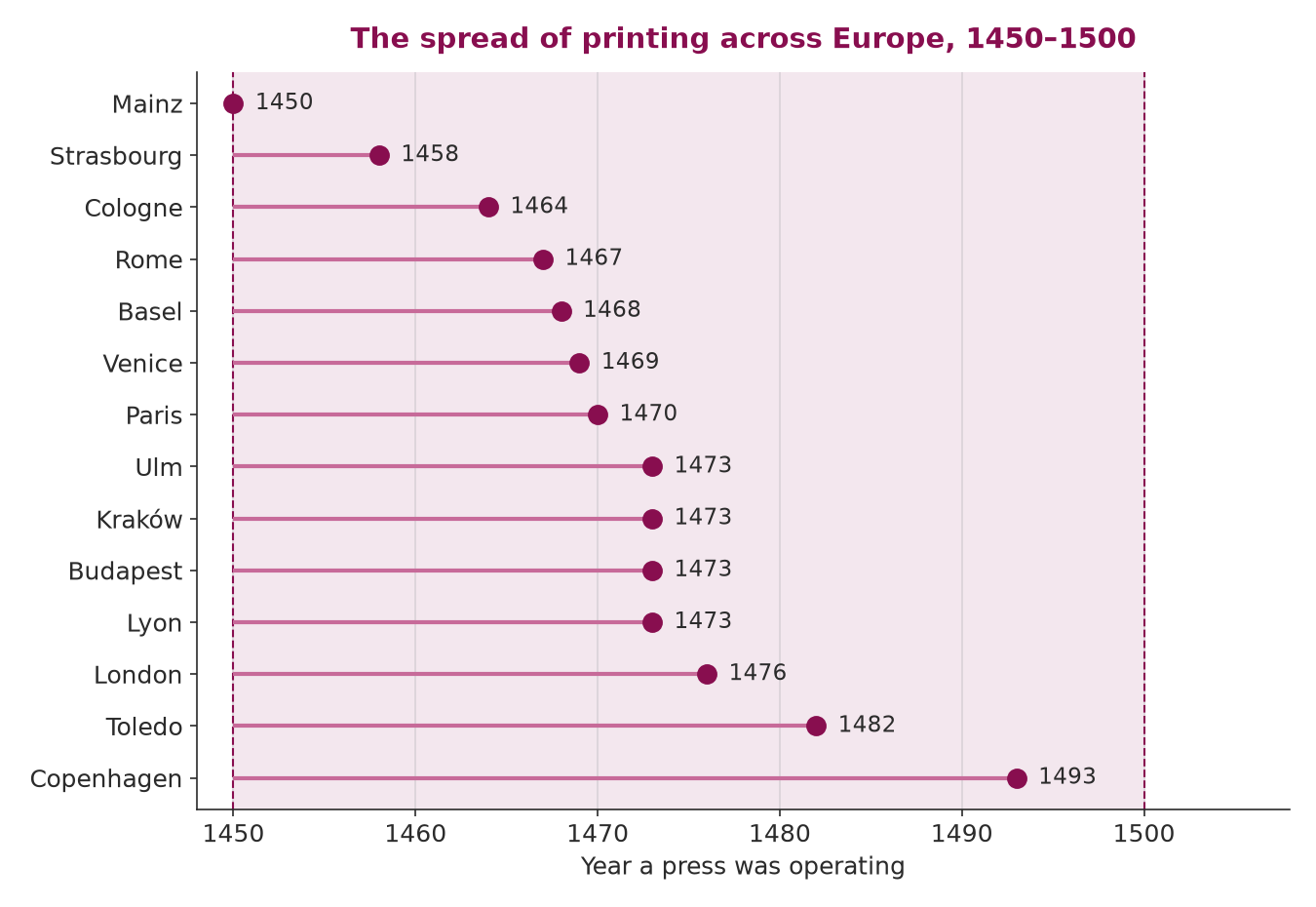
The pattern of that spread is visible in the arrival of presses in major centers. Mainz led, followed quickly by Strasbourg, Cologne, Rome, Basel, and Venice, then Paris, and then a widening ring that reached London, Kraków, Budapest, Lyon, and beyond before the century was out. The map of printing followed the map of European commerce: river towns, fair cities, and seats of learning filled in first.
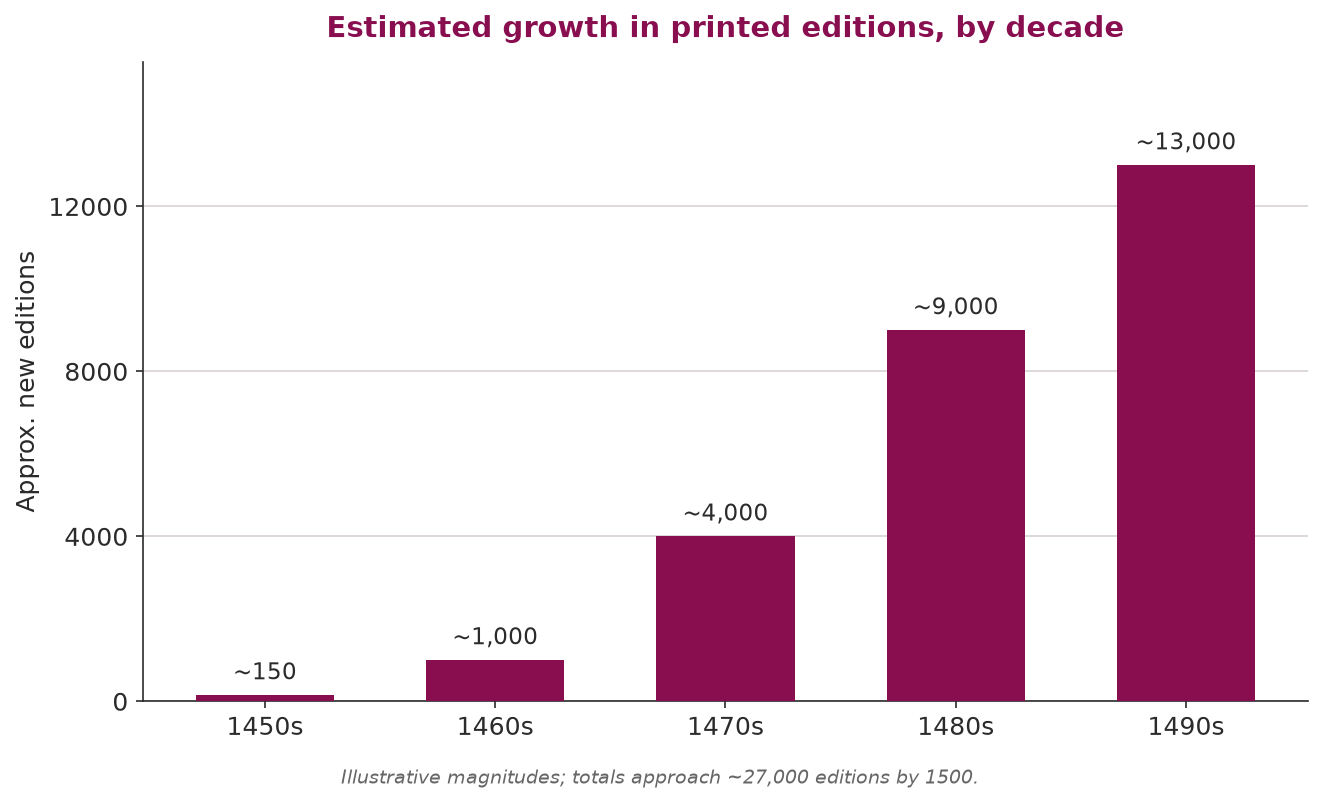
The growth in output was even more striking than the spread of locations. The number of distinct editions — separate printed works — rose steeply decade by decade through the fifteenth century, as printers scaled up from a handful of titles to a flood of them. The curve is not smooth, but its direction is unmistakable.
Certain cities became famous as publishing centers. Venice rose to prominence in part through the work of Aldus Manutius, who around 1500 pioneered compact, affordable editions of the classics and helped popularize italic type, making books that scholars could actually carry. Paris and Lyon served the large French-speaking market; Basel became a hub for scholarly and illustrated works; and in England, William Caxton set up the first press at Westminster in 1476, printing Chaucer and other works in English. The early leaders were Germany and Italy, but the craft quickly became pan-European, and the great book fairs — above all Frankfurt — turned printing into a continent-spanning trade in which a dealer could order titles from a catalogue.
Crucially, printers were entrepreneurs. They chose titles based on what would sell — devotional books, classical texts for students, law books, medical manuals, popular romances, and, increasingly, works in the vernacular languages people actually spoke. Printing therefore did not merely reproduce the old Latin canon; it created new markets in living tongues. A reader who spoke only English, or German, or French could now buy a book written in that language, and the demand for such books pulled the technology further into everyday life. Over the course of the sixteenth century the share of printing in vernacular languages rose steadily, until Latin no longer dominated the catalogue.
The printed book also brought standardization. Because every copy of an edition came from the same forme, all copies agreed page for page and word for word. A reader in one city held exactly the same text as a reader in another. For the first time, a text could be fixed, quoted precisely, and corrected in a later edition that everyone could obtain. This sameness — the uniformity of copies — underpins nearly every cultural change that printing then set in motion, from religious reform to scientific cooperation. A fixed text is an argument everyone can share; a drifting one is a private conversation that never quite meets.
The trade in printed books quickly became a continent-spanning business. The Frankfurt Book Fair, held twice a year, drew dealers from across Europe who bought and sold rights, exchanged catalogues, and carried titles home to reprint or distribute. A book printed in Venice might be sold in London within the year, and a bestseller in one tongue was often translated and reset in another. Of the perhaps fifteen to twenty million incunabula produced, a remarkable share survive — by one estimate close to half — because printed books were valued, stored, and rebound rather than read to pieces, giving modern scholars an unusually rich documentary record of the first printed century. Certain titles became landmarks of the new medium: the lavishly illustrated Nuremberg Chronicle of 1493, with its hundreds of woodcut views of cities and wonders, and the Hypnerotomachia Poliphili of 1499, a typographic and artistic tour de force. Illustrated books in particular showed off what print could do that manuscript could not: place the same precise image, in the same relation to the same words, into thousands of hands. The incunabula period thus closed not with a whimper but with a demonstration that printing could be beautiful, authoritative, and massively reproduced at once — a combination the manuscript world had never achieved.
Print and the Reformation
The connection between printing and the Protestant Reformation is one of the clearest examples of a technology amplifying an idea. In 1517 a monk and professor named Martin Luther posted, in the customary academic manner, a set of objections — the Ninety-Five Theses — concerning the sale of indulgences. In an earlier century such a document might have circulated slowly among a small circle of theologians. Printed, it spread across Germany within weeks and across Europe within months, in edition after edition, in Latin and in German alike. The economic grievance at its root — the lucrative trade in indulgences, whose profits funded grand building projects — found in print a megaphone it could never have had by manuscript alone.
Luther understood the medium. He wrote deliberately for a broad public and in the vernacular, and his works were reprinted in the hundreds of thousands. His German New Testament appeared in 1522, and a full German Bible was complete by around 1534; the printing houses that produced it helped shape the very language of that Bible, because a standardized text fixed spellings and usages for readers across regions. Print put scripture into the hands of people who knew no Latin, and a reader with a Bible in the kitchen was a reader who could, in principle, interpret scripture without a priest as intermediary. The multiplication of Bibles in the vernacular is sometimes called the first mass-medium campaign in European history.
Pamphlets became the social media of the age. A controversial claim could be written, set, and distributed in weeks, and rival pamphlets answered them in rapid succession — the pamphlet wars of the early Reformation. Because print could bypass the slow machinery of ecclesiastical approval, reformers used it to reach the public directly. A sermon heard by a hundred people in a church could be read by tens of thousands as a printed tract. Visual propaganda mattered too: woodcut broadsheets, often designed by artists such as Lucas Cranach, turned complex theological disputes into memorable images that even the semi-literate could grasp.
The Catholic response also ran through the press, but in the opposite direction. Church authorities, alarmed at the speed with which heretical ideas spread, moved to control printing. The Index of Prohibited Books, a list of works Catholics were forbidden to read, was first issued in 1559 under the auspices of the Council of Trent, and the production of approved texts — including revised editions of the Latin Vulgate Bible — became a tool of counter-reform. The geographic result was a religious splitting of the map: northern Europe inclined Protestant and printed Luther and Calvin by the wagonload, while southern Europe remained Catholic and policed its presses more tightly. The lesson on both sides was the same: whoever controlled the press could shape belief at scale, and so the press became an object of fierce contest.
The economic engine behind this religious upheaval is easily overlooked. The very trade in indulgences that Luther attacked was itself a printing-age business, producing printed certificates and publicity; the counter-attack likewise ran through print, as church authorities funded rebuttals and printed catechisms to hold the faithful. Woodcut propaganda turned doctrine into image: caricatures of the pope, scenes of indulgence-sellers, and allegorical broadsheets that a half-literate audience could read at a glance. The effect was to harden identities. Once Luther's Bible and Calvin's Institutes circulated cheaply in the vernacular, whole regions developed confessional print cultures — Lutheran, Calvinist, Catholic — each with its own favored titles, its own standardized texts, and its own guarded borders against the others' books. The violence of the subsequent Wars of Religion was, in part, a war of pamphlets as much as of armies, and the Council of Trent's careful, controlled printing of approved texts was the Catholic answer to a medium that had slipped its leash. Print did not cause the Reformation, but it determined its speed, its scale, and its permanence.
Print and the Scientific Revolution
Printing transformed science by making observations repeatable and communicable. Before print, a natural philosopher's findings might survive only in a few manuscript copies that drifted and decayed. After print, a description, a diagram, a table of measurements, or a map could be issued in identical form to readers across the continent, who could check it, repeat the experiment, and build upon it. Science became a public, cumulative enterprise rather than a scattered collection of private insights.
The change is visible in the books that mattered. In 1543, the same year often taken to mark the start of the Scientific Revolution, two landmark printed works appeared: Copernicus's book proposing a sun-centered cosmos, and Vesalius's richly illustrated anatomy of the human body. A printed anatomical figure looked identical in every copy, so a student in Leiden could be certain he was seeing the same illustration as a teacher in Padua. Maps could be corrected and reissued in identical form, so geographic knowledge improved with each edition rather than fracturing into incompatible manuscripts. The printing of precise mathematical tables — astronomical ephemerides, then logarithms — let calculations be shared without the errors that recopying invariably introduced, and the slow standardization of mathematical notation was accelerated because symbols, once set in type, became fixed reference points.
Print also enabled the Republic of Letters — the loose community of scholars who exchanged letters, books, and findings across political and linguistic borders. A printed claim could be checked against an earlier printed one, and published accounts of failed experiments spared others from repeating them. The first scientific journals appeared in 1665, independently in France and England (the Journal des Sçavans and the Philosophical Transactions), giving the Republic a regular periodical voice; the English journal was closely tied to the newly founded Royal Society. The learned journal was, in effect, print applied to the organized conversation of science, and it remains the dominant form of scientific communication to this day. Cartography, too, leapt forward: Mercator's projection of 1569 could be printed, copied exactly, and corrected, making navigation charts reliable across the maritime powers.
The deeper point is that printing changed not just the volume of scientific writing but its nature. Discovery became something that could be recorded once, reproduced exactly, challenged openly, and improved collectively. The Scientific Revolution was not caused by the press alone, but it is hard to imagine it proceeding as it did without the press as its nervous system. Where a manuscript isolated a finding, a printed book networked it.
The timing of print's scientific payoff is itself instructive. The great printed scientific works of the mid-sixteenth century — Vesalius, Copernicus — appeared within decades of Gutenberg, but the institutional form that turned printing into a research engine, the scientific journal, did not arrive until 1665, over two centuries later. The lag shows that print was a necessary condition, not a sufficient one; it took new social institutions — academies, correspondences, journals — to harvest the medium's full potential. When those arrived, the payoff was enormous: Galileo's Starry Messenger of 1610 could be bought and argued over across Europe within months, and Newton's Principia of 1687 became a shared object of study rather than a rumor. Print also extended observation across time. Astronomical and meteorological records, once lost with their authors, could be compiled and compared year to year; logarithm tables and nautical almanacs turned calculation from a craft into a reference. Even so, some fields lagged — alchemy and the occult often stayed oral or secret, and not every practitioner trusted the public page — so the "Republic of Letters" was never quite as open as its name implied. Still, the default posture of early modern science became: publish, so that others may check.
Print, Literacy, and the Public Sphere
Cheaper books lowered the cost of reading and, over time, widened the circle of readers. Book prices fell by a factor of several over two centuries, putting ownership within reach of tradespeople and the middling sort who could never have afforded a manuscript. Literacy rose as a result, though never evenly and never universally; the poorest remained excluded, and women's literacy lagged men's in most places. Still, the direction was clear: reading shifted from an almost exclusively clerical skill to a more broadly shared one, and the reader of print was increasingly a private individual encountering a text alone rather than a congregant hearing one read aloud.
Vernacular print did cultural work beyond mere access. When a language was printed, its spellings and grammar tended to stabilize, because printers and readers converged on a standard written form. Printing thus helped forge the modern standard languages — the English of printed Bibles and plays, the French of printed law and literature — out of the looser dialect mixtures of speech. A reader in one region could meet, on the page, the language of another, and a common written tongue emerged from the exchange. This standardization quietly fed the rise of national identities: a "French" or "English" reading public, sharing texts, was a new kind of community that print made possible.
Print also changed what people read and how they read it. A growing share of writing was composed for print from the start — newspapers, periodicals, essays, and pamphlets — rather than copied from older manuscripts. The first recognizable newspapers appeared around 1605 at Strasbourg (the Relation) and spread as English corantos in the 1620s and similar sheets elsewhere. News became a regular, repeatable product, carried by the expanding postal systems that grew up alongside the book trade. Readers came to expect a steady stream of distant information — battles, plagues, elections, discoveries — that connected them to a wider world than their town. Cheap chapbooks and broadsheets, peddled by traveling sellers, carried ballads, almanacs, and folk tales into the countryside, extending print's reach below the level of the educated elite.
Physical sites grew up around this reading public. Coffeehouses, from the mid-seventeenth century, became places where men gathered to read newspapers and debate what they read; similar roles were played by salons and reading clubs. The theorist Jürgen Habermas later gave this cluster of practices a name: the public sphere, a space of discussion that stood apart from both church and court, where private individuals reasoned together about matters of common concern. Print supplied the shared texts that the public sphere argued over, and the public sphere in turn became a check on authority that could not easily be exercised in private. A public that could read the same news and discuss it openly was a public that could, in principle, hold power to account.
The reading public that emerged was not, however, a democratic one in any modern sense. It was overwhelmingly male, urban, and comparatively well-off; the "reading revolution" that historians describe — the shift from reading aloud, communally, to reading silently, alone — happened first among those who could afford a private book and a quiet corner. The rise of the novel in the eighteenth century created a new kind of reader and a new anxiety: that fiction might corrupt, especially women, whose reading was watched with suspicion. Yet the very existence of a mass reading public transformed politics. A pamphlet costing a few pence could reach thousands; a newspaper, read aloud in a tavern, could reach thousands more who could not buy it. Patriotic songs, satirical prints, and serialized tales knitted distant strangers into imagined communities bound by shared texts — the seedbed of modern nationalism. The price of a single newspaper, often a penny or less, put current affairs within reach of apprentices and servants in a way manuscripts never had. Print thus built not only a public sphere but a public, a constituency of readers whom political power could no longer address only through the pulpit and the herald.
Print and the Struggle for Control
From the first sheets off Gutenberg's press, printing was also a problem for those who governed. A technology that could put identical, subversive, or merely unauthorized texts into thousands of hands was a threat to any authority that relied on controlling what people believed. The history of print is therefore inseparable from the history of attempts to control it.
In England, royal proclamations of the 1530s required that certain works be approved before publication. The Stationers' Company, chartered in 1557, was granted a monopoly over printing and, with it, the power to search out and destroy unlicensed work — a neat fusion of commercial privilege and state censorship. The Printing Act of 1662 systematized pre-publication licensing, requiring that books be approved before they could be legally printed, and the Star Chamber decrees of the earlier century had already prescribed the burning of offending books and the punishment of their printers. In France, royal privilege granted the right to print particular works while pre-publication censorship screened what reached the public. Across Europe, the pattern was similar: licensing, monopolies, and official lists of forbidden books, enforced by searches, fines, and occasionally the firing of printers.
Control was never complete. Writers and printers evaded licensing through underground presses and, crucially, through cross-border printing: a book banned in one jurisdiction could be set in another and smuggled back. Banned books were shipped to the very places where they were illegal, and the difficulty of policing a dispersed, mobile trade meant that prohibition often advertised a work more effectively than it suppressed it. The cat-and-mouse between censors and printers is a thread running through the whole history of the press, and it explains why so many famous works first appeared "pirated" or abroad.
The arguments against licensing were also printed. John Milton's Areopagitica (1644) attacked the English licensing system in print, contending that truth is best served not by shielding readers from error but by letting opposing views contend openly, so that the reader, through exercise, learns to discern. Milton's was not a modern doctrine of unlimited speech, but it articulated a principle — that a free press serves truth better than a managed one — that has echoed ever since. Notably, the same states that feared the press also learned to use it: printed law codes, proclamations, and propaganda let rulers address subjects directly, standardizing administration and rallying support. Print strengthened the state even as it threatened it.
The deeper lesson is that the printing press was from the outset both an instrument of control and a forum for contestation. Authorities used it to standardize and to police; subjects used it to reform, to argue, and to circumvent. The same machine that printed the official Bible printed the forbidden pamphlet. That duality is not a bug in the technology but a consequence of what it is: a means of multiplying speech, which no single owner can fully monopolize once the means of production has spread. The struggle over the press that began in Mainz is, in essence, the struggle over who gets to speak to the public — and it has never ended. What printing did was to make that struggle permanent, because it made the spoken word of one person reachable by everyone, at a scale the manuscript world could never have imagined.
That permanence is visible in the slow evolution of the law around print. The early licensing systems treated printing as a privilege granted by crown or church, revocable at will. Out of the Stationers' monopoly grew, almost by accident, the first registers of copies — the ancestor of copyright — which began as a printer's protection against piracy rather than an author's right. Over the eighteenth and nineteenth centuries, control shifted from pre-publication licensing toward post-publication accountability: instead of censoring beforehand, states increasingly let works appear and punished afterward, a change forced partly by the sheer impossibility of reviewing everything the press could produce. The Enlightenment's battles for a free press — from John Peter Zenger's trial in colonial New York to the polemics of the French philosophes — turned Milton's earlier plea into a political program. Even then, states suspended press freedoms in wartime and regulated what could be printed about enemies, elections, and morals. The history of the press since Gutenberg is thus a long argument, still unresolved, about whether speech that reaches everyone should be free by default and restricted by exception, or controlled by default and freed by permission. Printing settled the technical question of multiplication; it left the political question open.
Seen across six centuries, the through-line is clear. The press took the written word out of the monastery and the scriptorium and put it into the market, the home, and the street. It made knowledge cheap enough to own, uniform enough to quote, and public enough to argue over. In doing so it underwrote the Reformation, accelerated the Scientific Revolution, bred the modern languages and the reading public, and forced every government to reckon with a voice it could not fully own. The digital age is often described as a second printing revolution, and the parallels are real: just as movable type lowered the cost of copying a book, the internet lowered the cost of copying everything, and just as the first printers unsettled church and crown, the first platforms unsettled the publishers and states that thought they controlled the page. The anxiety we feel about misinformation, piracy, and the concentration of media power is, in this light, not new but the latest episode of a struggle that began in a Mainz workshop in the 1450s. To understand the modern information world, it helps to remember that its deepest roots are not in silicon but in lead, oil-based ink, and a screw borrowed from a wine press.